Here In this article “ChatGPT vs Gemini vs Claude” you will know the basic difference between AI chatbot comparison which are the best best AI assistant of 2026.You will get to know the difference between ChatGPT vs Gemini comparison and Claude vs ChatGPT comparison and which AI tool is better for you in 2026?
| Feature | ChatGPT | Gemini | Claude |
|---|---|---|---|
| Best For | Creativity | Real-time data | Deep analysis |
| Speed | Fast | Medium | Slow |
| Accuracy | Medium | High | High |
| Free Plan | Limited | Good | Excellent |
So you’ve decided to jump on the AI bandwagon. Smart move! But now you’re staring at your screen, paralyzed by choice. In the ChatGPT vs Gemini vs Claude debate, how do you even know where to start? It’s like standing in the cereal aisle, except instead of choosing between Frosted Flakes and Cheerios, you’re picking a digital brain that might help you write your novel, debug your code, or finally understand what your teenager is talking about.
Here’s the thing: ChatGPT became a household name faster than you could say “artificial intelligence.” Your aunt uses it. Your boss uses it. That guy at the coffee shop who won’t stop talking about crypto? Yeah, he definitely uses it. But while ChatGPT was busy becoming famous, two worthy competitors quietly sharpened their knives. Google launched Gemini (formerly Bard, because apparently even AI needs a rebrand), and Anthropic introduced Claude, the thoughtful newcomer that’s winning over power users faster than you can say “large language model.”
By the end of this ChatGPT vs Gemini vs Claude guide, you’ll know exactly which AI assistant deserves a spot in your digital toolkit. No tech degree required. Promise.
More to Read: Which is the most Venomous Snake in the World
ChatGPT Review: Features, Pros, Cons & Use Cases
Let’s start with the celebrity of the bunch. ChatGPT exploded onto the scene in late 2022 and basically broke the internet. Why? Because it was the first AI chatbot that felt genuinely conversational, surprisingly capable, and—most importantly—available to anyone with an internet connection.
The Good Stuff:
ChatGPT is like that friend who’s decent at everything. Need help brainstorming blog post ideas? It’s got you. Want to learn Python? It’ll walk you through it step by step. Trying to write a cover letter that doesn’t sound like a robot wrote it? (Ironic, I know.) ChatGPT can help with that too.
It’s particularly strong at creative tasks. Ask it to write a short story about a time-traveling accountant, and you’ll get something genuinely entertaining. It’s also surprisingly good at explaining complex topics in simple terms—like having a patient tutor who never gets tired of your questions.
The interface is clean and intuitive. You type, it responds. No learning curve. Your grandma could use it. (Mine does, actually. She uses it to generate crossword puzzle clues.)
The Not-So-Good Stuff:
ChatGPT has a knowledge cutoff, meaning it doesn’t know about events after its training data ended. Ask it about yesterday’s news, and it’ll politely tell you it has no idea what you’re talking about. It’s like talking to someone who’s been in a coma since 2023—knowledgeable about the past, clueless about the present.
It can also “hallucinate,” which is a fancy way of saying it sometimes makes stuff up with alarming confidence. Ask it for a citation, and it might invent a completely fake academic paper, complete with author names and publication dates. Always fact-check important information.
And if you want the good stuff—GPT-4, faster responses, priority access—you’re looking at $20/month for ChatGPT Plus. Not terrible, but not free either.
Real-World Example:
Imagine you’re writing a resignation letter. You want to be professional but not cold, grateful but not gushy. You feed ChatGPT the basics: “I’m leaving my marketing job after three years to pursue freelance work. I want to thank my manager but keep it brief.” Thirty seconds later, you’ve got a polished draft that strikes exactly the right tone. You tweak a few sentences, and boom—done. That’s ChatGPT’s sweet spot.
More to Read: Mukul Choudhary: LSG’s 2.6 Crore Rising Star
Google Gemini Review: Features, Pros, Cons & Performance
If ChatGPT is the popular kid, Gemini is the one with all the connections. Because it’s made by Google, it plugs directly into the entire Google ecosystem—and that’s a game-changer.
The Good Stuff:
Gemini’s superpower is real-time internet access. Unlike ChatGPT, it can search the web and give you current information. Want to know what’s trending on Twitter right now? Gemini’s got you. Need the latest research on intermittent fasting? It’ll pull up recent studies and summarize them.
The Google integration is genuinely useful. You can ask Gemini to search your Gmail for that receipt from three months ago, summarize a Google Doc, or find specific information in your Drive. It’s like having a personal assistant who actually knows where you put everything.
It’s also multimodal, meaning it can understand and work with images. Upload a photo of your messy closet and ask for organization tips. Show it a plant and ask what species it is. Take a picture of a math problem, and it’ll solve it. This visual capability makes it incredibly practical for everyday tasks.
The Not-So-Good Stuff:
Gemini sometimes feels like it’s trying too hard to be helpful. It can be overly cautious, occasionally refusing to engage with topics that other AI assistants handle just fine. It’s the friend who won’t let you eat cookie dough because of the raw eggs—technically correct, but come on.
The interface has improved, but it still feels a bit more corporate than ChatGPT’s sleek simplicity. And while the Google integration is powerful, it’s really only a huge advantage if you’re already deep in the Google ecosystem.
Real-World Example:
You’re planning a trip to Japan next month. You ask Gemini: “What’s the weather like in Tokyo in November, and what are the current COVID entry requirements?” It searches the web, pulls up current weather forecasts, checks the latest travel advisories, and gives you a comprehensive answer with sources. Then you ask it to search your Gmail for your flight confirmation and add the dates to your Google Calendar. Done and done. That seamless integration? That’s Gemini’s magic.
Also Read; AVGC Content Creator Labs Scheme 2026: स्कूलों में सीखें Animation, Gaming, VFX | करियर गाइड
Claude AI Review: Features, Pros, Cons & Best Use Cases
Claude is the newest kid on the block, but don’t let that fool you. Made by Anthropic (founded by former OpenAI folks), Claude has quickly become the darling of writers, researchers, and anyone who needs an AI that actually thinks things through.
The Good Stuff:
Claude’s standout feature is its reasoning ability. It doesn’t just spit out answers—it thinks through problems methodically. Ask it a complex question, and you’ll get a nuanced, well-structured response that considers multiple angles. It’s like the difference between asking a question in a crowded room versus having a deep conversation over coffee.
The context window is massive—we’re talking the ability to process entire books’ worth of text in a single conversation. Upload a 50-page document, and Claude will actually read and understand all of it. Try that with most other AI tools, and they’ll choke.
Claude is also refreshingly honest about its limitations. Instead of making stuff up, it’ll tell you when it doesn’t know something. This makes it more reliable for important tasks where accuracy matters.
Safety-wise, Claude is thoughtful without being preachy. It has strong ethical guidelines but implements them in a way that feels reasonable rather than restrictive.
The Not-So-Good Stuff:
Claude is sometimes slower than its competitors, especially when processing long documents. It’s thorough, but thoroughness takes time. If you need lightning-fast responses, you might find yourself tapping your fingers.
It’s also less well-known, which means fewer tutorials, fewer tips and tricks floating around online, and a smaller community to learn from. You’re more on your own figuring out how to get the most out of it.
Real-World Example:
You’re writing a research paper on climate change policy. You upload three dense academic articles (totaling 40 pages) and ask Claude to identify the main arguments, compare the authors’ methodologies, and highlight areas of disagreement. Twenty minutes later, you’ve got a detailed analysis that would’ve taken you hours to compile manually. Claude didn’t just skim—it actually understood the nuances and gave you insights you might have missed. That’s the Claude difference.
ChatGPT vs Gemini vs Claude: Detailed Comparison (2026)
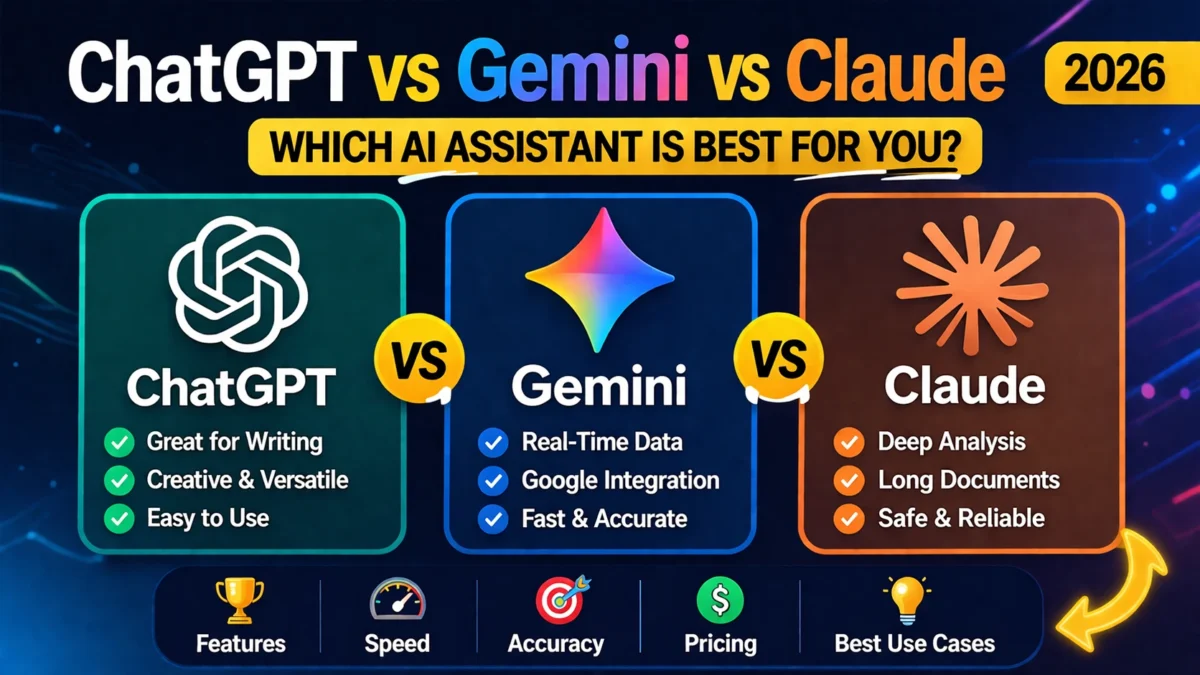
Alright, let’s get specific. How do these three actually stack up?
Ease of Use: 🏆 ChatGPT wins
ChatGPT: ⭐⭐⭐⭐⭐ – Dead simple. If you can text, you can use ChatGPT.
Gemini: ⭐⭐⭐⭐ – Easy, but the Google integration adds slight complexity.
Claude: ⭐⭐⭐⭐ – Straightforward, but less familiar to most users.
Accuracy & Reliability: 🏆 Tie between Gemini and Claude
ChatGPT: ⭐⭐⭐ – Good but prone to hallucinations and outdated info.
Gemini: ⭐⭐⭐⭐ – Real-time search helps a lot with factual accuracy.
Claude: ⭐⭐⭐⭐ – Honest about limitations and less likely to make stuff up.
Speed: 🏆 ChatGPT wins
ChatGPT: ⭐⭐⭐⭐⭐ – Lightning fast, especially with Plus.
Gemini: ⭐⭐⭐⭐ – Quick, though search queries add time.
Claude: ⭐⭐⭐ – Thoughtful but slower, especially with long inputs.
Creativity: 🏆 ChatGPT wins
ChatGPT: ⭐⭐⭐⭐⭐ – Excellent for creative writing, brainstorming, and imaginative tasks.
Gemini: ⭐⭐⭐⭐ – Creative but sometimes plays it safe.
Claude: ⭐⭐⭐⭐ – Great for structured creativity; less whimsical than ChatGPT.
Safety & Responsibility: 🏆 Claude wins
ChatGPT: ⭐⭐⭐⭐ – Good guardrails, occasionally overzealous.
Gemini: ⭐⭐⭐ – Sometimes too cautious, can feel restrictive.
Claude: ⭐⭐⭐⭐⭐ – Thoughtful approach that balances safety with usefulness.
Pricing: 🏆 Claude wins (for free tier)
ChatGPT: ⭐⭐⭐ – Free tier is limited; $20/month for Plus.
Gemini: ⭐⭐⭐⭐ – Generous free tier; Advanced costs $20/month.
Claude: ⭐⭐⭐⭐⭐ – Very generous free tier with huge context window; Pro is $20/month.
Which AI Assistant Is Best for You?
Let’s get practical. Here’s what you should actually use:
Writing Essays or Reports: Claude takes this one. Its ability to handle long documents and provide nuanced analysis makes it perfect for academic or professional writing. Upload your research, and let it help you structure arguments and identify gaps.
Learning to Code: ChatGPT is your best bet. It’s been trained on tons of code, explains concepts clearly, and can debug your mistakes patiently. The community is huge, so you’ll find tons of coding-specific tips online.
Creative Writing: ChatGPT wins for pure creativity. Whether you’re writing fiction, poetry, or just need help brainstorming character names, ChatGPT’s imaginative capabilities are hard to beat.
Research with Current Information: Gemini, hands down. Need to know what’s happening right now? Gemini’s real-time search makes it the obvious choice. It’s also great for fact-checking recent claims.
Work Productivity (if you use Google Workspace): Gemini integrates seamlessly with Gmail, Docs, and Calendar. If your work life lives in Google, Gemini will save you hours of searching and organizing.
Personal Projects Requiring Deep Thinking: Claude excels at complex problem-solving. Planning a career change? Working through a difficult decision? Need help analyzing a complicated situation? Claude’s thoughtful approach is invaluable.
Which One Wins?
| Feature | ChatGPT (GPT-5.4) | Claude (Opus 4.6) | Gemini (3.1 Pro) |
| Best For | General Productivity & Voice | Coding & Nuanced Writing | Research & Google Ecosystem |
| Model Strength | Most versatile “all-rounder” | Deep reasoning & accuracy | Multimodal (Video/Audio) analysis |
| Context Window | ~128K – 1M tokens | 1M tokens (highly reliable) | 2M+ tokens (largest) |
| Ecosystem | GPT Store, Sora (Video) | Claude Code (Agentic) | Gmail, Docs, Drive, Search |
| Key Advantage | Superior Voice/Conversation | Least likely to hallucinate | Best “Grounding” with live data |
Frequently Asked Questions:
1. Which is better: ChatGPT or Gemini?
It depends on your goal. ChatGPT is the best all-rounder, leading in creative tasks, image generation (DALL-E 4), and natural voice conversations. Gemini wins for research and power users; its massive “context window” allows it to analyze thousand-page documents or hour-long videos effortlessly, all while syncing perfectly with Google Docs and Gmail.
2. Is Claude better than ChatGPT?
For coding and technical writing, many pros say yes. Claude 4.6 is widely considered more “human” and less formulaic in its prose than ChatGPT. It also holds a slight edge in logic and complex programming tasks, making it the favorite for developers who need precision over ChatGPT’s flashy multimedia features.
3. Which AI is best for students and is it free?
Gemini is currently the top choice for students due to NotebookLM, which turns class notes into interactive study guides and “AI podcasts.” All three offer free tiers, but Gemini is the most generous with its usage limits, while ChatGPT is best for quick help with its free “GPT-5.3” access.
The Bottom Line: Try Them All
Here’s the truth: there’s no single “best” AI assistant. It’s like asking whether a hammer, screwdriver, or wrench is the best tool. Best for what?
ChatGPT is the versatile generalist—great at most things, excellent at creative tasks, and familiar to everyone. Gemini is the connected specialist—perfect if you need current information and live in Google’s world. Claude is the thoughtful analyst—ideal for complex tasks requiring nuance and deep reasoning.
My advice? Take advantage of the free tiers and test-drive all three. Use ChatGPT for a week. Then switch to Gemini. Then try Claude. See which one clicks with your workflow and thinking style. You might even find yourself using different tools for different tasks—ChatGPT for brainstorming, Gemini for research, Claude for analysis.
The AI landscape is evolving faster than a chameleon on a disco floor. What’s true today might be outdated next month. These tools are constantly improving, adding features, and learning new tricks. The best way to stay current? Stay curious and keep experimenting.
Welcome to the future. It’s weird, it’s exciting, and it’s got three pretty amazing AI assistants ready to help you navigate it. Pick one (or all three) and dive in. Your digital brain awaits.

Hardik is a professional writer and researcher with over 5 years of experience and a Master’s in Writing. He specializes in simplifying complex topics and government schemes into easy-to-understand guides. Passionate about accuracy and empowerment, Hardik helps the Namaste Vishwa community stay informed and navigate opportunities with confidence.