
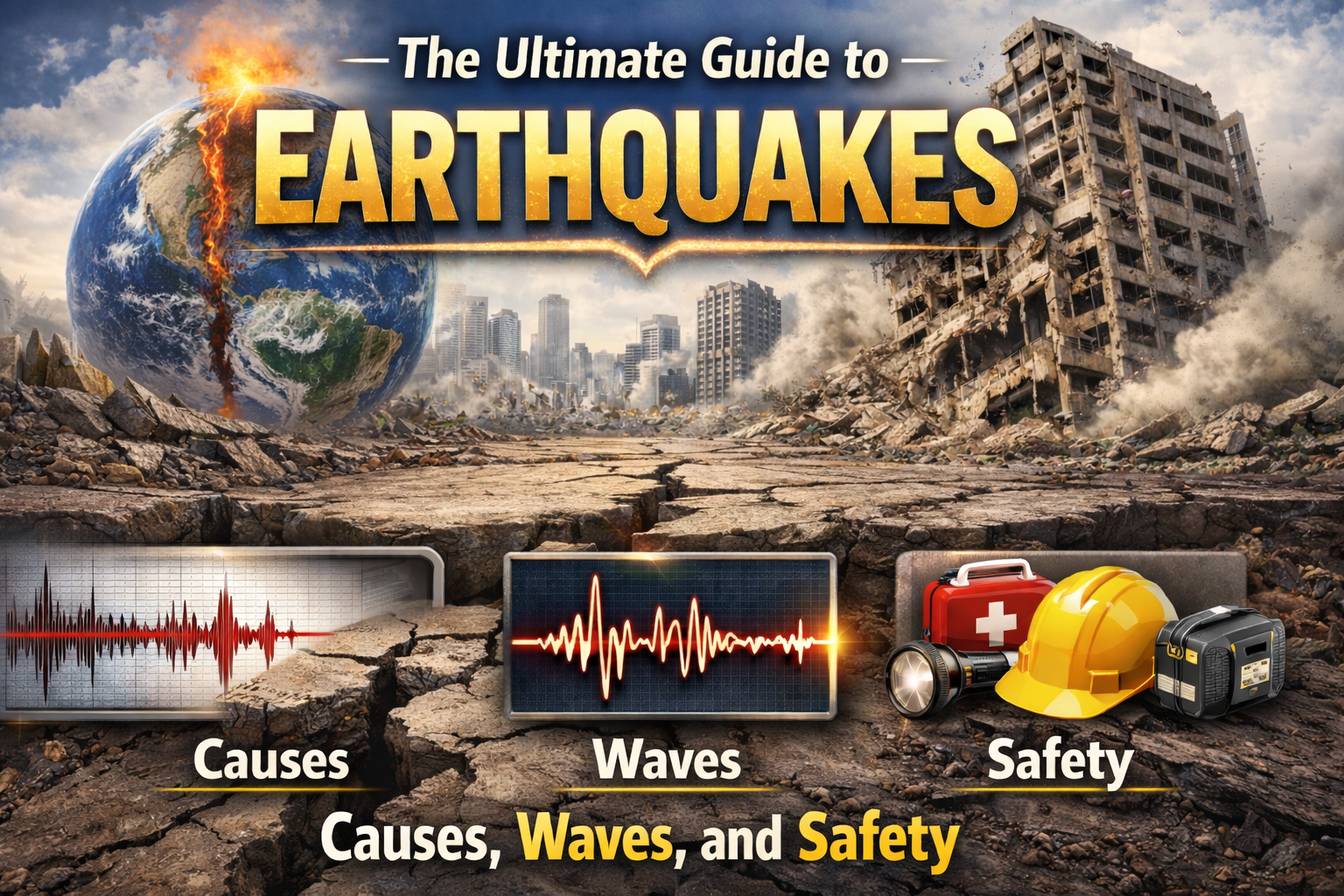
Welcome to my deep dive into one of nature’s most terrifying yet fascinating phenomena: earthquakes. In this article, I am going to walk you through exactly what causes the ground to shake, the science behind the destruction, and how we can measure and even predict these events. I have synthesized all the information to give you a complete picture.
What Exactly Is an Earthquake?
At its simplest, we can define an earthquake as the sudden shaking of the Earth. While it feels like the ground beneath us is solid, it is actually constantly moving. We know that the Earth is not just one solid piece; it is like a jigsaw puzzle made up of around 19 to 20 massive pieces called tectonic plates (or lithospheric plates). These plates float on the hot, partially molten layer of the Earth’s mantle, which causes them to move continuously—about 1 to 10 centimeters every year.
Usually, we don’t feel these movements. However, when these plates interact—whether they are coming together, moving apart, or sliding past each other—they can get stuck. The edges of these plates are jagged and irregular, causing friction that locks them together even as the plates themselves keep trying to move.
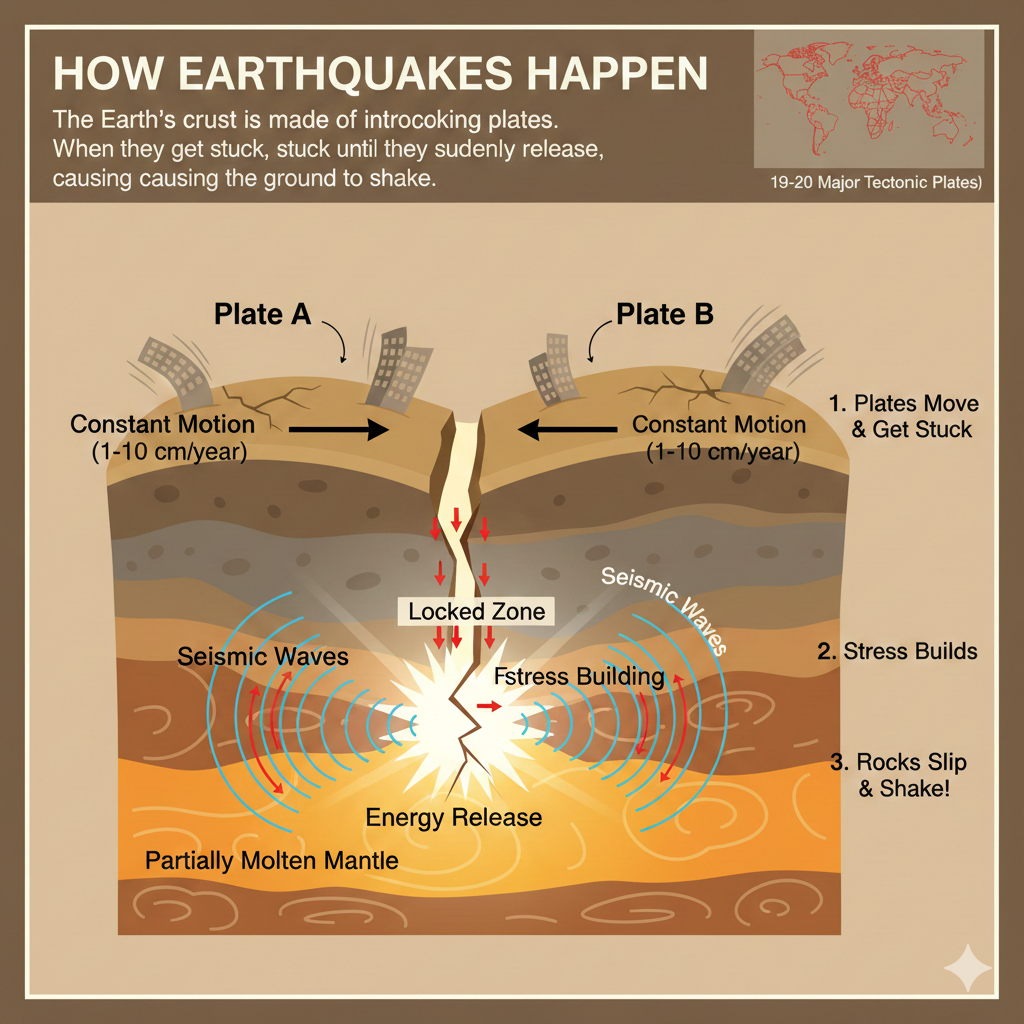
Eventually, the stress overcomes the friction. The rocks slip or break along a fault line, releasing a massive amount of stored energy. This release of energy produces vibrations that travel in all directions, shaking the Earth violently. This is what we experience as an earthquake.
The Anatomy of an Earthquake: Focus and Epicenter
To understand how this damage spreads, we need to distinguish between two key terms:
The Focus (or Hypocenter): This is the point deep inside the Earth where the energy is actually released and the earthquake originates.
The Epicenter: This is the point on the Earth’s surface directly above the focus.
I want you to imagine a demonstration using sugar cubes. If we hit a table from underneath with a hammer, the cubes directly above the impact point (the epicenter) will fall first and vibrate the most because that is where the waves are strongest. Similarly, in a real earthquake, the regions closest to the epicenter usually experience the most severe damage, and the intensity gradually reduces as we move further away.
The Science of Seismic Waves
When that energy is released at the focus, it travels through the Earth in the form of seismic waves. I can categorize these waves into two main types: Body Waves and Surface Waves.
Body Waves
These waves travel through the interior (the body) of the Earth. There are two specific types of body waves:
P-Waves (Primary Waves): These are the fastest waves and the first to arrive at a seismograph (the instrument we use to record earthquakes). They travel at speeds of about 6 km/s. P-waves are longitudinal, meaning they push and pull the ground, compressing and expanding material in the same direction the wave is moving—similar to sound waves. A key characteristic of P-waves is that they can travel through solids, liquids, and gases.
S-Waves (Secondary Waves): These arrive after the P-waves because they are slower, traveling at about 3.5 km/s. They move the ground perpendicular to the direction of the wave (transverse motion), creating a shearing effect. Crucially, S-waves cannot travel through liquids. This property tells us that the Earth’s outer core is liquid because S-waves essentially disappear when they hit it, creating a “shadow zone” where they aren’t detected.
Surface Waves (L-Waves)
When body waves reach the surface, they interact with surface rocks to generate a new set of waves called surface waves. These are the last to report on the seismograph. Although they are the slowest (around 1.5 km/s), they are by far the most destructive.
We sometimes call these L-waves (Love waves), named after their discoverer, H.D. Love. Unlike body waves, which have lower amplitude (height), surface waves have a high amplitude and shake the ground violently, causing displacement of rocks and the collapse of buildings.
Types of Earthquakes
While tectonic plate movement is the most common cause, we should recognize that there are actually five distinct types of earthquakes:
Tectonic Earthquakes: These are the most common, generated by the sliding of rocks along a fault plane due to plate tectonics.
Volcanic Earthquakes: These are a special class confined to areas with active volcanoes. When magma pushes upward towards the surface, it causes an explosion or movement that vibrates the surrounding land.
Collapse Earthquakes: In areas of intense mining, underground tunnels can leave the ground hollow. If the roof of a mine collapses, the massive drop of earth causes tremors. These are usually localized but can be significant.
Explosion Earthquakes: Ground shaking can also occur due to the detonation of chemical or nuclear devices.
Reservoir-Induced Earthquakes: Surprisingly, human activity can cause earthquakes through large dams. When we fill a massive reservoir, the sheer weight of the water puts immense pressure on the underlying rocks. If this pressure causes the rock to fracture or slip, it triggers tremors.
Measuring the Magnitude
We use a device called a seismograph (or seismometer) to detect seismic waves. To measure the power of the earthquake, we use the Richter Scale, which assigns a magnitude from 0 to 10. Here is how we interpret the numbers:
0–2: Barely sensed. 2–4: Minor vibrations, felt a little. 4–4.9: Light earthquake; small houses may shake, but buildings usually stay intact. 5–5.9: Moderate earthquake; can shatter small houses and crack buildings. 6–6.9: Strong earthquake; enormous damage, buildings broken, roads cracked. 7+: Major earthquake; capable of destroying entire cities and causing loss of life over large areas.
It is important to note that the scale is logarithmic. This means that a magnitude 7 earthquake is not just “one unit” stronger than a magnitude 6; it is roughly 10 times more intense in amplitude and releases about 32 times more energy.
Global Distribution: Where Do Earthquakes Happen?
Earthquakes do not happen randomly; they follow specific patterns along plate boundaries.
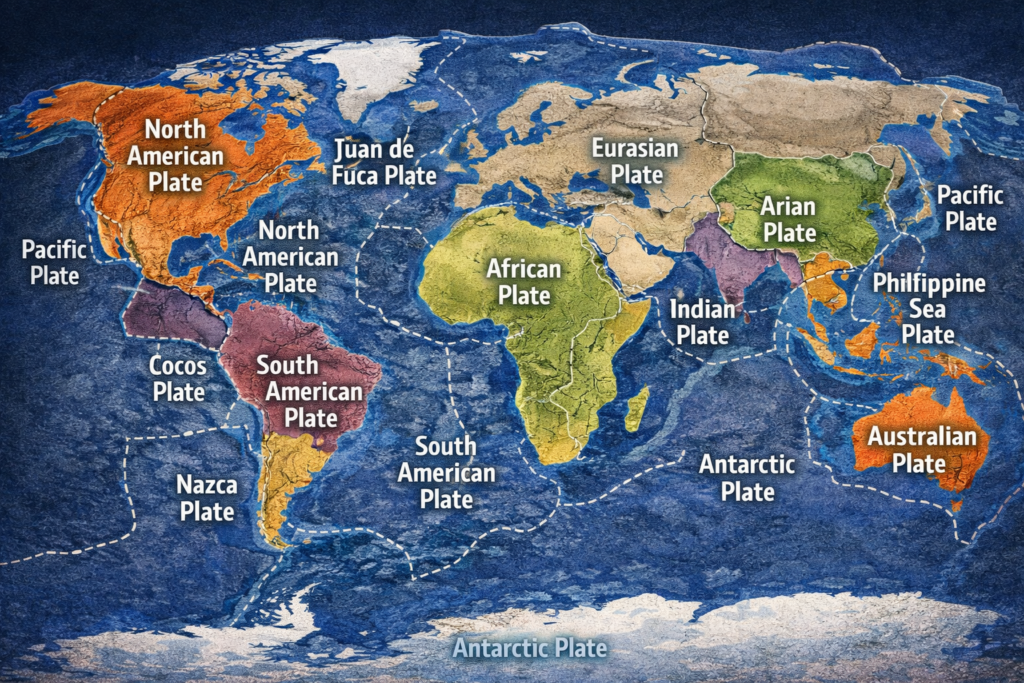
The Ring of Fire: This is the most active belt, located around the rim of thePacific Ocean. It accounts for about 63-68% of all earthquakes. Here, the Pacific Plate is colliding with (subducting under) American and Asian plates. This area is also famous for volcanic activity.
The Mid-Continental Belt: This belt extends through the Mediterranean, across the Middle East, and into the Himalayas. It is caused by the collision of theAfrican and Indian plates with the Eurasian plate. The Indian plate is continuously pushing northward into the Eurasian plate, which is why the Himalayas are still rising and why the region (including Nepal and North India) is so seismically active.
The Mid-Atlantic Ridge: This runs through the middle of the Atlantic Ocean. Here, plates are moving away from each other (divergent boundaries). As they separate, magma rises to fill the gap, creating new crust. While earthquakes here are less destructive to humans because they are in the ocean, they are frequent.
In India, we have divided the country into Seismic Zones 2 through 5 (Zone 1 was removed as it was considered too safe). Zone 5 is the most dangerous and includes areas like Kashmir, the North-East, and parts of Gujarat.
Can We Predict Earthquakes?
Currently, we cannot predict the exact time and location of an earthquake with certainty. However, we have identified some precursors:
Radon Gas Emission: Before an earthquake, the concentration of radioactive radon gas in the atmosphere often increases as it escapes from micro-cracks in the rock.
Electromagnetic Changes: There can be sudden spikes in electromagnetic waves in the atmosphere.
Animal Behavior: Many animals, like dogs and cats, can hear the low-frequency sound waves (infrasonic) generated before the main shockwaves arrive. If you see animals behaving frantically or running away, it might be a warning sign. Technology is also improving. NASA uses software called QuakeSimto analyze data, and even our smartphones can now help detect seismic waves to provide a few seconds of early warning.
Safety: What Should We Do?
If we find ourselves in an earthquake, the most important thing is to protect ourselves from falling debris, which causes most injuries.
Drop, Cover, and Hold On: If you are inside, get under a sturdy table or piece of furniture.
Find the “Triangle of Life”: If you can’t get under a table, lie down next to a sturdy object (like a sofa or bed) or in the corner of a wall. If the wall collapses, it often leaves a small triangular void next to the object where you can survive.
Building Codes: The most effective protection is prevention. We must build structures using earthquake-resistant designs, such as using flexible steel reinforcements and light materials that won’t cause fatal injuries if they fall.
By understanding the science of the Earth’s interior, we can better prepare for these powerful events. While we cannot stop the tectonic plates from moving, we can certainly minimize the destruction they cause.
Read More :
The Mystery of the Vanishing Ozone: How We Saved the World

I'm a education-driven content creator dedicated to breaking down complex ideas into simple, practical, and easy-to-understand explanations. The website is built with a clear mission: to promote learning, awareness, and education.