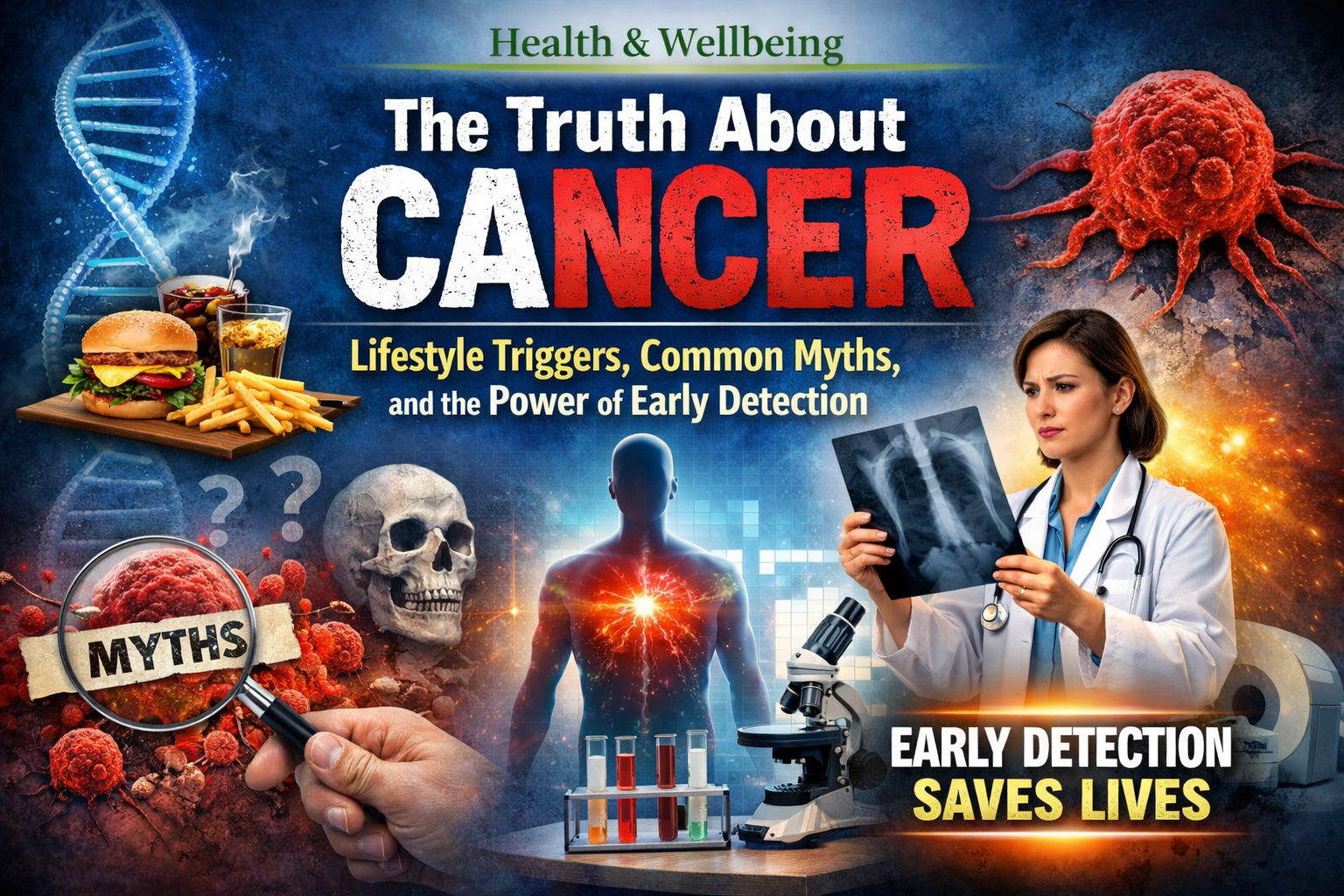
Cancer prevention requires healthy lifestyles, including avoiding tobacco, alcohol, and processed foods. Key risks include plastics, nonstick peeling, and stress. Modern treatments like immunotherapy and targeted therapy offer high survival rates, especially when screened early. Physical activity and nutrition are vital.
Common and Most Important Information
Look, we’re all very scared about cancer, but after researching and listening to all these experts, one thing is clear: Cancer doesn’t happen just because of bad luck; it’s a result of our daily habits and lifestyle. The most important common fact that’s emerging is that early detection is the best cure. The problem is that we ignore the signs. The body always gives signals—be it a change in bowel movements, a lump, or constant acidity—but we dismiss it as “gas” or some minor problem. By the time we go to the doctor, the matter has reached stage 3 or 4.
Kitchen and Diet Mistakes : .
The biggest threat lurks in our kitchen. All experts have strongly emphasized one thing eliminate plastic. Be it plastic bottles, tiffin boxes, or the plastic containers in which we microwave food. When plastic is heated, it releases BPA (Bisphenol A) which leaches into the food and is cancer causing (carcinogenic). Apart from this, aluminium utensils and non-stick cookware whose coating has come off are direct poison. Old-fashioned cast iron or clay/glass utensils are best.
When it comes to diet, sugar is cancer’s worst friend. Cancer cells survive and grow on glucose. If you want to prevent or defeat cancer, refined sugar and processed foods (flour, bread, biscuits) will have to be eliminated from your diet. Burnt bread or charred meat should also be avoided because they produce acrylamide, which is dangerous.
Role of Stress and Mental Health:
This may sound strange, but stress is a major cause of cancer. When we are constantly stressed, get angry, or hold on to old things (grudges), the cortisol hormone increases in the body. This creates chronic inflammation which can later turn into cancer. Loneliness has been said to be more dangerous than smoking. Experts say that “people do not die of cancer, people die of fear”. Positive attitude and “Willpower” are 50% part of the treatment.
Smoking and Vaping:
We all think that vaping or e-cigarettes are safe because there is no smoke, but this is the biggest lie. Vaping contains chemicals that go directly into the lungs and can be even more dangerous than traditional cigarettes because we don’t yet know their long-term effects. Whether it’s hookah or vaping, it damages DNA.
Immunity and Prevention:
Finally, Vitamin D (Sunlight) is very important for prevention, which we Indians ignore. Night sleep (especially between 10 PM and 2 AM) is crucial for body repair as it releases melatonin, which fights cancer. Adding broccoli, tomato (cooked), and berries (or Indian options like amla, jamun) to your diet boosts immunity.
The simple principle is this: “Constant irritation causes cancer.” If something in the body, mind, or emotions is constantly irritating, it can become cancer.
The Genetics and Environment Analogy
A compelling perspective on why cancer occurs is explained through a powerful analogy: “Genetics loads the bullet, but the environment pulls the trigger”. This means that while you may inherit a predisposition or “bad genes” from your parents, that alone doesn’t guarantee you will get cancer. It is your lifestyle, diet, and surroundings that act as the trigger to activate those genes.
Another unique point raised here is the alarming shift in demographics. In the past, breast cancer was typically seen in women over 60. However, in India specifically, we are now seeing a surge of cases in women aged 35 to 50. This is attributed to a rapid transition in lifestyle where we are adopting Western habits—processed foods and high stress—without having the genetic makeup to process these carcinogens efficiently. Furthermore, there is a distinct warning about the rising cases of lung cancer in non-smokers due to pollution and occupational hazards, proving that simply not smoking isn’t complete protection anymore.
The Surgeon’s Visualization and “Goons” Theory
From a surgical standpoint, the physical manifestation of tumors is described vividly. Tumors can appear in various colors depending on their origin: black for melanoma, yellow for ovarian, white for testicular, and red for liver tumors. The growth of cancer is explained using a sociological analogy: Cancer cells are like “goons” or delinquent children in a family. The body can handle a certain amount of disorder, but when these cells multiply uncontrollably due to stress or toxins, they start bullying the normal organs and disrupting their function.
A fascinating insight into the surgical process is that “Surgery takes place in the mind first”. A surgeon visualizes every step before making a cut. There is also a discussion on the incredible advancement of laparoscopic surgery, where massive tumors (even the size of a football) can be removed through tiny keyhole incisions by liquefying or morcellating the tissue inside a bag within the body before extraction. This source also touches on the spiritual aspect, noting that highly successful people or athletes rarely get cancer, except for anomalies, perhaps due to their intense physical discipline and mental focus, contrasting with the high rates in high-stress professions.
The “C.A.N.C.E.R” Acronym and Hygiene Hazards
This source introduces practical mnemonics to help people remember prevention strategies. The acronym C.A.N.C.E.R stands for: Cut alcohol/smoking, Active lifestyle, Nutrition rich food, Checkups regularly, Exposure to sunlight, and Rest well.
A unique and often overlooked hazard mentioned here is pillow hygiene. Pillows can become breeding grounds for carcinogens and allergens because they absorb Volatile Organic Compounds (VOCs) from room fresheners, perfumes, and sweat. We inhale these toxins for 8 hours every night. It is recommended to change pillows every year or vacuum them weekly, which almost no one does.
Furthermore, there is a specific emphasis on the “First 72 Hours” rule. The body gives a sign within the first 72 hours of a malignancy forming—a slight fever, a pinch of pain, or a sudden change in digestion. However, we are conditioned to ignore these subtle physiological signals until they become pathological problems.
The Theory of Constant Irritation and Vaping Chemistry
This section delves deeper into the psychological roots of the disease, proposing that “Constant Irritation Causes Cancer.” This isn’t limited to physical irritation (like a jagged tooth cutting the cheek) but extends to emotional irritation. A poignant example is given of a woman from a pristine mountain environment who ate purely organic food but developed cancer. The root cause was identified as chronic emotional trauma from an abusive marriage. She suppressed her grief and anger for years, and that emotional toxicity manifested as cancer.
Regarding vaping, this source provides specific chemical details. It explains that while propylene glycol might be safe to ingest, when it is heated over a copper coil in a vape pen, it undergoes a chemical reaction that releases formaldehyde, a known, potent carcinogen used to preserve dead bodies. This makes the “cool” habit of vaping potentially more dangerous than traditional smoking because users are directly inhaling a chemical that alters DNA integrity.
The “MEDS RX” Framework and Lipid Myths
To simplify immunity boosting, a new framework called MEDS RX is introduced: Meditation, Exercise, Diet, Sleep, Relationships, and the X-factor (hobbies/passion). If these pillars are balanced, the immune system becomes impenetrable.
This source also specifically tackles the myth of fats. It argues that the anti-ghee propaganda was a marketing gimmick by the oil industry. Ghee is described as the only medium that does not break down into carcinogens at high boiling points and is easily absorbed by cells to lubricate and protect them. Conversely, refined oils and palm oil are inflammatory.
Finally, there is a strong debunking of the fear regarding contagion. Many people in India wrongly isolate cancer patients, fearing that sharing food or touching them will spread the disease. It is clarified emphatically that cancer does not spread through touch, kissing, or sexual intercourse. Isolating a patient only increases their emotional trauma (loneliness), which worsens their prognosis. Love and physical touch actually release positive hormones that aid healing.
Read More :
The Invisible Crisis: Why India is the Diabetes Capital and How to Fix Our Metabolic Health

I'm a education-driven content creator dedicated to breaking down complex ideas into simple, practical, and easy-to-understand explanations. The website is built with a clear mission: to promote learning, awareness, and education.