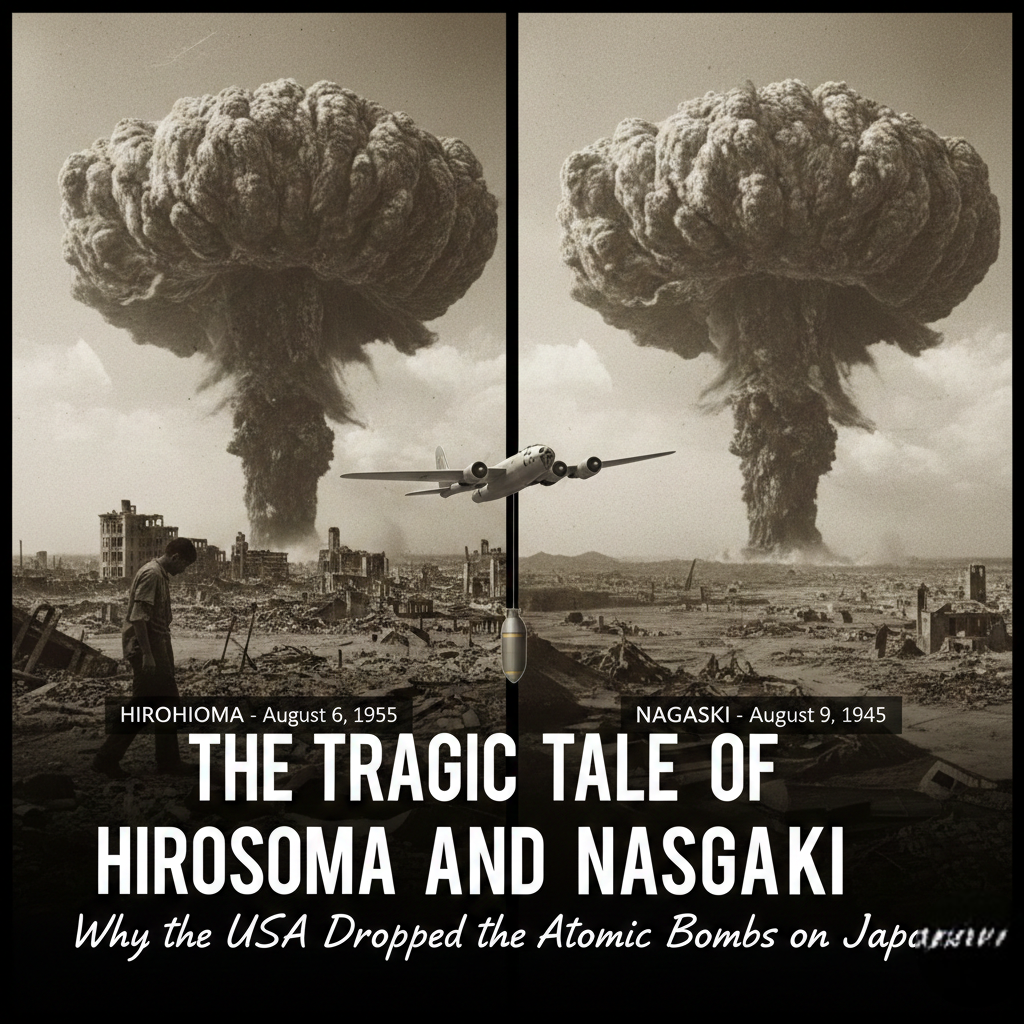
This historical account of the atomic bombings of Hiroshima and Nagasaki, contextualizing the events within the broader scope of World War II. How Japanese imperialism and the attack on Pearl Harbor transitioned the United States from isolationism to active military involvement. Highlighting the extreme brainwashing of the Japanese citizenry and the high casualties of the Battle of Okinawa, which led American leadership to pursue nuclear options over a traditional invasion. The horrific physical and environmental consequences of the “Little Boy” and “Fat Man” bombs, factors that finally led Emperor Hirohito to surrender. Finally, the ongoing moral debate regarding whether the use of such devastating weapons was a necessary evil to end the war or an unjustified atrocity against civilians.
On the pleasant, sunny morning of August 6, 1945, summer was in full force in the Japanese city of Hiroshima. It was a typical Monday; at 8:00 AM, people were arriving at their offices, and children were sitting in their first period at school. Around 8:15 AM, citizens spotted an American Boeing B-29 aircraft in the clear blue sky, from which an unidentifiable object was dropped. For exactly 43 seconds, the object was in freefall. In the blink of an eye, thousands of people saw a blinding light in the final moments of their lives. The dropping of the world’s first atomic bomb, known as “Little Boy,” created an instant fireball with temperatures reaching 4,000°C, instantly killing 80,000 people as if the sun itself had descended on Earth.
Witnessing the horrific power of the weapon, Robert Oppenheimer, a leading figure in the bomb’s creatio. But this leads to a massive historical question: Why was this devastating bomb dropped in the first place? To understand this, we must look at the deeply intertwined global conflicts of World War II.
The Backdrop: World War II and Japanese Imperialism
World War II broke out in 1939 when Adolf Hitler invaded Poland, eventually dragging nations into two major factions: the Axis Powers (Nazi Germany, Italy, and Japan) and the Allied Powers (Great Britain, the Soviet Union, the United States, France, and China). Initially, America tried its best to stay out of the war, wanting to avoid European and Asian conflicts after the devastation of World War I.
However, the war in Asia had already been brewing. While history often focuses on Hitler, Japan was aggressively pursuing its own form of imperialism in the early 1900s. Under the guise of uniting the continent into a “Greater Asia,” Japanese colonizers were ruthlessly capturing territories to exploit their resources. By 1940, the Japanese Empire had expanded to include Manchuria, eastern China, Korea, Indonesia, Myanmar, and the French Indo-China territories of Vietnam, Laos, and Cambodia.
America observed this violent expansion and decided to intervene economically rather than militarily. The US halted the export of essential materials like copper, iron, and steel to Japan. When this failed to deter them, America stopped selling oil to Japan—a critical blow, considering Japan relied on the US for 80% of its oil supply. America demanded that Japan withdraw from occupied Chinese territories and break its alliance with Germany and Italy in order to resume oil trades. Refusing to abandon their imperial dreams, Japan’s leadership instead looked south to capture oil-rich regions like the Dutch East Indies (Indonesia) and British Malaya (Malaysia).
Because attacking British and Dutch territories—and the nearby US-colonized Philippines—would inevitably force America to defend its allies, Japan decided they needed to launch a preemptive strike to completely paralyze the American military.
The Attack on Pearl Harbor and the Escalation of War
On December 7, 1941, Japan launched a devastating surprise attack on the US naval base at Pearl Harbor in Honolulu. Over 350 Japanese naval aircraft bombed the harbor, destroying 19 US Navy ships, 188 military aircraft, and killing more than 2,000 US military personnel in just two hours. Within hours of the attack, Japan successfully captured the Philippines.
This reckless strategy backfired dramatically. Far from being silenced, America immediately declared war on Japan, officially entering WWII. Britain and China quickly followed suit, and within three days, Nazi Germany and Italy declared war on the USA, plunging the entire world into total war.
By 1945, the war was turning. Italy had surrendered in 1943, and following Hitler’s suicide on April 30, 1945, Germany surrendered as well. Yet, despite continuous, heavy losses, Japan refused to yield.
The Brainwashing of a Nation and the Brutality of Okinawa
To understand Japan’s refusal to surrender, one must look at the extreme fascism and brainwashing prevalent in the country at the time. Emperor Hirohito was revered as a literal god, and his words were followed blindly; anyone who opposed the war was hunted down and executed as a traitor. The government even modified the ancient Samurai “Bushido” tradition. Instead of simply facing death without fear, citizens were taught that dying for the Emperor was the highest possible honor, and surrendering was the ultimate humiliation.
This extreme indoctrination birthed the Kamikaze—pilots who intentionally crashed their fighter jets into enemy warships in suicide missions. The brainwashing was so profound that even children were trained to strap explosives to themselves and lie in front of enemy tanks. Even though Japan faced mass starvation and rampant unemployment, the citizens did not revolt against their Emperor as the Allies had hoped.
Seeing no other path, America prepared for “Operation Downfall,” a massive, full-scale ground invasion of Japan. Before launching this, American forces engaged in the Battle of Okinawa from April to June 1945 to secure a staging ground. The battle shocked the American military: the Japanese fought to the absolute last man, utilizing relentless Kamikaze attacks with zero intention of surrendering. The human cost was staggering. The US lost 12,000 soldiers, while 110,000 Japanese soldiers and over 100,000 Okinawan civilians (a full 25% of the island’s population) were killed.
Military leaders quickly calculated that a full invasion of the Japanese mainland could take up to 10 years and cost the lives of 1 million American soldiers. They desperately needed an alternative.
The Manhattan Project and the Ultimatum
Following the death of US President Franklin D. Roosevelt in April 1945, Vice President Harry Truman took office and was burdened with ending the Pacific War. Truman soon learned of the top-secret “Manhattan Project,” an effort by top scientists to develop the world’s first atomic bomb. On July 16, 1945, the bomb was successfully tested in New Mexico.
Believing he had found the ultimate solution to force Japan’s hand, Truman and the leaders of China and Great Britain issued the Potsdam Declaration on July 26, 1945. They demanded Japan’s unconditional surrender, warning that failure to do so would result in “prompt and utter destruction”. The Japanese populace, tired, starving, and economically ruined, had no power to oppose their military, and Emperor Hirohito might have surrendered only if guaranteed he could retain his power. Because America demanded unconditional surrender, Japan formally rejected the Potsdam Declaration on July 29.
On August 3, President Truman authorized the use of the atomic bomb.
The Devastation of Hiroshima and Nagasaki
On August 6, the atomic bomb was dropped on Hiroshima. The devastation was beyond human comprehension. The initial blast was so loud it caused permanent hearing loss in survivors, and the 4,000°C heat instantly vaporized people within the radius, leaving nothing but their black shadows permanently scorched onto the rocks. Shockwaves and intense temperature changes created hurricane-force winds that hurled glass and debris everywhere.
Within 15 minutes, the clear blue sky was replaced by toxic black dust. An estimated 70% of Hiroshima’s buildings were utterly wiped out, and 90% of the city’s healthcare workers were killed, leaving virtually no one to help the agonized, dehydrated survivors whose skin was literally peeling off. Shortly after the blast, a horrific “black rain” fell as moisture mixed with toxic, greasy fumes in the sky, poisoning even more people. Those who didn’t die instantly succumbed days, weeks, or months later to severe radiation sickness.
Incredibly, fanatics within the Japanese military dismissed the catastrophic event as just another bomb, and the Emperor still refused to surrender.
Three days later, on August 9, 1945, America dropped a second, even more powerful bomb called “Fat Man” on the city of Nagasaki. This bomb created a massive mushroom cloud and completely destroyed a 6.7 km² radius of the city, instantly killing 40,000 people. The death toll in Nagasaki was lower than Hiroshima mainly because warning pamphlets had been dropped beforehand, prompting people to flee the city center, and the surrounding hills naturally lessened the blast’s impact.
The Surrender and Aftermath
Across the two bombings, an estimated 200,000 people were killed—a tragic 95% of whom were regular civilians, not military personnel. But the bombs were not the only catastrophic blow Japan suffered that week. Just hours before the Nagasaki bombing, the Soviet Union declared war on Japan and successfully invaded the Japanese-occupied region of Manchuria.
Facing nuclear annihilation from the Americans on one side, a massive Soviet invasion on the other, and growing unrest in their occupied territories, the Japanese Supreme Council finally met to discuss surrender. Unbelievably, the council was still deadlocked in a 3:3 tie regarding the decision to yield. Ultimately, Emperor Hirohito acted as the tie-breaker and officially agreed to surrender. Despite a brief, unsuccessful coup attempt by angry military personnel, the surrender held. On August 15, 1945, World War II was officially over.
The Allied forces occupied Japan until 1952, helping to establish a new constitution and a democracy where the Emperor was reduced to a mere figurehead without political power. Although the destruction of Hiroshima and Nagasaki cost roughly $970 million, volunteers flooded in, and the cities were beautifully rebuilt to the point where modern visitors wouldn’t even know they had been subjected to nuclear strikes. While survivors dealt with lifelong disabilities and elevated cancer risks, the long-term radiation impact faded surprisingly fast, aided by a subsequent typhoon that washed away much of the fallout.
The Great Moral Debate: Was it Justified?
Today, the morality of dropping the atomic bombs remains one of history’s most fiercely debated topics.
President Harry Truman never apologized or showed regret for his decision. He and his military officials firmly believed it was an absolute necessity: they chose to sacrifice 200,000 Japanese lives to prevent the estimated 1 million American casualties that a 10-year ground invasion would have caused. They also claimed ignorance regarding the horrifying, long-term effects of radiation sickness, stating the weapon had never been tested for its biological impacts.
However, critics vehemently argue against this justification. They question why America chose to drop their only two available nuclear bombs on cities where 95% of the population were innocent civilians, rather than demonstrating the weapon’s power on an isolated military island to force a surrender. Furthermore, many historians point out that because the Soviet Union had already invaded, Japan was on the verge of collapsing anyway; the second bomb on Nagasaki, they argue, was utterly pointless and completely unnecessary.
This raises a profound psychological and moral dilemma: Does any leader sitting thousands of miles away have the right to actively choose to kill 200,000 civilians to potentially save soldiers in a hypothetical future battle?. As one US psychologist proposed to highlight this grim reality, a president should have to personally murder a volunteer with a knife to access nuclear launch codes, physically feeling the weight of sacrificing an innocent life for the “greater good”.
The divide on this issue is stark. A 1991 survey revealed that while 63% of Americans believed the bombings were justified, only 29% of Japanese people felt the same way. It is not an easy question to answer.
Ultimately, the tragedy of Hiroshima and Nagasaki served as a terrifying, undeniable lesson to humanity. The devastating, indiscriminate impact of nuclear weapons is something no country should ever inflict on another. Thankfully, in all the decades since the summer of 1945, no other nation has ever used a nuclear bomb in warfare—a fragile peace we must hope continues forever.

I'm a education-driven content creator dedicated to breaking down complex ideas into simple, practical, and easy-to-understand explanations. The website is built with a clear mission: to promote learning, awareness, and education.