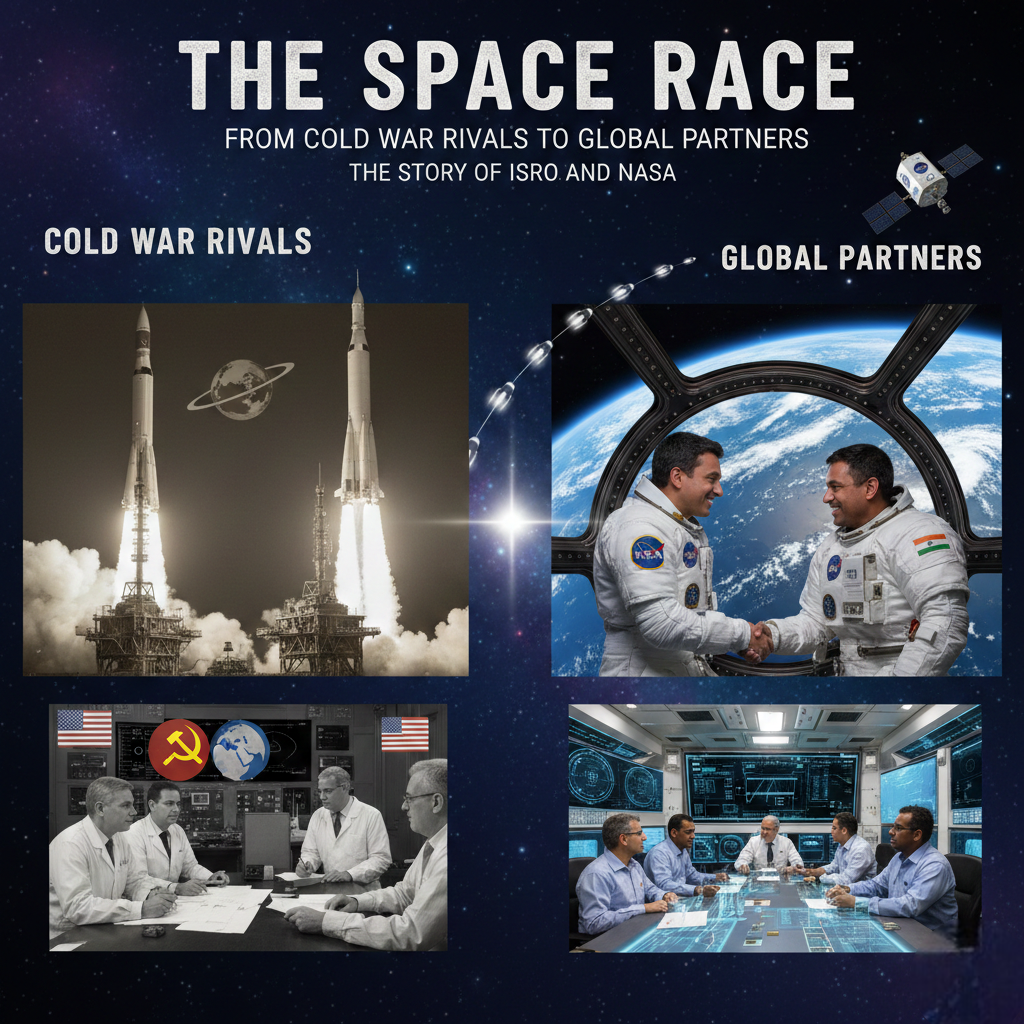
The historical evolution of global space exploration, beginning with the Cold War rivalry between the United States and the Soviet Union. The founding of India’s space agency, ISRO, highlighting how the organization achieved major milestones despite early infrastructure limitations and modest budgets. NASA and ISRO reveals that while the former focuses on pioneering scientific research, the latter prioritizes national development and extreme cost-efficiency. Upcoming Indian missions, such as Gaganyaan and Chandrayaan-3, which aim to further solidify India’s status as a space power. Ultimately, A shift from fierce international competition toward a modern era of global collaboration for the benefit of all humanity.
When we look up at the night sky today, we see a frontier of cooperation, but the journey to get here started with intense rivalry. In 1947, just two years after the end of World War II, tensions were rapidly escalating between the United States and the Soviet Union. Both nations had emerged as superpowers, yet they were divided by a deep clash of political ideologies. This rivalry birthed the Cold War, a period where both nations raced to develop their nuclear capabilities.
To deliver nuclear weapons across continents—intercontinental ballistic missiles (ICBMs)—they needed to master rocket technology capable of reaching outer space. Both countries understood that whoever mastered space first would hold a massive military advantage. In 1955, America announced its plan to launch artificial satellites. However, the Soviet Union shocked the world in October 1957 by launching Sputnik, the world’s first artificial satellite. Just a month later, they launched Sputnik 2, carrying a dog named Laika, the first living creature in orbit. America eventually caught up in January 1958 with Explorer 1, but the race was officially on.
The Birth of India’s Space Dream
While the superpowers were locking horns, a different kind of story was unfolding in India. Dr. Vikram Sarabhai, a visionary scientist, was deeply inspired by the launch of Sputnik. He realized that space technology was not just about showing off power but was vital for a nation’s development. By 1962, he had convinced Prime Minister Jawaharlal Nehru that India needed its own space program.
This marked the birth of what we now know as ISRO. Initially, it was established as INCOSPAR (Indian National Committee for Space Research) under the Department of Atomic Energy. Dr. Sarabhai became the Chairman, earning him the title of the Father of the Indian Space Program.
Our beginnings were humble, to say the least. While other nations had advanced facilities, INCOSPAR had limited infrastructure. You have likely seen the iconic photos of rocket parts being transported on bicycles and bullock carts. We even set up our first control room in a bishop’s room at a church in a remote village, and there were instances where a toilet in Bengaluru was repurposed into a satellite data receiving center.
Despite these resource constraints, India’s journey began almost immediately. In November 1963, just a year after establishment, we launched our first sounding rocket—supplied by NASA—to study the atmosphere. Learning from this experience, we developed our own sounding rocket, the Rohini 75, launched in 1967. On August 15, 1969, INCOSPAR was renamed ISRO (Indian Space Research Organisation), with the clear aim of using space technology for national development.
Milestones of Independence
Under Dr. Sarabhai’s leadership, we worked diligently. In 1975, India launched its first artificial satellite, Aryabhata, named after the famous 5th-century mathematician. While we had to use a Soviet launcher for this due to an agreement between our nations, we were rapidly moving toward self-reliance.
Sadly, Dr. Sarabhai passed away in 1971 and did not see the launch of Aryabhata. He was succeeded by Dr. Satish Dhawan, an exceptional aerospace scientist. Under his guidance, the 1980s became a decade of breaking records. We created our own Satellite Launch Vehicle (SLV-3), ending our reliance on other countries for launches. This vehicle successfully placed the Rohini satellite into orbit.
This success paved the way for more advanced vehicles like the ASLV, the PSLV (Polar Satellite Launch Vehicle), and the GSLV (Geosynchronous Satellite Launch Vehicle). Interestingly, while the US and USSR were fierce rivals, India accepted help from both. In 1983, we used NASA’s help to launch the INSAT series—satellites that revolutionized communication, television broadcasting, and weather forecasting in India, proving crucial for disaster warnings.
A major historic moment occurred in April 1984 when Rakesh Sharma, an Indian Air Force pilot, became the first Indian citizen to travel to space. He spent eight days aboard a Soviet spacecraft. To this day, he remains the only Indian citizen to have achieved this feat.
ISRO’s Rise to a Space Superpower
Over the next two decades, ISRO’s growth was exponential. The turning point came in 2008 with the success of Chandrayaan-1, India’s first mission to the Moon. This mission proved our potential to the world. Then, in 2013, we launched the Mars Orbiter Mission (Mangalyaan). India became the first country to enter Mars’ orbit on its very first attempt—and the fourth space agency in history to do so.
What shocked the world was the cost. We executed the Mars mission for just $74 million. To put that in perspective, the Hollywood film The Martian had a budget of $108 million. We went to Mars for a fraction of the cost of a movie about going to Mars.
ISRO vs. NASA: A Comparison
This brings us to a question many people ask: Can ISRO compete with NASA?
We must look at the facts. NASA was founded in 1958, just four years before India’s program began. However, NASA has undertaken over 1,000 unmanned missions and sent humans to the Moon in 1969—a feat no other country has replicated since. They have rovers on Mars and telescopes like Kepler and James Webb discovering exoplanets and the origins of the universe.
Why is NASA so far ahead?
1. Origins: NASA was born out of a race for dominance against the Soviet Union. The US government poured resources into it to ensure they didn’t lag behind.
2. Goals: NASA’s primary goal has always been exploration and increasing human knowledge. In contrast, ISRO was built not to compete, but to provide socio-economic benefits to the Indian people—like weather forecasting and communication. Exploration missions like Chandrayaan came much later.
3. Budget: This is the biggest differentiator. NASA’s annual budget is around $24 billion. In comparison, India’s entire Department of Space gets about $1.7 billion, and ISRO receives only a portion of that. NASA has nearly 20 times the budget of ISRO, allowing them to take risks on ambitious missions to Saturn, Jupiter, and beyond.
However, there is one area where ISRO surpasses NASA: Efficiency and Cost-Effectiveness.
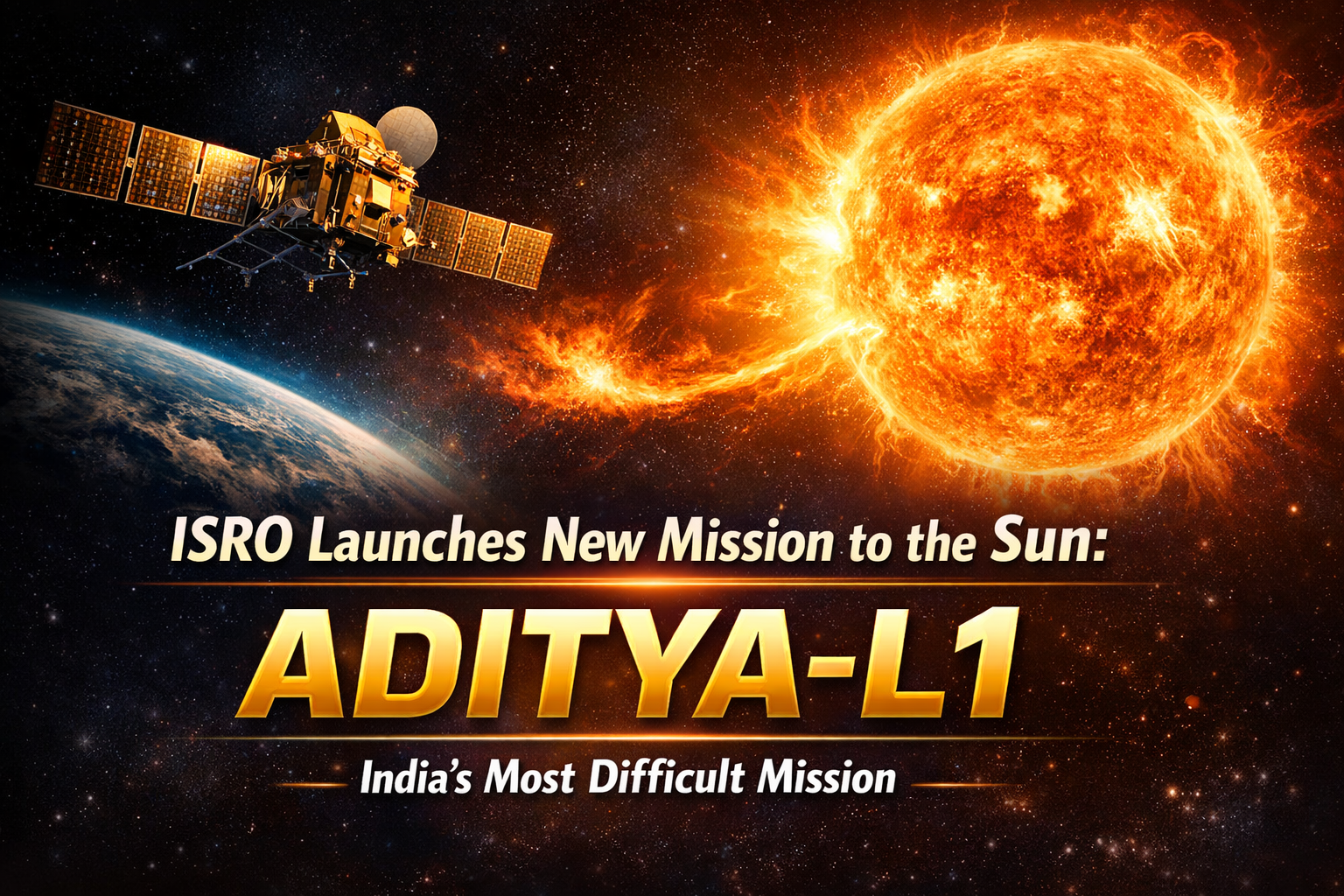
We are masters of frugality. For example, NASA’s solar mission Stereo cost $550 million in 2005. ISRO is launching a similar solar mission, Aditya L1, for just $55 million—one-tenth of the cost. Similarly, NASA’s upcoming Venus missions (Veritas and Da Vinci) are estimated to cost $1 billion combined. ISRO’s planned Shukrayaan-1 mission to Venus is estimated to cost between $62 million and $125 million. Again, roughly one-tenth of the price.
The Future of Indian Space Exploration
Looking ahead, we have an incredibly exciting roadmap.
1. Gaganyaan (Human Spaceflight): The most anticipated mission is Gaganyaan. This will be India’s first manned mission to space. We plan to send a crew of three people to orbit Earth at a height of 400 km for 5 to 7 days. The budget is over ₹90 billion, and almost every component—from the launch vehicle to the life support systems—is being developed indigenously in India.
However, for astronaut training and spacesuits, we are collaborating with international partners. Four Indian Air Force pilots have undergone training with the Russian space agency Roscosmos, and flight physicians are being trained by the French agency CNES. If successful, India will become only the fourth country in the world (after the USA, Russia, and China) to send humans to space independently. While Kalpana Chawla was of Indian origin, she was an American citizen; Gaganyaan will take Indian citizens to space on an Indian vehicle. We expect test flights (Gaganyaan I and II) soon, with the manned mission.
2. Aditya L1: this will be India’s first mission to study the Sun, with an allocated cost of ₹3.78 billion.
3. Chandrayaan-3: Following the software glitch that caused the Vikram lander to crash during Chandrayaan-2 in 2019, we are attempting the mission again. Chandrayaan-3 done with the for a soft landing on the Moon’s south pole.
4. Future Explorations: Beyond these, we are planning Shukrayaan-1 for Venus, a Lunar Polar Exploration mission in collaboration with Japan and even Mangalyaan-2. Perhaps most ambitiously, former ISRO Chief K. Sivan announced plans for an Indian Space Station by 2030.
Competition to Collaboration
The era of the “Space Race,” where America and the Soviet Union fought for dominance, is over. Today, it is no longer about ISRO versus NASA. It is about ISRO plus NASA.
In 1975, the Space Race symbolically ended with the Apollo-Soyuz mission, where American and Soviet spacecraft docked together in orbit. “When we opened this hatch in space, we were opening back on the Earth an era in the history of man,” it was said.
Today, nations prefer to collaborate rather than compete. By sharing technology and ideas, we increase efficiency and save costs. This progress is not for the glory of one country, but for the benefit of all humanity. We hope the Indian ecosystem continues to support ISRO just as it has in the past, empowering our scientists to reach new heights. The story that began with fear and rivalry has found a happy ending in unity.

I'm a education-driven content creator dedicated to breaking down complex ideas into simple, practical, and easy-to-understand explanations. The website is built with a clear mission: to promote learning, awareness, and education.