
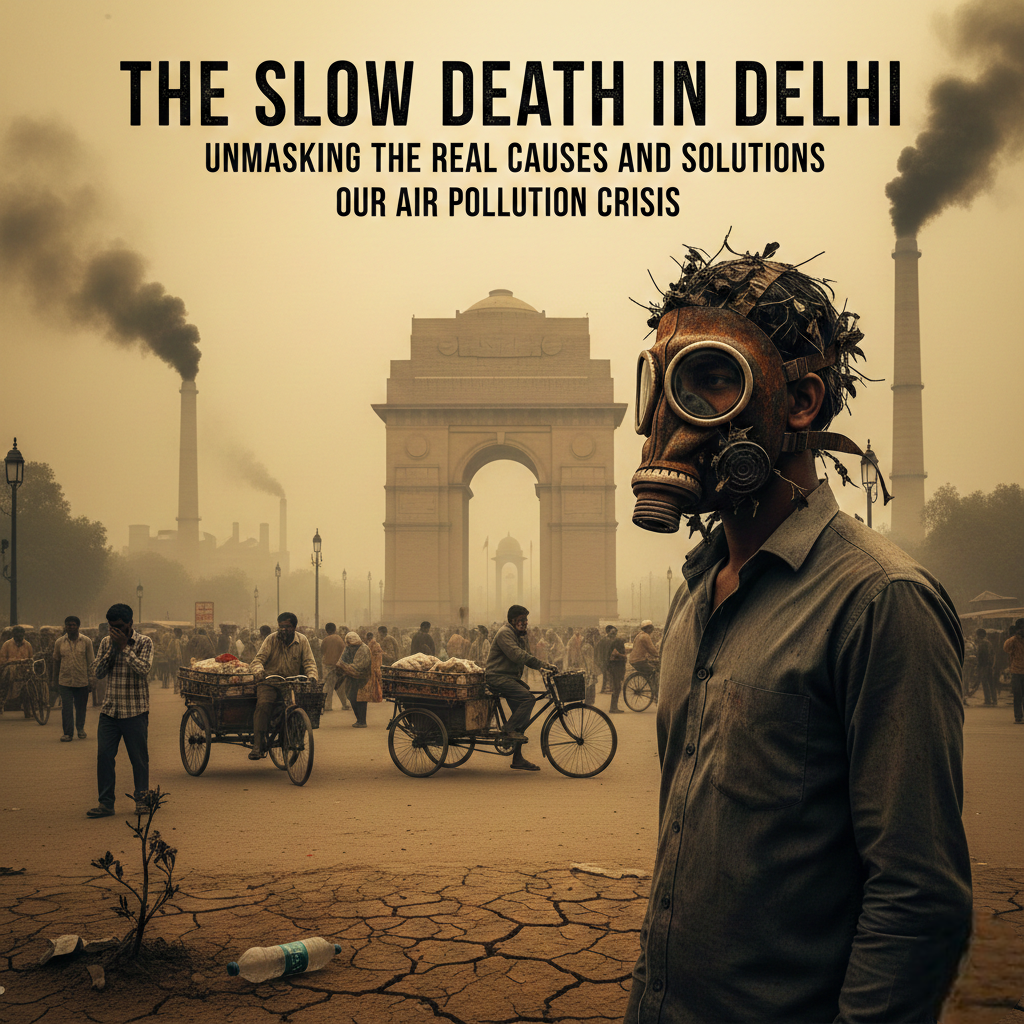
Air Pollution Crisis- The severe air pollution crisis in Northern India, specifically focusing on how Delhi has transformed into a dangerous “gas chamber.” Stubble barning, vehicular emissions, and construction dust as the primary drivers of toxic PM 2.5 levels that significantly reduce life expectancy. Criticizing on the political blame game and the lack of genuine infrastructure, such as efficient public transport and waste management, which prevents long-term solutions. Successful international models like Beijing to prove that air quality can be restored through strict enforcement, localized innovations like bio-enzymes and crop diversification. Ultimately, Overcoming this health emergency requires moving beyond seasonal outrage to implement systemic policy changes and accountability for both the government and citizens
Imagine someone telling you that simply living in your city could cut your lifespan by over eight years. What would your reaction be? Shock? Anger? Or a deep-seated fear that the very air keeping you alive is slowly destroying you from the inside?
Delhi, a city historically known as the cultural and political heart of India, has unfortunately transformed into a gas chamber. According to a report by the Energy Policy Institute at the University of Chicago (EPIC), the incredibly high levels of PM 2.5 in Delhi’s air can reduce the average life expectancy of its residents by 8.2 years. The World Health Organization (WHO) states that the safe limit for PM 2.5 is just 5 micrograms per cubic meter, but in recent years, Delhi’s annual average hit 88.4, making it nearly 17 times more toxic than the safe limit. Even more terrifying, fresh reports from 2025 show this level has surged to 101 micrograms per cubic meter.
Today, I want to take you on a deep dive into the exact reasons why North India—and specifically Delhi—is facing this health emergency, the systemic failures holding us back, and the tangible solutions we desperately need.
Understanding the “Invisible Killer”: PM 2.5
Before we point fingers, we must understand the enemy. Air pollution isn’t just a single gas; it’s a toxic mixture of pollutants like nitrogen dioxide (NO2), sulfur dioxide (SO2), carbon monoxide (CO), and ozone. But the deadliest of them all is PM 2.5.
PM 2.5 stands for particulate matter that is 2.5 microns or smaller. To put that into perspective, it is about 30 times smaller than the thickness of a single human hair. Because it is so microscopic, it isn’t just a gas but a lethal cocktail of solid particles and liquid droplets, including soil dust, metal dust, and industrial ash. When you breathe, PM 2.5 easily bypasses your body’s natural filters, entering your lungs and directly infiltrating your bloodstream. From there, it travels to major organs like the heart and brain, drastically increasing the risk of asthma, bronchitis, emphysema, strokes, and lung cancer.
The Blame Game: Is it just Diwali?
Every year, people point to the festival of Diwali as the primary culprit for the smog. But let’s look at the facts. Diwali is celebrated across the entire country, yet states like Maharashtra don’t experience the apocalyptic smog seen in the North. Shortly after Diwali, Mumbai’s air quality was clear enough that weather apps were actively encouraging people to go out for walks. The truth is, while firecrackers contribute to the problem, out of the 75 most polluted cities in India, 70 are in North India. Blaming Diwali is a distraction from the root causes.
Cause 1: The Complex Reality of Stubble Burning
Whenever the Air Quality Index (AQI) crosses 400 or 500, politicians immediately blame stubble burning in neighboring states like Punjab, Haryana, Uttar Pradesh, Rajasthan, and Madhya Pradesh (along with winds bringing smoke from Pakistan).
But there is a deeper, more systemic issue here. In 2009, the Punjab Preservation of Subsoil Water Act was introduced to save depleting groundwater. This law prevents farmers from sowing paddy before a specific date, which leaves them with a severely narrow time window between harvesting the paddy and sowing the next season’s wheat. With no time to clear the fields manually, they resort to burning the stubble.
Furthermore, farmers have become incredibly smart at dodging satellite detection. Satellites track farm fires, but farmers know the satellites’ schedules and deliberately start fires after 2:00 PM when the satellite has already passed.
What’s tragic is that this cycle doesn’t even yield high-quality crops. To produce this rice, massive amounts of water, fertilizers, and pesticides are used—heavily subsidized by up to ₹2 lakh crores annually. This results in substandard rice that has been rejected for human consumption by Indian states like Arunachal Pradesh, Karnataka, and Nagaland, and is frequently rejected by foreign nations. Ironically, burning the stubble destroys the soil’s microorganisms by raising the ground temperature, meaning the farmers are destroying their own long-term livelihood for short-term convenience.
Cause 2: The Traffic Nightmare
Traffic alone is responsible for 25% of Delhi’s pollution. There are currently around 1.5 crore registered vehicles in Delhi. Every single day, lakhs of cars hit the roads, emitting NO2, CO, and PM 2.5, creating a toxic invisible cloud.
To fix this, a robust public transport system is mandatory. Back in 1998, the Supreme Court stated that Delhi needed 10,000 buses. Yet, as of July 2024, the city only has about 7,600 buses. This leaves Delhi with a dismal ratio of just 45 buses per 1 lakh people. Because the public transport infrastructure is broken, citizens are forced to buy private vehicles—which have become a status symbol—adding roughly 6.5 lakh private vehicles to the roads in 2023 alone.
Cause 3: Construction Dust
Pollution isn’t just smoke; it is also dust. There are currently 611 active construction sites in Delhi. Road cutting, drilling, cement mixing, and demolitions release a massive amount of fine dust into the air.
This isn’t ordinary soil; it is a highly toxic cocktail containing silica particles, cement powder, brick dust, metal particles, lime, and chemical residues. This dust is so fine that even the filters in your nose cannot stop it. While there are clear rules—like spraying water regularly, setting up green nets, covering construction debris, and covering trucks transporting materials—these are rarely followed. To save a few pennies, builders leave sites completely exposed, allowing fine particles and concrete batching fly ash to blanket the city.
Cause 4: The Geographical Trap
Delhi is inherently at a geographic disadvantage. The city sits in a bowl-shaped region. During the winter, the cold air settles down, trapping all the generated pollutants inside this geographical bowl. While nature multiplies the problem, our poor policies ensure that the trap is constantly filled with toxins.
Cause 5: Waste Management and Power Generation
Delhi is home to massive “mountains” of mixed garbage containing everything from old furniture and batteries to food waste. Because the city lacks land, municipal corporations often resort to literally burning this waste, or the methane buildup causes spontaneous fires, burning anywhere from 190 to 246 tons of garbage daily.
Furthermore, our electricity mostly comes from coal. Out of India’s 280 gigawatts of coal power, only 10% of plants have proper pollution control equipment installed. When coal is burned, sulfur dioxide breaks down into sulfates, which accounts for one-third of the smog you see. The government gave these power plants a deadline of 2015 to install pollution-reducing equipment, but these deadlines have been continually missed.
Add to this the estimated 9,000 dhabas, hotels, and restaurants around Delhi that still use coal or wood for their tandoors, emitting black smoke that leads to severe lung diseases. Even though coal was banned for hotels in October 2023, enforcement is virtually nonexistent. Similarly, nearly half of the country’s population still relies on biomass (wood, cow dung) for cooking. Many people who received subsidized LPG cylinders use them for commercial businesses instead of household cooking, continuing to pollute the air inside their own homes.
Systemic Failures: Why is Nothing Changing?
If we know all the causes, why are we still suffering? The answer lies in a three-tiered systemic failure:
1. Misplaced Priorities: Whenever pollution spikes, governments react with PR stunts—social media campaigns, full-page newspaper ads, and symbolic projects like “smog towers.” True root-cause solutions like expanding electric buses and reliable metro feeder systems are ignored.
2. Zero Implementation of Rules: We have rules for clean fuel, industrial emissions, and construction dust, but they only exist on paper.
3. Lack of Political Will: Pollution simply isn’t an election issue. Politicians win votes on caste, religion, and freebies. They sit in homes and offices equipped with air purifiers and only hold high-level meetings when the AQI reaches hazardous levels in winter, completely forgetting the issue by January.
The Beijing Miracle: Proof That Change is Possible
If you think this problem is unsolvable, look at Beijing. In 2013, Beijing was considered the most polluted capital in the world, suffering from identical conditions to Delhi. But within 7 to 8 years, they reduced their PM 2.5 levels by an astonishing 40%. How? Through pure political will. The Chinese government shut down coal plants, relocated high-emission factories, massively adopted electric vehicles (EVs), provided machinery subsidies to farmers, installed real-time monitoring systems, and enforced strict penalties for rule-breakers.
The Ultimate Solutions: How We Can Save Our City
To stop Delhi from becoming a place that tourists completely avoid, and to stop hurting our global image and economy, we need immediate, aggressive action at both the systemic and personal levels.
Systemic Solutions:
• Fixing Stubble Burning: The government must amend the 2009 Subsoil Water Act to give farmers more time. We need to adopt innovations like the PUSA bio-enzyme, which decomposes stubble into manure in just 20-25 days. We should also scale the Chhattisgarh model, where farmers collect stubble in a 5-acre plot in every village to convert it into organic fertilizer, creating a win-win scenario.
• Enforcement and Penalties: If farmers continue to burn stubble, their electricity and fertilizer subsidies must be revoked. We must strictly penalize builders who don’t cover construction dust and properly utilize telescopic chutes and water sprays.
• Public Transport and Workplace Flexibility: The government needs to drastically increase the number of electric buses. In the meantime, companies should embrace Work-From-Home policies or flexible office timings to drastically reduce daily vehicular emissions.
• Agricultural Diversification: We must pivot away from water-intensive, pesticide-heavy crops like paddy and encourage food diversification so we don’t end up with massive amounts of stubble in the first place.
Personal Solutions: We cannot wait for the government to save us. On an individual level, we must start composting our wet waste to reduce the burden on landfills. We need to engage in wet cleaning of our homes, plant indoor greenery, reduce unnecessary car usage by opting for carpooling or public transit like the Metro, and most importantly, become part of citizen movements.
Clean air, safe water, and unadulterated food are our fundamental rights. It is time we stop treating pollution as a seasonal winter topic and start demanding year-round action. If we combine smart policies, strict enforcement, and powerful public demand, Delhi could transform into one of the world’s cleanest cities within a decade.
What do you think? Will Delhi ever be free of pollution, or will it forever remain a casualty of political apathy? It’s time we decide
Read More :
The Dark Truth About Packaged Fruit Juices: A Deep Dive into What You Are Really Drinking

I'm a education-driven content creator dedicated to breaking down complex ideas into simple, practical, and easy-to-understand explanations. The website is built with a clear mission: to promote learning, awareness, and education.