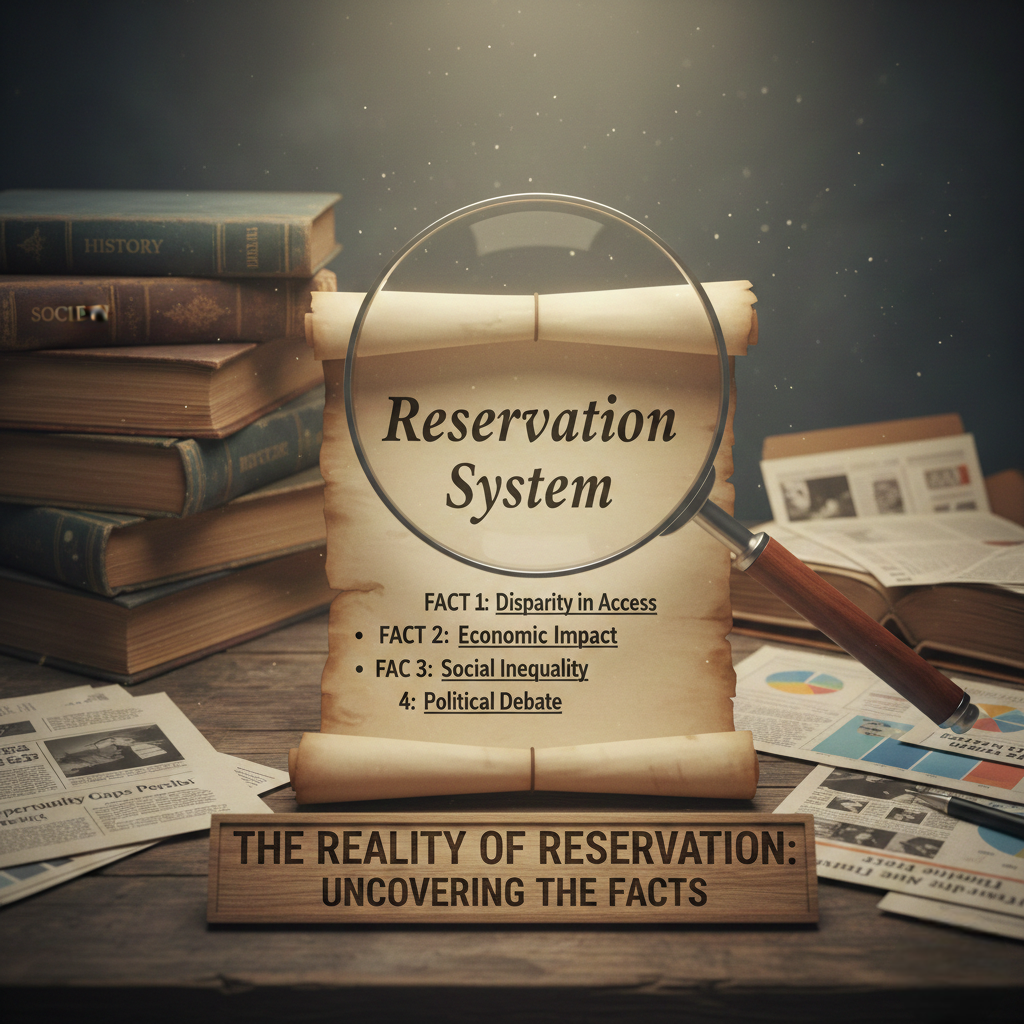
Reality of Reservation – The complex socio-political reality of caste-based reservation in India, framing it as a necessary tool for representation rather than a simple poverty-alleviation program. Historical systemic discrimination and the exclusion of backward classes from education and land ownership justify the ongoing need for affirmative action. Providing extra support to those who are disadvantaged ensures long-term social stability and prevents rebellion. The disparity between high-ranking positions dominated by upper castes and the lack of basic resources available to many SC/ST/OBC communities. Finally, Criticising on political parties for using reservation as a vote bank tactic while failing to address the deep-rooted social prejudices that persist in both rural and urban environments.
Reservation is one of the most controversial topics in our society, and you will find people debating it every day, especially during elections when the discussions become much more intense. Some people argue that reservation should be based on financial status rather than caste, claiming that if the status of backward classes hasn’t improved in 70 years, the current tool is useless. Others argue that they should not have to suffer for the mistakes made by their ancestors. On the other hand, it is ironic that people who refuse to take responsibility for their ancestors’ oppressive actions never step back when it comes to inheriting their ancestors’ property.
Ultimately, those who receive reservation support it, and those who don’t mostly argue against it.
The Demographic Reality
Before discussing reservation, we must understand the actual ground reality through data. According to the 2011 Census, India’s total population is 121 crore. Out of this, 20 crore (16.63%) belong to Scheduled Castes (SC), and 10 crore (8.61%) belong to Scheduled Tribes (ST). The data for Other Backward Classes (OBC) is slightly controversial; the Mandal Commission estimated the OBC population at 52%, while the NSSO survey placed it at 41%.
From this available data, we can estimate that around 75% of the total population belongs to backward classes, while the remaining 25% belongs to the general category.
Now, look at how reservation is distributed among this 75% of the population:
• SC receives a 15% reservation.
• ST receives a 7.5% reservation.
• OBCs receive a 27% reservation. In total, about 50% reservation is allocated to the backward classes who make up 75% of the population. On top of this, there is a 10% Economically Weaker Section (EWS) quota.
Is Reservation a Form of Discrimination?
The most common argument is that reservation is itself a form of discrimination. People argue that giving someone more priority based on caste violates the fundamental right to equality.
Our Constitution considers the whole country as a family and acts exactly the same way. We only dislike reservation because we view people outside our families as outsiders.
Logically, ignoring a community is dangerous. If a father ignores one of his three sons, that neglected son will eventually rebel against the family. Similarly, when a country discriminates against a specific community, they become rebellious. If a government ignores a state or community, it becomes a bigger threat to the country than a nuclear bomb. A true democracy requires the participation of every community.
The Historical Monopoly on Education and Wealth
Historically, society was divided by occupation: Brahmins handled education, Kshatriyas handled defense, Vaishyas handled business, and Shudras served the other three. Originally, there was no “upper” or “lower” hierarchy; it was strictly division of labor, much like how the English surname “Smith” originated from blacksmiths.
However, over time, those who possessed knowledge and power grew larger, set their own rules, and turned the system into a discriminatory hierarchy. Today, people complain about reservation, but for thousands of years, the upper castes had 100% reservation in education and wealth. In fact, they even had 100% reservation on the roads—backward classes were not even allowed to walk on certain paths.
Untouchability is India’s harsh reality. People would feed ants but consider it forbidden to touch a fellow human being. Because they were treated worse than animals, backward classes were denied education and jobs. Generation after generation, this stripped away their capabilities.
People casually say that backward classes are genetically less capable, or you will hear remarks like, “You don’t look like an SC/ST” or “This is a real Rajput”. This is a myth. For thousands of years, opportunities were snatched away from them. Look at the US: white people hold more important positions than black people not because black people are less capable, but because of historical discrimination. If historical figures like Ved Vyas or Maharishi Valmiki were alive today, they would be classified as Dalits.
The Vicious Cycle of Privilege
The environment and opportunities you receive matter more than the caste you are born into. Take the example of Dr. B.R. Ambedkar, who struggled so much that he had to bring his own sitting sack from home to school, yet he became so successful that his statue now stands at Columbia University.
Consider two children: one has educated parents, goes to a good school, gets multiple tutors, plays sports, and is given a laptop at the right time. The other child hasn’t even seen a laptop. Who do you think will get a job and succeed? The privileged child. This creates a never-ending vicious cycle where the successful remain successful generation after generation, and the marginalized remain stuck, save for a few rare exceptions that society loves to point out.
The Ground Reality: Empty Seats and Deep Stigma
Today, a harmful trend exists where people point at an SC/ST candidate and say, “Look, their marks were lower, but they still got selected”. People do not understand that backward classes often lack the basic resources required just to claim those reserved seats.
For example, 81 PhD seats and over 42,000 seats in 16 IITs (as per 2020 data) for SC, ST, and OBC candidates were left completely vacant. Out of 1000 seats, perhaps 20-25 are secured by backward classes, and even then, they are humiliated and insulted on social media by those who didn’t get selected.
The stigma is severe. Khap panchayats and the fear of social boycott terrify people in villages. Untouchability is something we refused to let go of even after independence. Reservation in elections (reserved constituencies) is absolutely necessary because, without it, backward classes wouldn’t stand a chance of winning against the money and muscle power of dominant castes.
Even today, violence and discrimination persist. In 2020, a man named was shot simply for entering a temple despite being from a “lower” caste. There were even rumors spread to stop the President of India from entering a temple until a clarification was issued.
Why Income-Based Reservation Fails
Many argue that reservation should be strictly income-based. I used to think the same until I read the details. Reservation is not a poverty elimination scheme; it is meant for representation. If you read Articles 14, 15, and 16 of the Constitution, you will find the word “Representation,” not “Economic Equality“.
Money can make you rich, but it does not erase your caste. For poverty, the government has schemes like MNREGA, old-age pensions, family benefit schemes, subsidies, and they can even increase corporate taxes to fund welfare. Reservation is strictly to counter thousands of years of atrocities. When Mayawati became Chief Minister, the mere representation of a backward-class leader empowered people, creating an environment where others were forced to treat them with respect.
Furthermore, the 10% EWS (Economically Weaker Sections) quota designed for the general category is highly flawed. With an annual income limit of 8 lakhs, almost 90-95% of the entire country falls under EWS. Tracking income is nearly impossible outside of organized sectors in metro cities. Parents are literally leaving their jobs a year before their children’s exams just to qualify for EWS.
Fake income certificates are incredibly easy for influential people to make. On the other hand, you rarely see fake caste certificates. Why? Because no upper-caste person wants to downgrade their caste to a backward one due to the immense social discrimination that comes with it. In India, changing your religion is easier than changing your caste.
Gandhi believed that discrimination would only end through intercaste marriages, which is why he only attended weddings that were intercaste. Yet, even today, finding a capable match is terribly difficult for a Dalit, and families casually advise their children to marry anyone but someone from a “lower” caste.
If you think reservation is no longer needed, walk out of your house, find 10-12 street sweepers or manual laborers, and ask them their caste. You will never hear surnames like Singhania, Oberoi, or Suryavanshi. Discussing the removal of reservation in a metro city mall is easy, but the ground reality in villages is vastly different.
Recently, the government introduced a lateral entry system for UPSC, recruiting directly via interviews without any exams or reservation. Unsurprisingly, not a single backward-class person was selected.
The Vote Bank Politics
Finally, the biggest hurdle in solving this issue is politicians, who treat people merely as voting numbers in a circus. Reservation was first introduced in politics via the Poona Pact in 1932 because backward classes demanded a separate electorate from the British, realizing their political power was nonexistent. Later, the Tamil Nadu government promised education reservation to win elections.
When Morarji Desai became PM, he formed the Mandal Commission to give 52% of OBCs a 27% reservation. Leaders like Indira Gandhi and Rajiv Gandhi avoided touching it. But in 1989, V.P. Singh, wanting to secure his political grip in UP, implemented the Mandal Commission. Then Narasimha Rao floated the idea of a 10% economic reservation.
Politicians know that implementing reservation secures a community’s vote for generations, while removing it means losing those votes forever. This is why no leader dares to remove it, and the Constitution has been amended multiple times (77th, 81st, 82nd, 85th, 93rd amendments) just to maneuver reservation policies. You will often see big leaders of a party supporting reservation, while their small-time leaders speak against it just to keep the public divided and confused.
This political manipulation is also why caste-based census data (other than SC/ST) has been hidden from the public since 1932. The Ministry of Social Justice and Welfare is sitting on the data but refuses to release it.
In the end, no person is greater than their caste. A truly great person is someone who makes sure that anyone sitting next to them never feels small or inferior.
Read More :
The Dark Truth About Packaged Fruit Juices: A Deep Dive into What You Are Really Drinking
Is a Sarkari Naukri Worth the Struggle? The Truth About Costs and Salaries
The “Bhedchaal” Mentality: Why 90% of Indian Students Are Chasing the Wrong Dream

I'm a education-driven content creator dedicated to breaking down complex ideas into simple, practical, and easy-to-understand explanations. The website is built with a clear mission: to promote learning, awareness, and education.