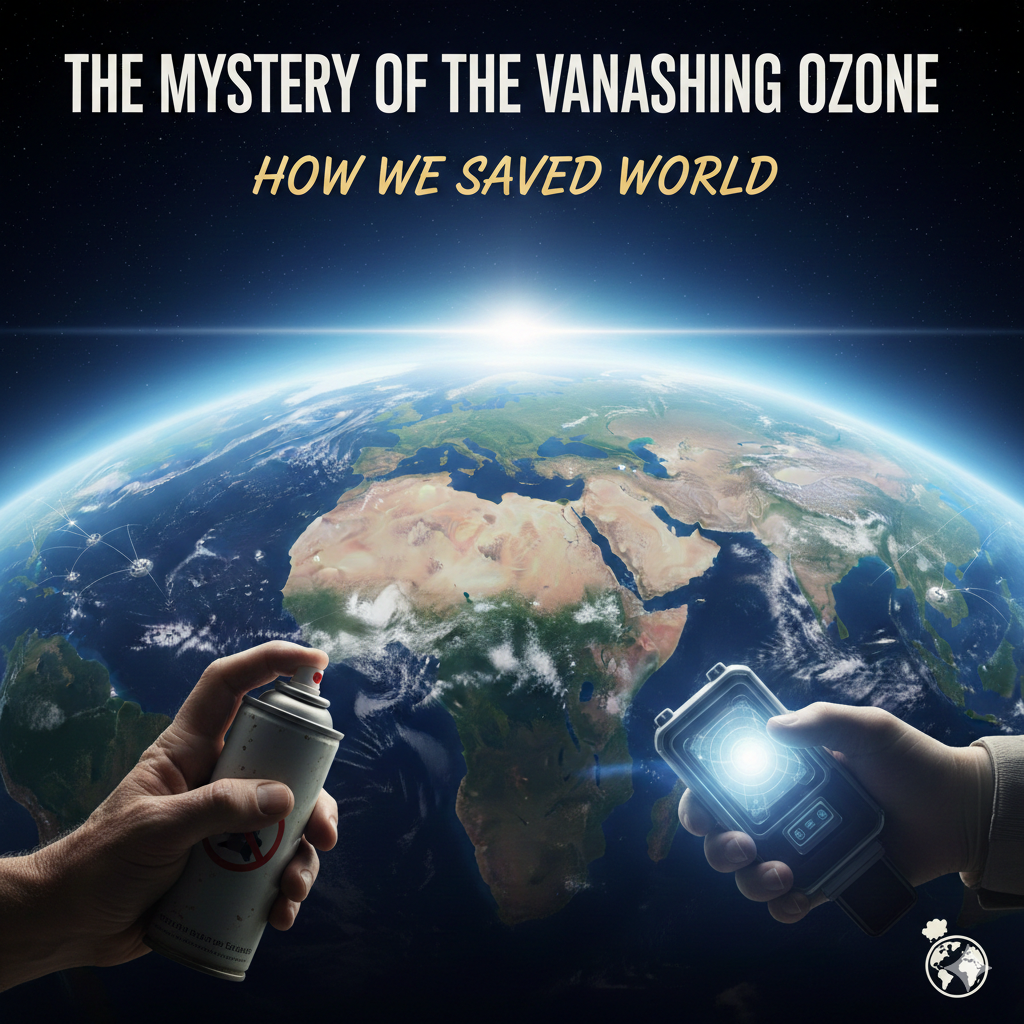
In 1982, Joseph Farman discovered a massive ozone hole over Antarctica caused by CFCs. These chemicals destroy the O3 layer, which protects Earth from lethal UV-C radiation. Global cooperation through the Montreal Protocol successfully phased out CFCs, allowing the layer to recover.
Let me take you back to a research station in Antarctica amidst the snowstorms of October 1982. A scientist named Joseph Farman was there taking measurements of the ozone in the Earth’s atmosphere using a machine. Suddenly, he encountered a very strange reading: the machine indicated that the amount of ozone had decreased by 40% compared to normal. Joseph looked at the number and simply couldn’t believe it; he assumed the machine—which was considerably old—was malfunctioning. He reasoned that if ozone levels had truly dropped that low, the thousands of orbiting NASA satellites would have detected it.
So, he packed up and went home. But when he returned the next year in October 1983 with a brand-new machine, the readings showed that the ozone level had deteriorated even more than the previous year. It seemed unbelievable, but again, he assumed that agencies like NASA would have flagged such a massive problem. By October 1984, he decided to verify his findings by traveling to a different research station about 1,000 miles away. The measurements there were even worse.
He realized then that this was an emergency. Farman took his evidence to NASA, and soon the world learned about the “ozone hole” over Antarctica. Surprisingly, NASA scientists had overlooked it in their data, but when they reviewed their satellite photos, the timeline was clear: in 1979, everything was normal; by 1982, a proper hole was visible; and by 1984, the hole had grown massive. The world went into a frenzy because if the ozone layer kept depleting, it would be a terrible event—a warning bell for all life on Earth. At that rate, it was predicted that the ozone layer would be completely depleted by 2050, ending life as we know it.
Understanding Our Shield: What is the Ozone Layer?
Before we move on, we must understand what the ozone layer is. Ozone is a gas with the chemical formula O3, meaning it is made of three oxygen atoms, unlike the oxygen we breathe (O2). This layer formed around the Earth about 600 million years ago and sits in a zone 15 to 35 kilometers above the Earth’s surface. About 90% of Earth’s ozone is found here, with the highest concentration at 32 kilometers up, though even there it only makes up 0.0015% of the atmosphere.
Despite being such a small amount, it is vital. Ozone is created through a process called Photodissociation or Photolysis. When ultraviolet radiation from the sun hits an oxygen molecule (O2), it splits it into two individual oxygen atoms. These separated atoms then mix with other oxygen molecules to form ozone (O2 + O = O3). This creates a constant cycle, known as the Chapman cycle (named after Sydney Chapman who explained it in 1929), where ozone molecules collide with oxygen atoms to form oxygen again.
Why Do We Need It?
The ozone layer is our primary defense against harmful solar radiation. The sun emits almost all types of rays in the electromagnetic spectrum, including visible light, X-rays, Gamma rays, and UV rays. The ionizing rays (X-rays, Gamma, and UV) are dangerous because they can change our DNA and tear our bodies apart.
UV rays are categorized into three types based on wavelength:
1. UV-A (315-400 nm): These pass through the ozone layer completely.
2. UV-B (280-315 nm): These are partially absorbed by the ozone layer.
3. UV-C (100-280 nm): These are the most dangerous and have the smallest wavelength, but our ozone layer stops them completely.
Without ozone, UV-C would reach the surface, causing skin cancer, cataracts, and immune system damage. This is why we use broad-spectrum sunscreen; it protects us from the UV-A and UV-B radiation that gets through. Interestingly, data science played a major role in analyzing UV radiation to help companies formulate these sunscreens effectively.
This layer is actually responsible for life on land. 600 million years ago, life only existed deep in the ocean to escape radiation. Only after the ozone layer developed could complex multicellular organisms survive in shallow water and eventually move onto land.
The History of Discovery
Humans only discovered this gas fairly recently. In March 1839, Christian Schönbein at the University of Basel noticed a strange smell while experimenting with the electrolysis of water. He named the gas “Ozone,” coming from the Greek word Ozein, meaning “to smell”. It smells similar to sparks from electrical equipment or soil during a thunderstorm—some find it sweet, others metallic like bleach.
We learned that while ozone protects us in the atmosphere, it is toxic to humans and animals at close proximity. In 1921, British geophysicist G.M.B. Dobson created the Dobson Spectrophotometer, a machine still used today to measure atmospheric ozone in “Dobson Units” (DU). A normal ozone layer thickness is 300-500 DU, which is only about 3-5 mm thick.
The “Bad” Ozone
You might wonder, since we produce ozone pollution on the ground, can’t that fill the hole? Unfortunately, no. “Bad ozone” forms at the surface when sunlight reacts with pollutants like nitrogen oxides (NOXs) from burning coal or car exhaust, and Volatile Organic Compounds (VOCs) from gasoline or paints. This surface ozone is a dangerous pollutant that causes chest pains and respiratory issues. It cannot ascend high enough to fix the layer, and its concentration is too low to be useful there.
The Culprit: How We Broke the Sky
The trouble began in the 1970s. While NASA worried about spacecraft damaging the atmosphere, the real enemy was in our daily lives: hair spray, shaving cream cans, and fridge coolants containing Chlorofluorocarbons (CFCs).
In June 1974, three scientists published a Nobel Prize-winning paper warning that CFCs could destroy the ozone layer. They were mocked at the time, but they were right. CFCs are stable on the ground, but when they reach the atmosphere and are hit by solar radiation, they release chlorine.
This triggered a devastating chemical loop:
1. Chlorine reacts with Ozone (O3) to form Oxygen (O2) and Chlorine Monoxide (ClO).
2. Chlorine Monoxide then reacts with oxygen atoms to release the Chlorine again.
3. This single recycled Chlorine atom can then destroy thousands more ozone molecules.
The Hole in Antarctica
By August 1985, the first map of the “ozone hole” was shown to the world. It wasn’t a physical hole, but a massive thinning where levels dropped below 200 DU—in some places to 150 DU.
Why Antarctica? The answer lies in the cold. Depletion happens at both poles, but Antarctica is colder. When temperatures drop to -78° Celsius, Polar Stratospheric Clouds form. The droplets in these clouds (a mix of nitric and sulfuric acid) provide a surface for chemicals like chlorine to react and break down ozone rapidly. The Arctic is generally warmer (-51°C to -15°C in the stratosphere), making the effect less severe there.
A Global Triumph
The good news is that politicians took immediate action. Following the 1985 findings, the United Nations drafted a treaty in 1986 to ban CFCs. This led to the 1987 Montreal Protocol, which became effective in 1989. It stands as the first UN treaty in history ratified by all 198 member countries.
Nations replaced CFCs with Hydrofluorocarbons (HFCs), and consumption dropped from 800,000 metric tons in the 1980s to just 156 metric tons by 2014—a 99% reduction. Although the ozone hole reached its largest size in 2000 due to the delay in chemical reactions, it is now shrinking.
The Future and A Lesson Learned
According to a January 2023 UN report, the ozone layer is on track to fully recover. It will return to 1980 levels by 2040 globally, and the hole over Antarctica will heal completely by 2066. By banning CFCs, we also prevented an additional 2.5° Celsius of global warming that would have occurred by 1999.
We are also addressing a side effect: HFCs, while safe for ozone, are potent greenhouse gases. In 2016, they were added to the controlled substances list to be phased out over the next 30 years to help fight climate change.
Vital lesson: if governments and people unite, we can solve global problems quickly. We face a similar challenge today with climate change, and we must take the same united action.
Read More:
From a Ball of Lava to a Blue Planet: The 4.6 Billion Year History of Our Home

I'm a education-driven content creator dedicated to breaking down complex ideas into simple, practical, and easy-to-understand explanations. The website is built with a clear mission: to promote learning, awareness, and education.