
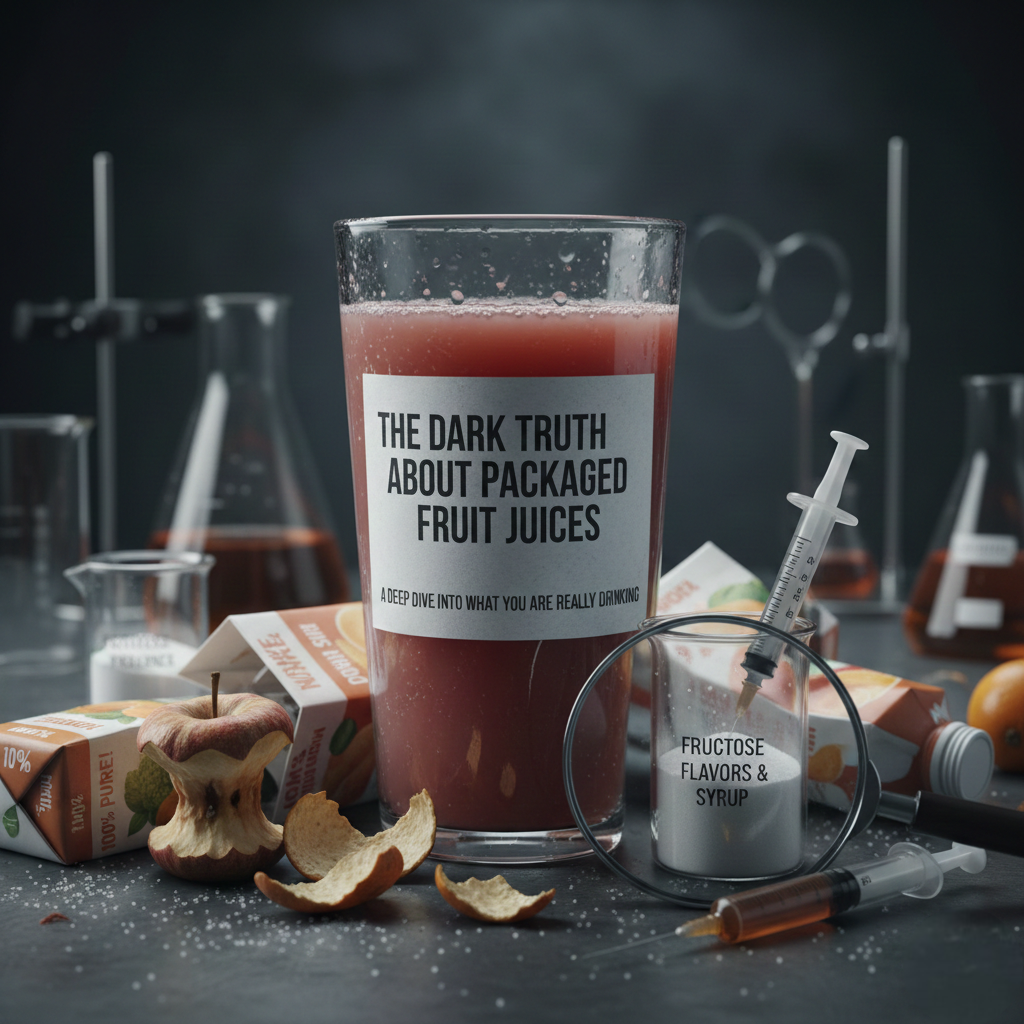
Cold drinks like Pepsi and Coco Cola aren’t good for our health. However, people often suggest fruit juice as a healthy alternative. Companies market these small Tetra Paks as immunity boosters full of minerals and vitamins, specifically targeting children. But how would you feel if I told you that in some aspects, these packaged juices are just as bad for your health as soft drinks? Let’s uncover the truth.

The Paradox: Whole Fruit vs. Fruit Juice
To understand the problem, we must first look at the source: fruits. Are fruits good for us? Absolutely. They are rich in vitamins, minerals, fiber, and antioxidants, which help prevent cancer and heart disease. They also contain flavonoids, a plant pigment shown to improve mood. Research consistently shows that eating fruits reduces the risk of depression and diabetes.
However, when we look at research regarding fruit juices, the picture changes drastically. A meta-analysis covering approximately 200,000 participants revealed that drinking fruit juices actually increases the risk of Type 2 Diabetes. How can a product derived from healthy fruit become a health risk? The answer lies in the history of how we process them.
A History of Preservation and Processing
Humans have consumed fresh juices for millennia. Ayurveda mentions drinking fresh orange juice with rock salt for fatigue and mango juice during the summer. The Old Testament of the Bible distinguishes between wine and fresh grape juice (known in Hebrew as Mishrah), and ancient manuscripts from 150 BC mention pomegranate juice. Even in ancient China and Rome, people used fruit juices to sweeten ice, creating an early form of ice cream.
But in those times, “fruit juice” meant fresh juice. The turning point came in the 1750s with English sailors. To combat Scurvy (a Vitamin C deficiency) on long voyages, the Royal Navy needed to provide lime and lemon juice. The problem was preservation. They discovered that adding rum, water, and sugar preserved the juice—a mixture we know today as the Daiquiri cocktail.
By 1867, Lochlan Rose realized that sugar alone could preserve the juice, leading to the world’s first commercial fruit concentrate. In America, Thomas Welch, a church preacher who opposed alcohol, applied pasteurization (heating to kill bacteria) to grape juice to create non-alcoholic communion wine. This launched the American fruit juice industry, turning Westfield into the “Grape Juice Capital” of the world.
Technology continued to evolve. In the early 1900s, Norman Walker invented the first juicer, and by the 1950s, centrifugal juicers brought extraction into our homes. But the massive shift for the packaged industry occurred in 1963 when the Swedish company Tetra Pak introduced their aseptic packaging. This allowed juices to be stored for months and transported without refrigeration, changing the industry forever.
Deconstructing the Label: What’s Inside the Box?
Let’s look at a typical fruit juice brand sold in India today and analyze its ingredient list.
First, the nutrition claims are often exaggerated. You might see claims about minerals like Sodium, Potassium, Calcium, and Iron. However, a 180ml serving provides only about 1% to 2.5% of your daily requirement. It is insignificant. The only significant nutrient present is Vitamin C, often meeting 75% of the Recommended Dietary Allowance (RDA). But frankly, we aren’t sailors in the 1700s. A single glass of fresh lemonade or half an orange provides 100% of your daily Vitamin C. We do not need a packaged sugary drink for it.
Now, look at the ingredients. The first ingredient is Water. The second is Concentrated Fruit Juice (approx. 10%).
What is “Concentrate”? It is the sticky syrup left behind when companies heat fresh juice to evaporate the water. They do this to save on storage and transportation costs, as the concentrate is lighter and lasts longer. However, this heating process destroys vitamins and enzymes. Worse, it destroys the natural flavor. To fix this, companies add “Natural and Nature-Identical Flavouring Substances” (chemicals) to make it taste like fruit again. They also add colors (like Beta-Carotenes) to make it look fresh, along with stabilizers and acidity regulators.
The Sugar Trap
The most harmful ingredient, however, is sugar.
Shockingly, packaged fruit juice contains roughly 13.5g of sugar per 100ml. It is almost identical to soda. Of this, about 7.5g is added sugar.
The American Heart Association states that children aged 7-10 should have a maximum of 24g of sugar per day. A single small 180ml packet of juice contains over 13g of added sugar—more than half a child’s daily limit. If a child consumes one packet daily, they are setting themselves up for a high risk of diabetes, regardless of the “healthy” marketing claims.
This deception isn’t new. In 2011, a woman named Angelina Lewis sued Tropicana in California for deceptive advertising, arguing that their “100% pure and natural” juice was actually scientifically engineered in labs. While she lost on technical grounds, the reality remains: these products are heavily processed.
The Verdict: Fresh is Best (With Conditions)
So, is the solution to buy a juicer and drink fresh juice at home? Yes, but with caution.
Fresh fruit juice is exponentially better than packaged juice because it has no added sugar or preservatives. However, eating the whole fruit is still superior to drinking it.
1. Fiber Loss: Juicing removes most of the fiber, which is crucial for digestion.
2. Rapid Absorption: Liquid juice is absorbed very quickly by the body, leading to rapid spikes in insulin and blood sugar levels. Over the long term, this can cause issues.
To drink fresh juice safely, follow these rules:
Never on an empty stomach: Drink it with a meal or when you are partially full. This slows down digestion and prevents blood sugar spikes.
Moderation: Limit consumption to about one glass (approx. 237ml) per day.
Try Smoothies: A healthier alternative to juicing is making smoothies. By blending the whole fruit rather than extracting just the liquid, you retain the fiber. You can even add nuts, seeds, or vegetables for added nutrition.
We must stop being swayed by advertisements depicting fruit juices as the ultimate health drink for our children. Packaged juices are essentially colored sugar water with a splash of fruit concentrate, offering little nutritional value while posing significant health risks similar to soft drinks.
My advice is simple: Eat fresh fruits. If you must drink, choose fresh juice in moderation or a smoothie, and keep the packaged Tetra Paks out of your children’s tiffins.
I hope this information empowers you to make better choices for your family’s health.
Read More:
The “Bhedchaal” Mentality: Why 90% of Indian Students Are Chasing the Wrong Dream

I'm a education-driven content creator dedicated to breaking down complex ideas into simple, practical, and easy-to-understand explanations. The website is built with a clear mission: to promote learning, awareness, and education.