
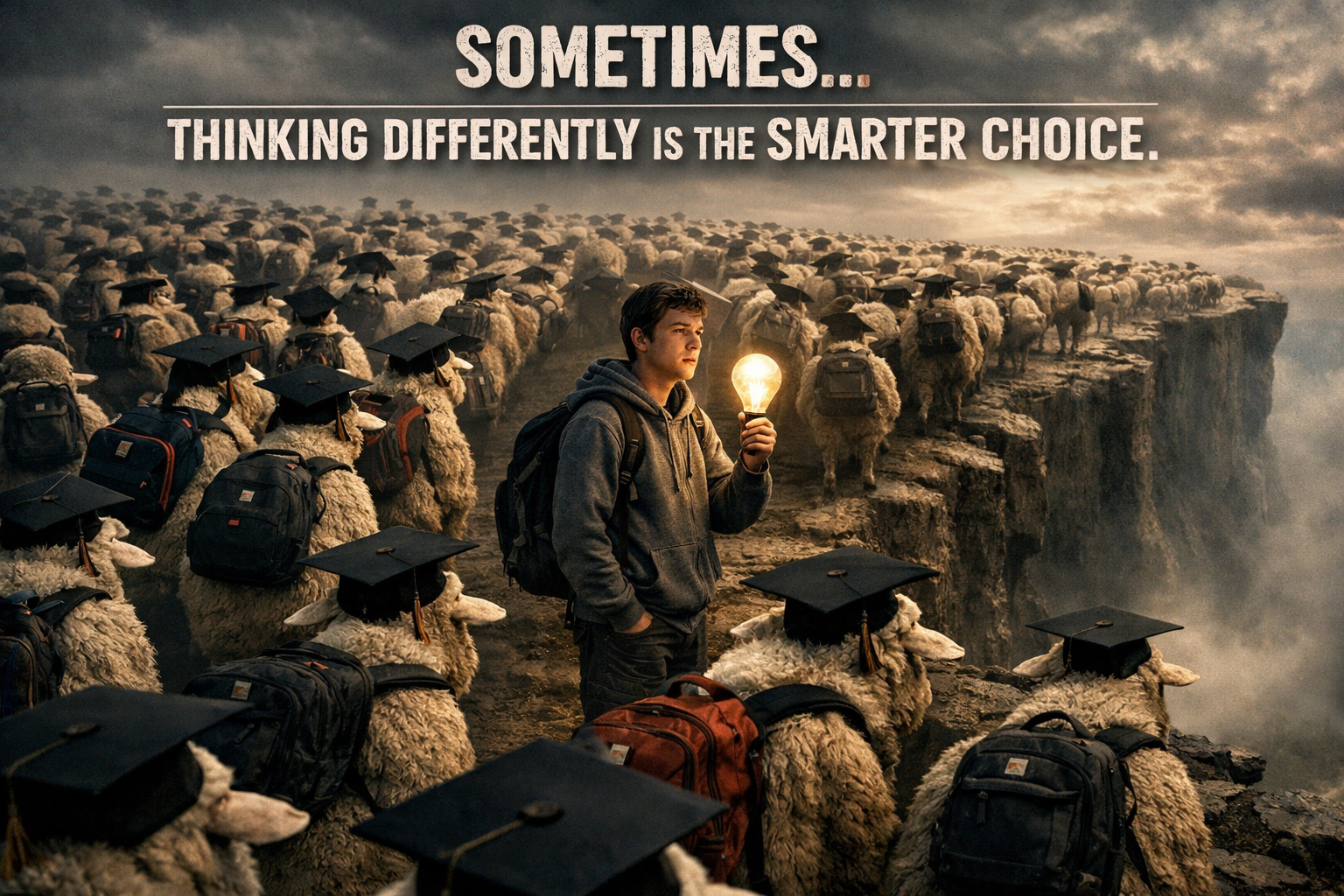
The Indian education system faces a crisis of unemployment and outdated curricula. Mass media and parental pressure trap students in narrow paths like engineering or medicine. Experts urge shifting toward skill-based learning, unconventional careers, and personal branding.
Part 1: The Reality of the Indian Education System
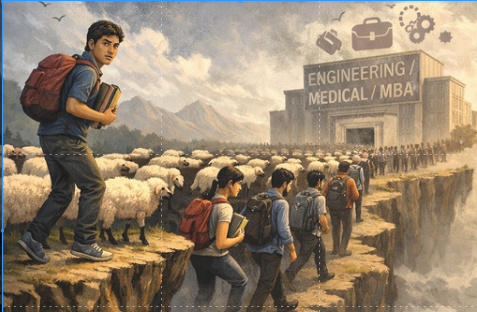
If we look at the ground reality of our education system today, the situation is quite alarming. It feels like we are all running in a blind race, a “bhedchaal,” without knowing where the finish line is. After analyzing all these, one thing is crystal clear: the system we trust to build our future is actually designed to keep us stuck in the past.
1. The Colonial Hangover: We Are Training Clerks, Not Leaders The root cause of our problem is history. Our current education system wasn’t built for our benefit; it was designed by the Britishers, specifically by people like Macaulay in 1835, to serve their own purpose. Back then, they didn’t need leaders or thinkers; they needed clerks and servants who could understand English and follow orders without questioning. Sadly, even after so many years of independence, we are following the same “factory model.” We are taught to memorize, follow instructions, and respect authority blindly, rather than innovate or ask questions. The bells ringing in schools, the uniforms, the strict discipline—it’s all designed to condition us to be obedient employees, not entrepreneurs.
2. The “Engineer-Doctor” Obsession and The Rat Race In every Indian household, the definition of success is limited to four or five options: Engineer, Doctor, MBA, or a Government Job. If you ask a student what they want to be, 90% will give you one of these answers. This herd mentality is created by society and parents who believe these are the only “safe” options. Because of this, millions of students fight for a handful of seats. For example, for government jobs, the ratio is shocking—sometimes 300 people are fighting for just one seat. We are ignoring thousands of other career paths like data science, creative arts, or entrepreneurship because our parents and society think they are “risky”
3. Education is a Business, and You are the Product This is the harshest truth. Schools, colleges, and coaching institutes have turned education into a massive money-making machine. They sell “dreams” and “ranks” to anxious parents. The coaching institutes put up big hoardings of the Top Ranker to attract customers, but they don’t care about the thousands who fail. In this business model, the parent is the customer, and the student is just the “product” used to market the institution. Private colleges take huge donations and fees, yet they don’t prepare students for the real world.
4. The Great Skills Gap: Degree vs. Employability Having a degree in India is becoming just a piece of paper. The most dangerous fact revealed is that having a degree does not mean you are employable. Reports suggest that huge numbers of engineering graduates—up to 80% in some estimates—are not fit for jobs because they lack basic skills. They have rote-learned definitions but can’t write code or communicate effectively. On one hand, we have high unemployment, and on the other, companies are desperate for skilled people but can’t find them. The syllabus is outdated and has no connection to the real world—students are still memorizing dates and formulas that they will never use in real life
5. The Mental Toll: Pressure and Depression This pressure cooker environment is destroying the mental health of our youth. The fear of exams, the pressure from parents to be a “topper,” and the shame of failure are driving students to depression and, in tragic cases, suicide. We are treating students like machines, expecting them to fulfill their parents’ unfulfilled dreams.
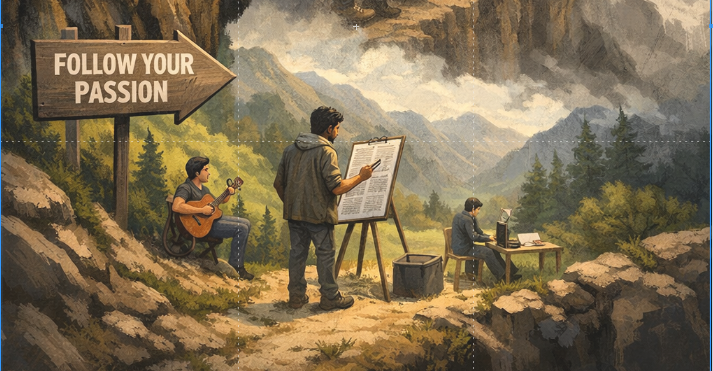
The consensus is that the system is broken. It focuses on rote learning over understanding, marks over skills, and conformity over creativity. To survive this, Indian students need to stop depending on their college degrees to save them. The only way out is to develop “High Income Skills” like coding, sales, and communication on your own, and to have the courage to choose a path different from the crowd.
Part 2
1.The Psychological & Media Angle
A unique psychological breakdown of why we make bad career choices, moving beyond just blaming the schools.
Cognitive Biases in Career Choice: It introduces the concept of the “Ambiguity Effect.” Humans prefer known risks over unknown risks. Students choose government jobs (where the chance of success is a known 1 in 300) over becoming a graphic designer (where success helps are unknown) because the human mind fears ambiguity. It also highlights “Conformity Bias,” which explains that historically, copying the tribe (conformity) saved us from wild animals, but today, copying others (doing Engineering because a cousin did it) is harmful.
The Role of Mass Media: The source argues that our career aspirations are limited because the media doesn’t celebrate diverse professions. It points out that while Indians won prestigious awards like the Ramanujan Prize (Mathematics) or the Pulitzer (Photography), news channels focused on celebrity outfits. Because we don’t see these careers on TV, we don’t aspire to them
Parenting Styles: “authoritative parenting” (strict obedience) actually erodes a child’s confidence and decision-making abilities, making them unable to choose unconventional careers later in life.
2. The Historical & Teacher-Centric Perspective
Diving deeper into the specific colonial tactics and the plight of teachers in the current economy.
Specifics of British Conditioning: It gives a specific example of the school bell. The concept of ringing a bell to switch periods was introduced by the British to train children to follow a schedule and orders reflexively, killing their independent time management.
The Uselessness of Specific Curriculum: It explicitly questions the utility of algebraic equations like (a+b)2=a2+b2+2ab and memorizing historical dates in real life, using these as examples of a disconnected syllabus.
The “Teacher’s Reality”: Unlike blaming teachers-by highlighting their economic reality-teaching, once a noble profession, now pays an average of only ₹20,000–₹25,000, forcing teachers to rely on private tuitions to run their households. It argues that we cannot expect a better system if we don’t pay or respect teachers enough.
The Animal Race Analogy: There is a specific analogy of a race between a horse, a lion, and a monkey to climb a tree. The monkey wins because of ability, not because the exam is fair. This illustrates that standardized exams (like JEE/NEET) are unfair to students who have different “abilities” like the lion or horse.
3: Statistical & Structural Breakdown
Seeing on data, statistics, and government policy failures, gives a more macroeconomic view.
Unemployment Statistics: 65% of Indian youth are jobless, and 83% of the jobless workforce is under the age of 34. Only 54.8% of graduates are actually job-ready according to the India Skill Report 2025
Infrastructure Reality: there is a digital divide- that out of 1.47 million schools, only 65% have computers, and internet is available in only 63%, making “Digital India” difficult to implement in education
Teacher Absenteeism: Unique stat that “ghost teachers,”- states like Jharkhand where teacher absenteeism can be as high as 42%, and nationally around 25% of teachers are absent on any given day.
Macaulay’s Specific Goal: the specific intention of Thomas Babington Macaulay: to create a class of persons who are “Indian in blood and color, but English in taste, in opinions, in morals, and in intellect”.
4: The Economic & Future-Forward Perspective
Focusing on the “Premiumization” of India, the specifics of high-income skills, and a comparison with ancient India.
Ancient vs. Modern Education: The grandeur of Nalanda University 1500 years ago, which had 10,000 students and international diversity, contrasting with Oxford which didn’t allow women until the 1920s. British surveys found a school in every Indian village before they destroyed the system.
Salary Inversion: A unique economic observation is that people in their 20s are currently making more money than people in their 30s because they are adapting to new technologies faster, causing friction in the workplace.
The “Premiumization” of India: India is moving towards a premium economy. The number of people filing income tax over ₹10 Lakhs has grown 2.5 times. This suggests that businesses catering to premium aspirations (better experiences, comfort) will succeed.
Specific High-Income Skills: Five specific “hard skills” for the future: Coding, Marketing (specifically Content Creation), Operations, Sales, and Design. “MERN Stack” and “LLM Engineers” as high-paying niches within coding.
Patience is Key: To build something substantial (like a startup), one needs a 10-year horizon, contradicting the “get rich quick” mentality of today’s youth.
5: The “Escape the Matrix” Perspective
This perspective takes a hard anti-system stance, focusing on the financial stagnation of jobs versus inflation.
Stagnant Salaries vs. Inflation: A shocking economic reality is that the entry-level salary for engineers—approximately ₹3.25 Lakhs—has remained exactly the same for the last 10 years. When you account for inflation over a decade, this means the actual value of a starting salary has crashed, making today’s graduates significantly poorer than those in the past.
The “Customer” Dynamic: The education model operates strictly as a business that creates artificial “scarcity,” such as waiting lists, to increase its perceived value. In this equation, the parents are the actual customers, while the children are merely “products” used to manufacture results (like marks and ranks) which are then used for marketing to attract the next batch of customers.
The Illusion of Success: The idea that getting into premier institutes like IIT or IIM guarantees a happy life is a myth. The reality is that many alumni from these top colleges are depressed, broke, and stuck in the same unfulfilling rat race as everyone else.
Instead of just “upskilling” to find a slightly better job, the only real way out is to stop depending on the system entirely, as it is designed to keep people financially limited. The true escape lies in building independent equity, specifically through Internet Businesses, rather than seeking employment

I'm a education-driven content creator dedicated to breaking down complex ideas into simple, practical, and easy-to-understand explanations. The website is built with a clear mission: to promote learning, awareness, and education.