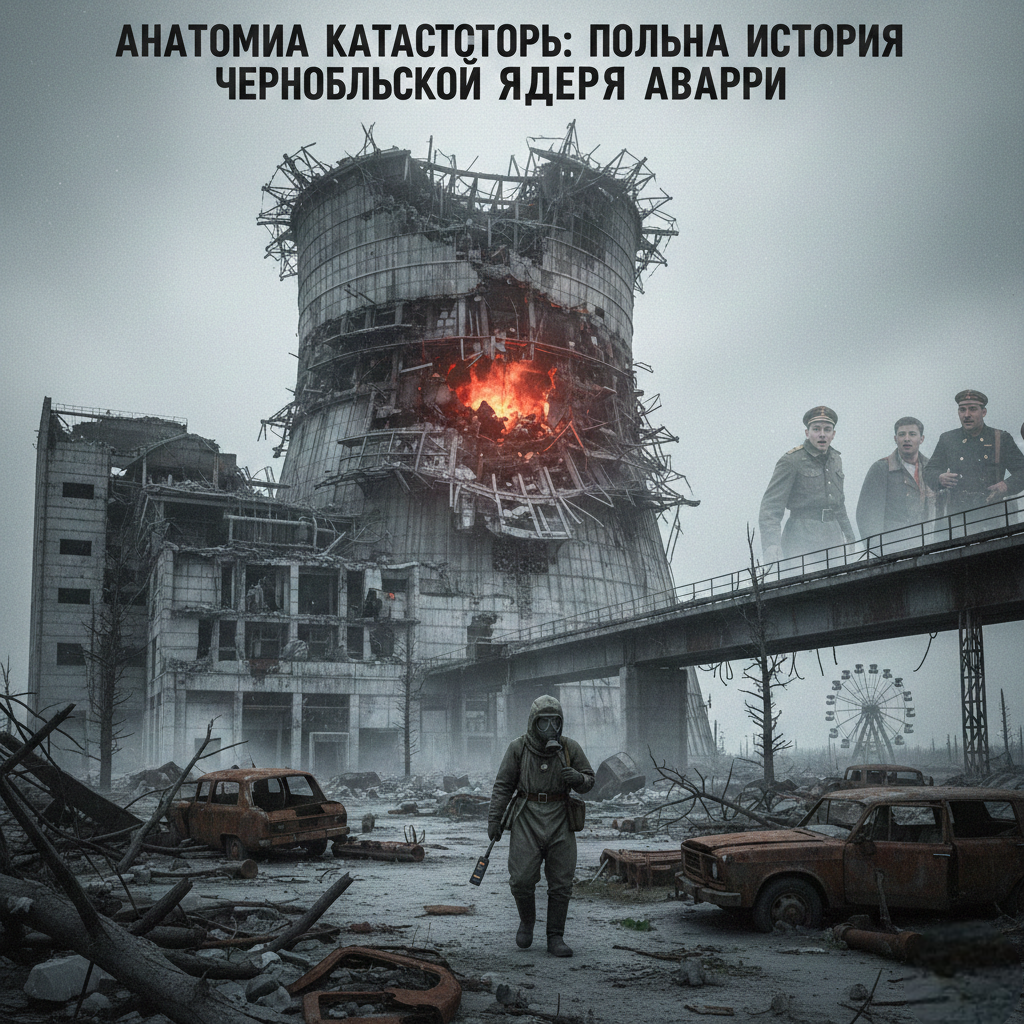
The 1986 Chernobyl nuclear disaster, identifying it as the most catastrophic event of its kind in history. How a routine safety test at Reactor Number 4 triggered a massive explosion due to a combination of human error and critical design flaws in the RBMK reactor. Highlighting the immediate and long-term consequences of the radiation, which caused widespread cancer and rendered the surrounding area uninhabitable for humans. Beyond the technical failures, the Soviet Union’s attempted cover-up and the immense economic and political toll the crisis took on the nation. Finally, how the tragedy led to global safety reforms and transformed the abandoned exclusion zone into a thriving, albeit radioactive, wildlife sanctuary.
On April 26, 1986, at 1:23 AM, a catastrophic event unfolded at Reactor Number 4 of the Chernobyl Nuclear Power Plant in the Soviet Union. What began as a routine safety test quickly spiraled completely out of control, resulting in a massive explosion that released an amount of harmful radioactive material equivalent to 400 Hiroshima atomic bombs. The shockwaves and subsequent radiation affected not just Ukraine, but spread across Europe from Spain to Sweden, even causing radioactive rain to fall in the United Kingdom. To this day, it remains the world’s worst nuclear disaster.
The Pride of the Soviet Union
Following World War II, the Soviet Union heavily invested in nuclear energy, constructing the advanced Chernobyl plant in the early 1970s. Despite its name, the facility was actually located about 16 kilometers away from the city of Chernobyl. It housed four powerful nuclear reactors utilizing the RBMK 1000 design, which came online between 1977 and 1983. These reactors were absolute workhorses; each could generate 1,000 megawatts of electricity, collectively supplying an impressive 10% of Ukraine’s entire energy demand.
Understanding the Science: How the Reactor Worked
To understand exactly what went wrong that night, it is essential to grasp the basics of how a nuclear reactor functions. In simplest terms, most electricity generation—whether hydroelectric, wind, or thermal—relies on spinning a wheel or turbine to create kinetic energy. In a nuclear plant, water is heated to create steam, which then spins the turbines. While a thermal plant uses coal to heat the water, a nuclear plant uses the intense heat generated by nuclear fission reactions.
Inside the RBMK 1000 reactor’s core, three critical components controlled this process:
The Fuel Rods: These were made of Uranium Dioxide enriched with the Uranium-235 isotope. When a neutron collides with a Uranium-235 atom, the atom splits, releasing tremendous heat and more stray neutrons, creating a continuous nuclear chain reaction.
The Control Rods (The Brakes): Made of Boron Carbide, these rods were designed to absorb extra neutrons. By inserting these into the core alongside the fuel rods, operators could slow down the nuclear reaction, acting much like the brakes of a car.
The Moderator (The Accelerator): The Chernobyl reactor used graphite blocks as a moderator. Graphite slows down the energy of the neutrons just enough to increase their chances of colliding with the uranium atoms, effectively speeding up the reaction like stepping on a car’s gas pedal.
Additionally, a constant, uninterrupted supply of water was required to act as a coolant, preventing the incredibly hot reactor from overheating.
The Fateful Safety Test
The disaster occurred during a safety test targeting a specific vulnerability in the plant’s design. In the event of a power cut, the plant’s backup diesel generators took about 1 to 2 minutes to fully power up and start pumping the crucial cooling water. The engineers wanted to know: during that 1-2 minute blackout window, could the residual steam continuing to spin the turbines generate enough temporary electricity to keep the water pumps running?.
This specific test had failed previously on Reactor 4, but the workers hoped for success this time. Initially scheduled for April 25th, the test was delayed, meaning the workers who eventually conducted the test late that night were fatigued and sleep-deprived.
A Deadly Chain of Errors
The test required the operators to lower the reactor’s power output from 1,600 megawatts to 700 megawatts. However, as they inserted the control rods, the power suddenly plummeted far below their expectations, crashing to a mere 30 megawatts. The workers were baffled, but the culprit was a byproduct of the nuclear reaction called Xenon 135. Under normal conditions, Xenon burns away quickly, but because the power was so low, it aggressively accumulated in the core—a condition known as “Xenon poisoning“. Just like Boron, Xenon absorbs neutrons, essentially slamming the brakes on the nuclear reaction.
Seeing the power output drop too low to run their test, shift supervisor Anatoly ordered his team to manually pull out the control rods to accelerate the reaction. By 1:00 AM on April 26, the power only reached 200 megawatts, still short of their 700-megawatt goal. In a desperate move to speed things up further, Anatoly ordered nearly all the control rods removed. Out of 211 control rods, only 8 were left inside the reactor. This was a flagrant violation of safety protocols, which strictly mandated that no fewer than 15 control rods should ever be in the reactor under any circumstances.
The Point of No Return
Because the control rods were abruptly pulled out, the reaction violently spiked at 1:19 AM. The rapid surge in heat instantly boiled whatever little cooling water was left in the core, turning it into steam.
This created a catastrophic “positive feedback loop“. In the RBMK reactor, less liquid water meant less cooling, but the graphite moderator was still present. As the reaction sped up, it burned off the neutron-absorbing Xenon, causing the reaction to accelerate even faster. The water aggressively boiled into steam, causing a massive power surge that violently shook the massive lid of the containment structure and sent shockwaves through the building.
The Blast Realizing the reactor was completely out of control, panicked workers hit the Emergency Stop button at 1:23 AM. This mechanism was designed to plunge all the control rods back into the core to kill the reaction.
However, there was a fatal design flaw in the RBMK reactor: while the main body of the control rods was made of neutron-absorbing Boron, the very tips of the rods were made of reaction-accelerating graphite. As the emergency button was pressed, the graphite tips entered the core first. Instead of acting like brakes, the graphite infinitely accelerated the already runaway reaction, causing the power output to skyrocket to an unimaginable 33,000 megawatts.
Just 6 to 8 seconds after the button was pressed, a massive blast melted the reactor core. Two to three seconds later, a second, incredibly powerful explosion blew the 1,000-tonne lid completely off the structure. The graphite inside combusted, and the blast instantly killed two workers, spewing more than 100 radioactive elements and 5% of the reactor’s 192 tonnes of Uranium fuel straight into the open atmosphere.
The Immediate Aftermath and The Heroes of Chernobyl
At 1:26 AM, fire alarms rang out. First responders arrived assuming they were fighting a standard fire and tried to extinguish it with water. They had no idea they were dealing with a burning, highly radioactive exposed graphite core. The deadly fire raged for over 10 days. To stop it, helicopters were forced to fly directly over the open reactor—a highly dangerous mission that led to one helicopter crashing, killing four crew members—to drop thousands of tonnes of sand, clay, lead, and boron onto the flames to smother the radiation.
Tragically, the brave firefighters suffered immense radiation sickness, experiencing severe fatigue and nausea; 28 of them died within just a few months, while others passed away from cancer over the following years.
Even after the flames were out, an apocalyptic threat loomed. The reactor was still producing immense heat, melting its own cracked base. Directly beneath it sat a massive tank filled with radioactive water. If the melting core touched this water, the instant vaporization into steam within a confined space would trigger a third explosion far larger than the first two. Experts believed this secondary blast would have spread enough radioactive material to make the entire European continent uninhabitable for 500,000 years, potentially killing millions.
To avert this, three real-life heroes—Boris, Alexei, and Valeri—volunteered for a suicide mission. On May 4, 1986, wearing simple diving gear, they waded into the pitch-black, highly radioactive water tank guided by a single lamp. They successfully located and opened the valves, draining the water and saving Europe. Miraculously, all three survived the immediate dive, with Alexei and Valeri still alive today (Boris passed away in 2005 from a heart attack).
The Cover-up, The Cleanup, and The Human Cost
As the Cold War was ongoing, the Soviet government initially tried to cover up the entire incident. However, the radioactive dust had traveled thousands of miles. Swedish monitoring stations detected unreasonably high radiation levels, analyzed wind patterns, and traced the source back to the USSR. Forced by this irrefutable evidence, the Soviet Union finally admitted to the disaster on April 28th, two days after the explosion. The delayed evacuation of nearby residents remains one of the greatest criticisms of the Soviet government.
By May 2nd, a strict 30-kilometer exclusion zone was established around the plant, restricting access to all but scientists and officials. Between 1986 and 1987, the government dispatched 200,000 “liquidators” to manually clean up the highly dangerous radioactive waste after remote-controlled robots broke down due to the intense radiation.
The human and environmental toll was staggering. The radioactive dust settled on pastures across the region, contaminating the grass consumed by local cows. The resulting high levels of radioactive Iodine 131 in cow’s milk were consumed by children, directly leading to an estimated 20,000 cases of childhood thyroid cancer, as reported by the UN in 2018. Even the surrounding pine forests absorbed so much radiation that the trees turned a sickly ginger hue, earning the area the nickname “The Red Forest”.
Financially, the disaster crippled the Soviet Union. The cost of emergency responses, evacuations, decontamination, and survivor compensation amounted to an estimated $235 billion. Many historians point to this immense financial and political burden as a major catalyst for the eventual collapse of the Soviet Union.
Containment and Legacy
To contain the exposed core, a massive concrete and metal “Sarcophagus” was hastily built over Reactor 4 by November 1986. When this structure began rusting and cracking decades later, a new $3 billion, state-of-the-art “New Safe Confinement” structure was built over the site between 2010 and 2019, designed to safely seal the reactor for the next 100 years.
The disaster forced the global scientific community to drastically overhaul nuclear safety. In 1989, the World Association of Nuclear Operators was founded to conduct international safety checks. Crucially, modern nuclear reactors now use water as both a coolant and a moderator. This ensures a “negative feedback loop”—if the water boils away or is lost, the moderator is also lost, acting as an automatic brake to stop the nuclear reaction entirely.
Despite the profound contamination, the remaining undamaged reactors at the Chernobyl plant surprisingly continued to operate to meet Ukraine’s power needs until the year 2000. Today, the facility is undergoing a prolonged dismantling process expected to conclude by 2028. Approximately 2,400 people—including guards, scientists, and technicians—still work at the plant, though they are restricted to just two heavily monitored shifts per week to limit their radiation exposure.
Meanwhile, the 30-kilometer exclusion zone remains completely abandoned by human society. In our absence, nature has rapidly reclaimed the land. Thriving populations of wolves, deer, lynx, beavers, boars, eagles, and bears—some of which are endangered—now roam the territory. While scientists have documented some animal deformities due to the lingering radiation, for the most part, the wildlife in the zone is flourishing, a haunting yet beautiful silver lining to the world’s most devastating nuclear disaster.

I'm a education-driven content creator dedicated to breaking down complex ideas into simple, practical, and easy-to-understand explanations. The website is built with a clear mission: to promote learning, awareness, and education.