
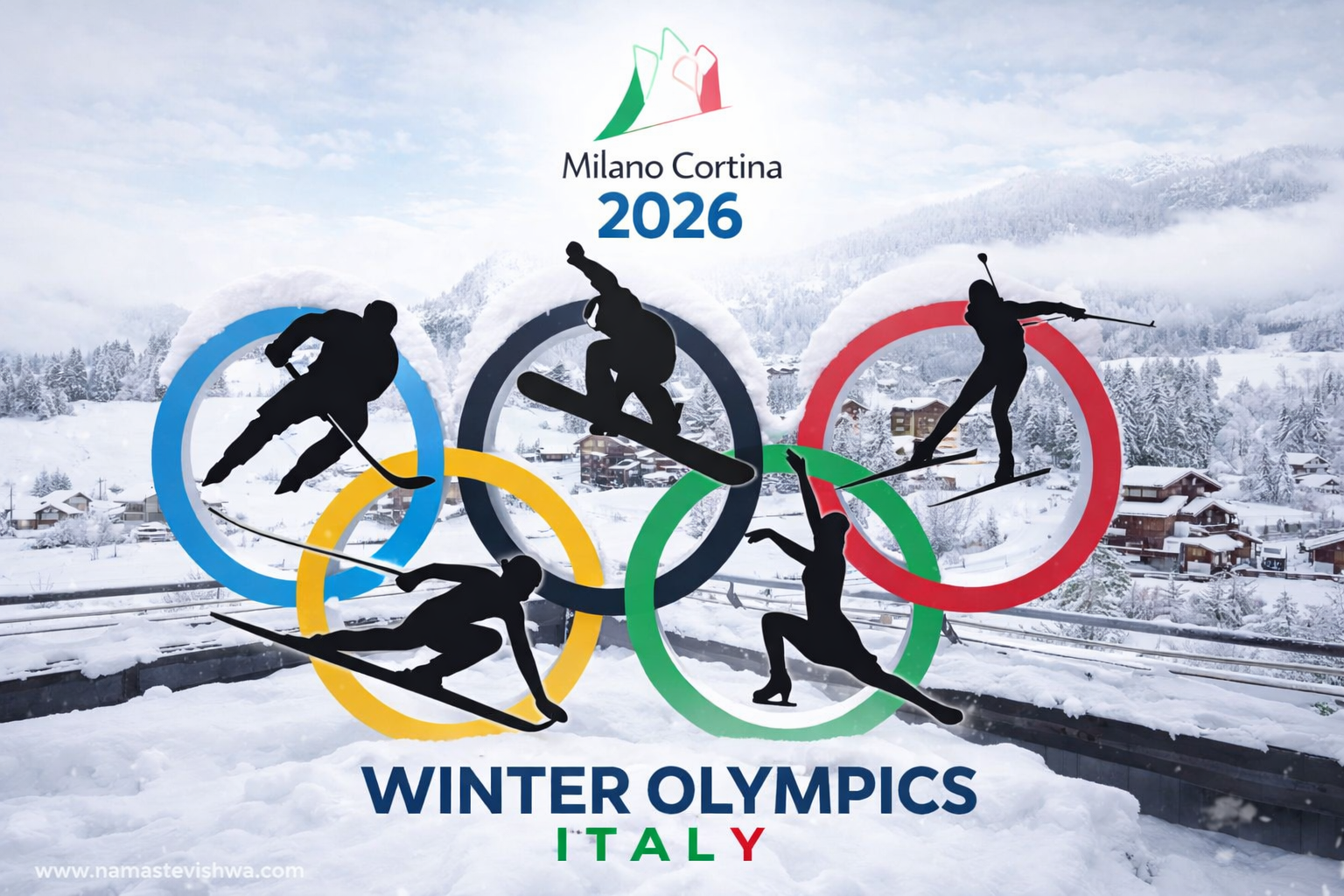
With the 25th edition of the Winter Olympics set to begin on February 6th in the Italian cities of Milan and Cortina, final preparations are in full swing. As the country gears up to host this international showpiece, the events are marked by a blend of logistical planning, political discourse, and a significant spiritual dimension highlighted by the arrival of the Olympic Cross.
The Winter Olympics is the premier global competition for sports played on ice and snow, held every four years.
Where & When-The 2026 Games, known as Milano Cortina 2026, are currently taking place in Northern Italy:
- Dates: February 6 – 22, 2026 (Preliminary events started February 4).
- Host Cities: Co-hosted by Milan and Cortina d’Ampezzo, with events across 15 different venues.
- Opening Ceremony: Friday, February 6 at the Stadio San Siro in Milan.
Sports Included-The 2026 program features 16 disciplines across 8 major sport categories:
| Category | Specific Disciplines |
|---|---|
| Skiing | Alpine, Cross-Country, Freestyle, Ski Jumping, Nordic Combined |
| Skating | Figure Skating, Speed Skating, Short Track Speed Skating |
| Sledding | Bobsleigh, Luge, Skeleton |
| Ice Sports | Ice Hockey, Curling |
| Snow | Snowboarding, Ski Mountaineering (New for 2026) |
| Combined | Biathlon (Skiing + Shooting) |
The 2026 Winter Olympics in Milan and Cortina focus on unity and sustainability. Pope Leo XIV sent an Olympic cross to promote peace and fairness. While Italy uses existing infrastructure, the UN calls for an Olympic truce despite ongoing global conflicts.
The Arrival of the Olympic Cross
In the lead-up to the opening ceremony, the Olympic Cross arrived in Milan, traveling from the Vatican to the city set to host the games. This specific cross has a storied history, having accompanied athletes at major international events since the London 2012 Games, including the Rio 2016 Olympics, the Paris 2024 Olympics, and various World Youth Days.
Constructed as a symbol of unity, the cross is made of wood sourced from 15 different countries, includingAustralia, Brazil, China, Russia, Argentina, and the Holy Land. Its arrival in Milan was marked by a procession where teams of local young athletes accompanied it into the Basilica of San Babila. This Basilica, chosen for its accessible location in the heart of Milan, will serve as a spiritual hub during the games. The doors of San Babila will remain open to athletes, staff, and tourists who wish to visit or pray, with chaplains specifically dedicated to accompanying those involved in the training and running of the competitions.
A Message from the Vatican
On the occasion of the cross’s arrival, a special message was delivered on behalf of Pope Leo by Vatican Secretary of State Cardinal Proin. The Pope expressed his deep appreciation for the enthusiastic cooperation involved in the sports event and extended his best wishes to the people of the Vicariat of Boro.
In his message, the Pope voiced hope that the Olympics would serve as a favorable occasion to promote authentic values such as fairness, respect, team spirit, and sacrifice, alongside social inclusion and the joy of meeting others. He encouraged local parish communities to embrace the event with open arms, hoping that healthy competition will build bridges between cultures and promote solidarity and peace. The Archbishop of Milan noted that these words demonstrate the Holy See’s attention to the Milano-Cortina games and the tradition of integrating ecclesial sensitivity with the practice of sport.
Infrastructure and Final Preparations
While the local church transforms into a “church of athletes,” the organizers are focused on the logistics of the event. The 2026 Games utilize a new, regionally distributed model designed to maximize sustainability; consequently, 85% of the competition venues already exist. This includes the resort town of Cortina, which previously hosted the Winter Olympics in 1956.
The Olympic Village has opened its doors, and the venues are described as blending history, culture, and passion—a trademark of Italian hosting. The games will welcome more than 3,500 athletes from 93 countries who will compete for 195 medals across 16 Olympic disciplines. Following the Olympics, the Paralympics are scheduled to be held from March 6th to the 15th.
Security and Geopolitics
The preparations have not been without controversy. There has been a fierce backlash in Italy regarding the involvement of U.S. ICE agents for the event, although the U.S. government has stated this is standard practice.
Furthermore, the games take place against a backdrop of global conflict. The United Nations and the International Olympic Committee (IOC) have called for a 52-day pause in all wars worldwide, known as the “Olympic Truce”. This tradition dates back to ancient Greece, where city-states would lay down arms before and during the games. While the UN General Assembly backs this resolution unanimously, it has rarely been followed in the past, and observers note it is unlikely to have a concrete effect in the current polarized world. Despite the diplomatic challenges, organizers and the faithful alike hope to celebrate the human spirit and the meaningful purpose of life amidst the spectacle of the mountains and snow.
The atmosphere in Milan reflects this anticipation. More than 200 people, including children in uniform, coaches, and family members, gathered at the Basilica of San Babila to mark the beginning of the Milano-Cortina Winter Olympic Games, celebrating a moment where the eyes of the world will be focused on Italy.
MORE READ
The Ultimate Guide to Earthquakes: Causes, Waves

I'm a education-driven content creator dedicated to breaking down complex ideas into simple, practical, and easy-to-understand explanations. The website is built with a clear mission: to promote learning, awareness, and education.