
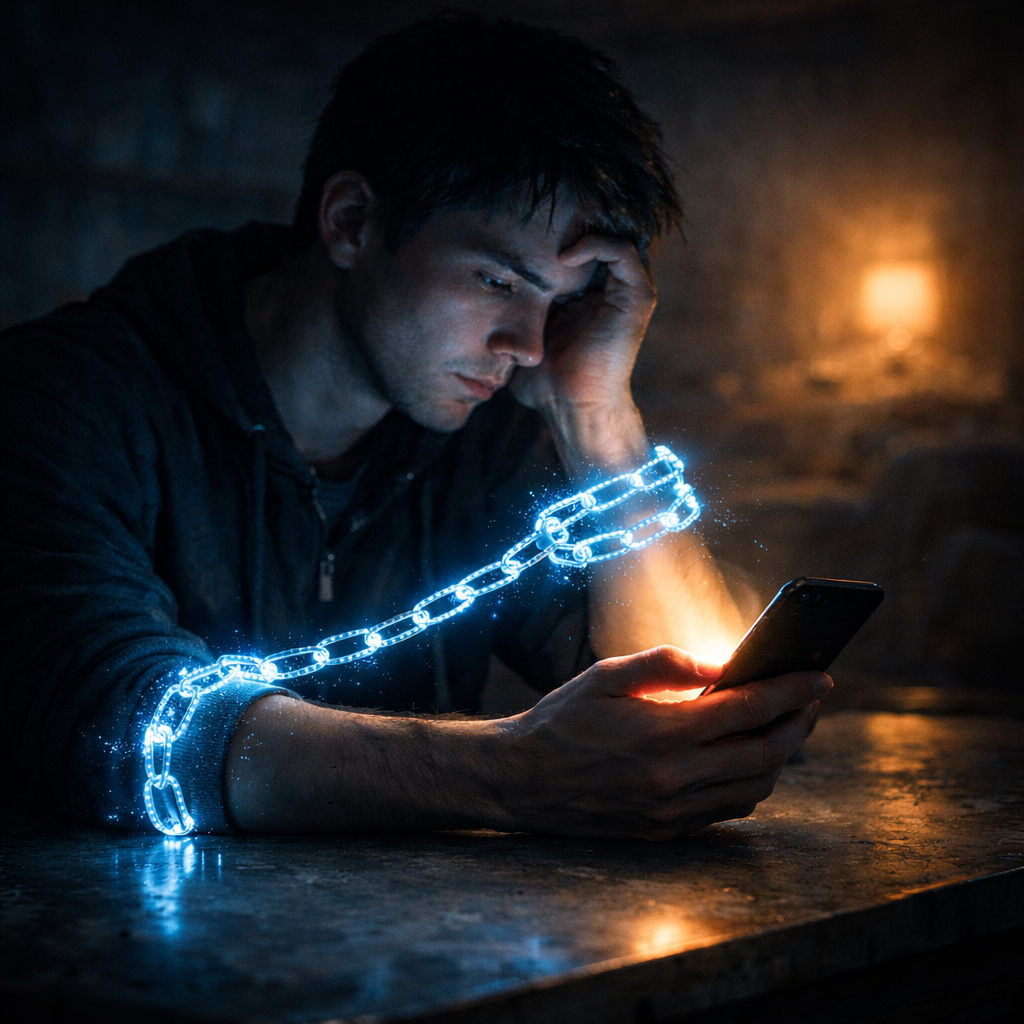
Mobile phone addiction is a growing epidemic altering children’s brain chemistry. Excessive screen time causes developmental delays, virtual autism, obesity, and myopia. Parents must model healthy habits, enforce zero screen time for toddlers, and foster real-world connections.
The impact of the small mobile phone in your pocket is far more severe than most of us realize. It is literally changing the brain chemistry of millions of children. I have seen cases where a 3-year-old refuses to eat until his mother plays cartoons on a phone, and terrifying instances where a 5-year-old couldn’t speak properly because his parents, busy all day, left him to watch TV.
The lack of critical social interaction is causing developmental delays, virtual autism, obesity, and myopia.
Today, we are facing a reality where children spend less time outdoors than prisoners. Just as adults use alcohol or cigarettes to escape reality, children are using screens for relief, and the result is a generation that has been hypnotized
The Collapse of the Family Connection
To understand the gravity of this, let’s look back at an Indian middle-class family in the 1990s. It is evening; the father reads a newspaper, the mother talks about her day, the 10-year-old asks for homework help, and the toddler plays with toy cars on the floor. Everyone is physically and mentally present, building a connection.
Now, imagine that same family in 2025. The father scrolls the news on his phone, the mother watches a show on an OTT platform, the daughter is checking Instagram in a corner, and the toddler is glued to YouTube Shorts on a tablet. Physically, they are in one room. Mentally, they are lost in separate digital worlds. There are no sounds, no conversations, only the blue light of screens falling on their faces. Behind this seemingly harmless scene lie dangerous consequences that few are talking about.
The Shocking Statistics
In October 2024, a survey of over 70,000 parents in urban India revealed that more than 66% reported their children were addicted to social media or online games. Even more alarming, 58% of parents noted that this addiction led to increased aggression and impatience.
The World Health Organization (WHO) is clear: screen time for children under 2 years should be zero, and for toddlers aged 2-4, it should be a maximum of one hour. However, an analysis by AIIMS Raipur shows the reality is starkly different. In India, children under 2 average 1.2 hours of screen time, and those under 5 average 2.2 hours.
A Warning Through Stories: Mohak’s Descent
I used to think giving a child a phone for an hour or two wouldn’t make a difference. Let me share the story of Mohak , a 9-year-old from Surat.
When Mohak was one, his busy parents gave him a smartphone to keep him quiet. It seemed like a convenient solution. But gradually, he refused to eat without the phone. When he turned four, his parents gave him his own device to keep him inside, fearing he would mix with the “wrong” children outside.
The consequences were physical and mental. First, his eyesight weakened, requiring glasses. Then came the headaches. By the time a doctor ordered a screen detox, Mohak’s addiction was so severe that taking the phone away caused him to throw tantrums and hit his head against the wall, behaving exactly like a drug addict. Aarav is not an isolated case; thousands of videos online show children screaming and throwing tantrums when denied screens.
The Physical Toll: Eyes, Sleep, and Obesity
The Myopia Epidemic: Because children are stuck to screens, their exposure to natural daylight decreases, drastically increasing the risk of Myopia (nearsightedness). The Association of Community Ophthalmologists of India predicts that if this trend continues, half of the children in India will need glasses by 2050.
Sleep Disorders: Screens are destroying sleep cycles. A review of 67 studies on children aged 5-17 found that increased screen time directly correlates with decreased sleep duration. A study from Finland on children aged 3-6 showed that every hour of screen time reduced sleep by 10 minutes.
This happens because the blue light from devices suppresses Melatonin, the hormone that tells our body it is time to sleep. Children are twice as sensitive to this suppression as adults. The result is sleep deprivation, which impacts learning, school performance, and psychological health. I have even seen videos of children “scrolling” in their sleep—a terrifying sign of deep addiction.
Obesity and Digestion: With American children spending less time outdoors than prisoners, and UK surveys showing 23% of kids believe video games count as exercise, obesity is rising. Furthermore, eating while distracted by screens causes people to consume more calories.
A survey in major Indian cities found that over 80% of mothers let children watch TV while feeding them to ensure peace. However, this causes children to hold food in their mouths longer without chewing properly, leading to cavities and digestion issues.
The Brain: Structural Changes and Mental Health
Screen time literally alters brain structure. It impairs the “executive functioning skills” that develop in early childhood—skills responsible for emotional control, social interaction, and motivation. A study in JAMA Pediatrics found that high screen time in infancy leads to proportionately poor executive functioning by age nine.
It also changes the Parietal Lobe, which processes sensory information like touch and pain. This was demonstrated in a heart-wrenching experiment where a mother pretended to collapse coughing. Her children, hypnotized by the TV, ignored her completely. Only one child out of three eventually brought water; the others didn’t even look away from the screen.
The Anxiety Spiral: For older children (around 10 years old), higher screen time is linked to anxiety and depression. When these children face emotional struggles, they use screens to escape, creating a downward spiral. They don’t learn to cope with real-life problems through human connection, leading to deeper depression and loneliness.
The Developmental Crisis: Speech and Motor Skills
One of the most horrifying impacts is on speech and motor development. I encountered a case in Jammu where a girl named Priya, who could say “mumma” and “papa” at age two, stopped developing speech entirely due to excessive screen exposure. By age five, even after therapy, she couldn’t form complete sentences.
Parenting coach shared a case of a 3-year-old who wouldn’t speak because he spent 90% of his time watching Tom & Jerry. Since the characters are mute and communicate through action, the child mimicked this, assuming that is how the world works.
Why Screens Fail Language Learning: Children are social learners. They learn to talk through two-way interaction and by studying lip movements. Screens fail at both. They offer only one-way interaction, and because they are two-dimensional (or show cartoons with unrealistic mouth movements), children cannot gauge how to form words. A child needs encouragement and reaction from a parent to learn; a phone cannot provide that.
Research on 7,000 children showed that if a 1-year-old gets 1 to 4 hours of screen time, their communication and problem-solving skills are delayed by three times by age two. If screen time exceeds 4 hours, the delay is nearly five times.
ADHD and Virtual Autism: We are also seeing cases like who began mimicking cartoon voices but eventually developed severe ADHD symptoms—inability to focus or sit still—due to screen overstimulation. There is even a phenomenon called “Virtual Autism,” where excessive screen time causes autism-like symptoms: social withdrawal, speech delays, and lack of eye contact.
The Mechanism of Addiction: The Dopamine Trap
Screen addiction works exactly like drug addiction. Video games and engaging content release dopamine, activating the brain’s reward system. Over time, the brain experiences “reduced reward sensitivity,” meaning the child needs even more screen time to feel the same pleasure.
Consider the tragic case of 12-year-old Sunil . During the pandemic, he moved from studying on a tablet to gaming and social media. He stopped talking to his family, stopped eating properly (leading to malnutrition and low hemoglobin), and fell into depression. In another instance, a 10th-grade student stole ₹15,000 from his mother to buy a phone because of peer pressure.
The CoComelon Effect: Shows like CoComelon may look harmless, teaching numbers and colors, but they are scientifically engineered to be addictive. They use hyper-saturated colors and rapid scene changes (every 2-3 seconds). There is constant motion; even when characters stand still, they vibrate slightly to hold attention. This overstimulation decreases a child’s attention span, making real life—which is slow and “boring”—unbearable. Parents report their kids behaving like “zombies” or showing withdrawal symptoms after watching such content.
The Solution: What Parents Must Do
The solution is simple, but difficult to implement.
1. Strict Age Limits: Keep children under the age of 2 away from screens under all circumstances. I would go further and suggest no screens until age 5. I will not allow my own child to watch my YouTube videos until he is 5. You are trading your child’s health for convenience, a cost you will pay later.
2. Understand the Void: Children aren’t just addicted to the screen; they are addicted to what it gives them: attention, validation, and entertainment. When they don’t get this connection in the real world, they turn to the device. The screen becomes their best friend because it does what they want.
3. Don’t Blame, Collaborate: If your child is addicted, do not shout or judge. Blaming them only increases the emotional void, driving them back to the screen. You must be on the same side as your child, fighting the screen together.
4. Educate the Family: Often, grandparents or relatives undermine rules by giving kids phones. Share this information with them so they understand the danger.
5. The Most Important Rule: Model Behavior: You cannot tell a child to get off a phone if you are glued to one. Parents who use phones in front of their children have kids with higher screen time. Children learn from action, not words. You must stay away from screens when you are with them.
6. Creative Alternatives & Zones: For children over 5, set strict limits and prioritize educational content. Engage them in 3 hours of physical activity daily. Replace screens with singing, building blocks, puzzles, or board games. However, remember: they won’t be interested unless you play with them.
Create “screen-free zones” in your house, such as the bedroom and dining room. No one—parents or children—should use devices in these areas.
This is a crisis of our time. We must understand child psychology and take control before the damage is irreversible.
Read More:
How to Save Your Eyes Naturally: Understanding the Myopia Epidemic

I'm a education-driven content creator dedicated to breaking down complex ideas into simple, practical, and easy-to-understand explanations. The website is built with a clear mission: to promote learning, awareness, and education.