
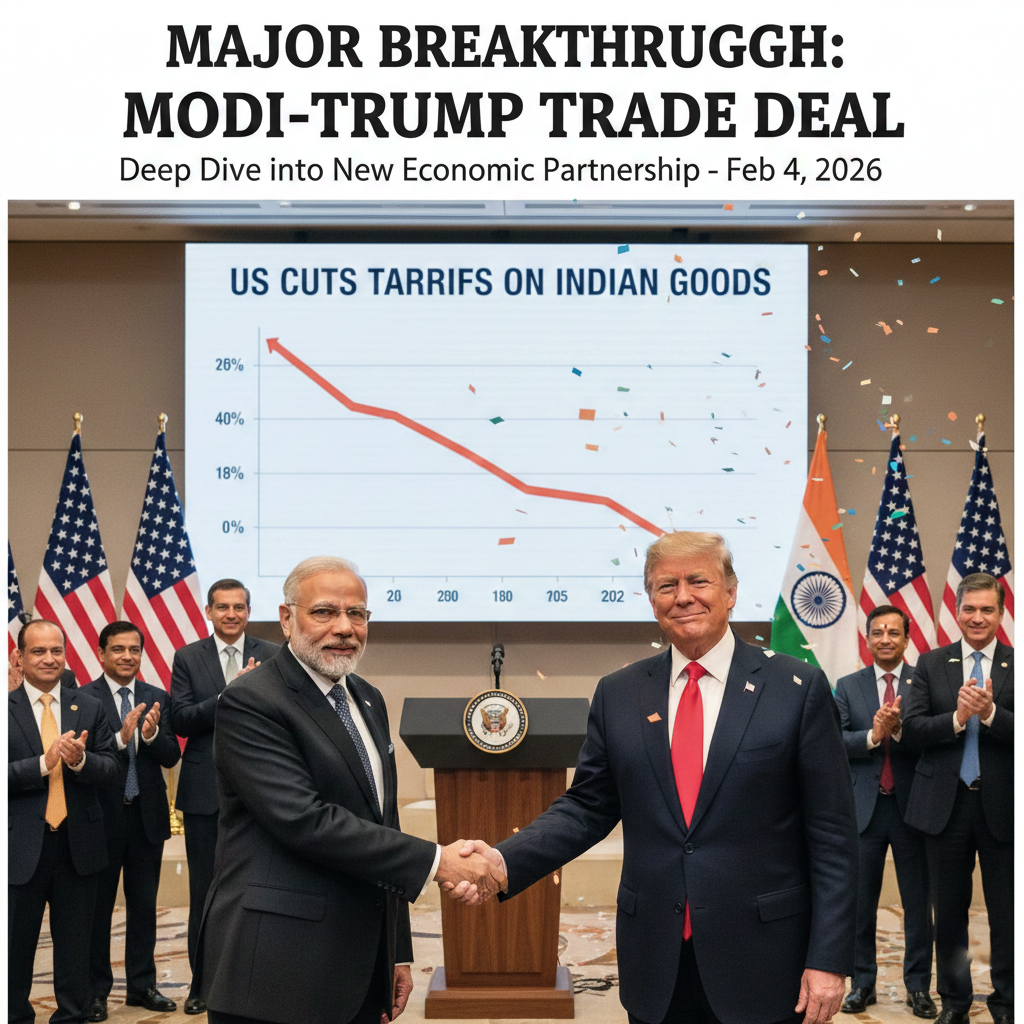
The US and India announced a major trade deal, slashing tariffs on Indian goods from 50% to 18%. This follows India’s recent pact with the EU. While the US claims India will halt Russian oil imports and remove import duties, India focuses on boosting exports and global ties.
In a significant development for global trade, the United States has announced a major reduction in tariffs on Indian goods, dropping the rate from 50% to 18%. This announcement follows a recent trade agreement between India and the European Union, a move that likely accelerated the timeline for a deal with the Trump administration to prevent American economic losses.
Here is a detailed breakdown of the deal, the geopolitical strategy behind it, and its impact on the Indian economy.
The Announcement: A sudden Diplomatic Shift
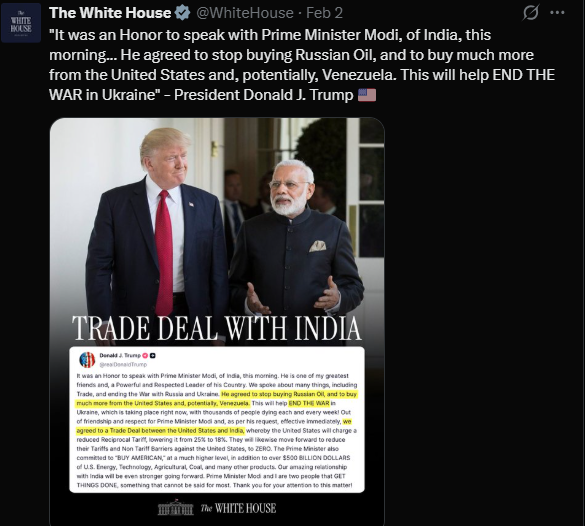
Late last night, Former US President Donald Trump announced via social media that a consensus had been reached regarding a bilateral trade deal between India and the United States. This development came after a telephonic conversation with Prime Minister Narendra Modi.
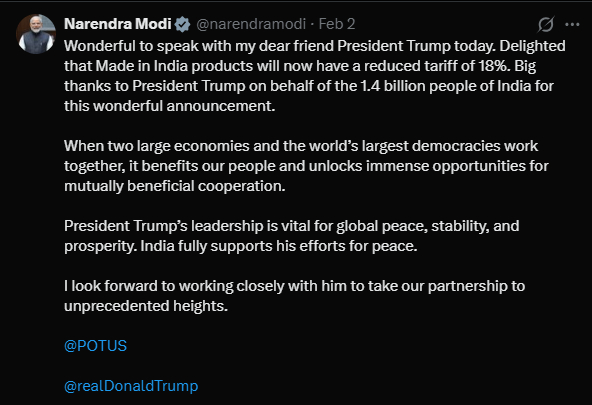
Prime Minister Modi confirmed the development via a tweet at 11:02 PM, stating it was wonderful to speak with his “dear friend” Trump. He expressed delight that “Made in India” products will now face a reduced tariff of 18%, down from the previous 50%. PM Modi thanked Trump on behalf of 1.4 billion Indians, emphasizing that cooperation between the world’s two largest democracies will open new opportunities and be mutually beneficial.
Deconstructing the Tariffs: From 50% to 18%
To understand the significance of this cut, it is essential to understand the composition of the previous 50% tariff imposed by the US:
1. Reciprocal Tariff (25%): Trump had imposed this flat rate, arguing that India charged too much on American goods. Under the new deal, this component is being reduced to 18% on an immediate basis.
2. Russian Oil Penalty (25%): The remaining 25% was an additional tariff imposed because India continued to purchase oil from Russia. According to Trump, this penalty will be completely removed.
Key Conditions and Claims
While the tariff reduction is confirmed, Donald Trump mentioned several conditions and pledges in his statement, some of which have not yet been officially confirmed by the Indian government:
• Russian Oil: Trump claims that India has agreed to stop buying oil from Russia. He stated that India will instead purchase oil from the United States and Venezuela. However, experts analyze that India is unlikely to completely sever ties with Russia, a trusted partner, merely to satisfy the unpredictable nature of US policy. It is possible India may reduce imports, but a full stop is doubtful.
• $500 Billion Pledge: Trump stated that India pledged to purchase $500 billion worth of US goods, including energy, technology, agriculture, and machinery.
• Zero Tariffs on US Goods: Trump claimed that India would remove tariff and non-tariff barriers, effectively placing zero tariffs on most American goods. However, historically, India has fiercely protected its agriculture and dairy sectors. Despite Trump’s claims, it is highly probable that India has retained protections for these sensitive industries.
The Strategic Context: Why Now?
The timing of this deal is crucial. Relations between India and the US had been deteriorating in 2025, largely due to India’s purchase of Russian oil. The US had imposed the highest tariffs in the world on India and Brazil (50%), which was even higher than tariffs on China.
The turning point was the India-European Union trade deal. Trump had hoped Europe would join the US in imposing tariffs on India. Instead, the EU acted in its own economic interest and signed a deal with India. This infuriated the Trump administration, leading them to accuse Europe of “funding a war against itself”.
Realizing that Indian exports would simply divert to Europe, causing a loss for the US, the Trump administration shifted its approach. Direct talks began between PM Modi and Trump, resulting in this swift agreement.
Impact on the Indian Economy
This deal is poised to provide a massive competitive edge to Indian exporters:
1. Competitive Advantage: India’s position is now stronger than its competitors in the American market. While India faces an 18% tariff, competitors face higher rates: Vietnam (20%), and Indonesia and Cambodia (19%).
2. Sectoral Boost: Sectors such as Gems and Jewelry, Textiles, Leather Goods, and Machinery will become cheaper and more competitive in the US market.
3. Investment Surge: The deal is expected to attract significant Foreign Direct Investment (FDI). Investors who were withdrawing from the market are likely to return, and stock market indices like the GIFT Nifty are expected to see a significant rise.
4. Export Focus: This aligns with the Indian government’s recent budget theme, which focuses heavily on boosting exports. With this deal, India has now successfully negotiated trade agreements with nine major entities in the last five years, including the EU and now the US.
While the headline tariff cut to 18% is a major victory for Indian diplomacy, the finer details regarding India’s concessions—particularly regarding Russian oil and agricultural market access—remain to be fully clarified. Nonetheless, this deal signifies a restoration of trust and a strengthening of the partnership between the two nations, moving past the friction of the previous year
Read More:
Escalating Violence in Balochistan: Over 200 Killed in Massive Coordinated Attacks

I'm a education-driven content creator dedicated to breaking down complex ideas into simple, practical, and easy-to-understand explanations. The website is built with a clear mission: to promote learning, awareness, and education.