
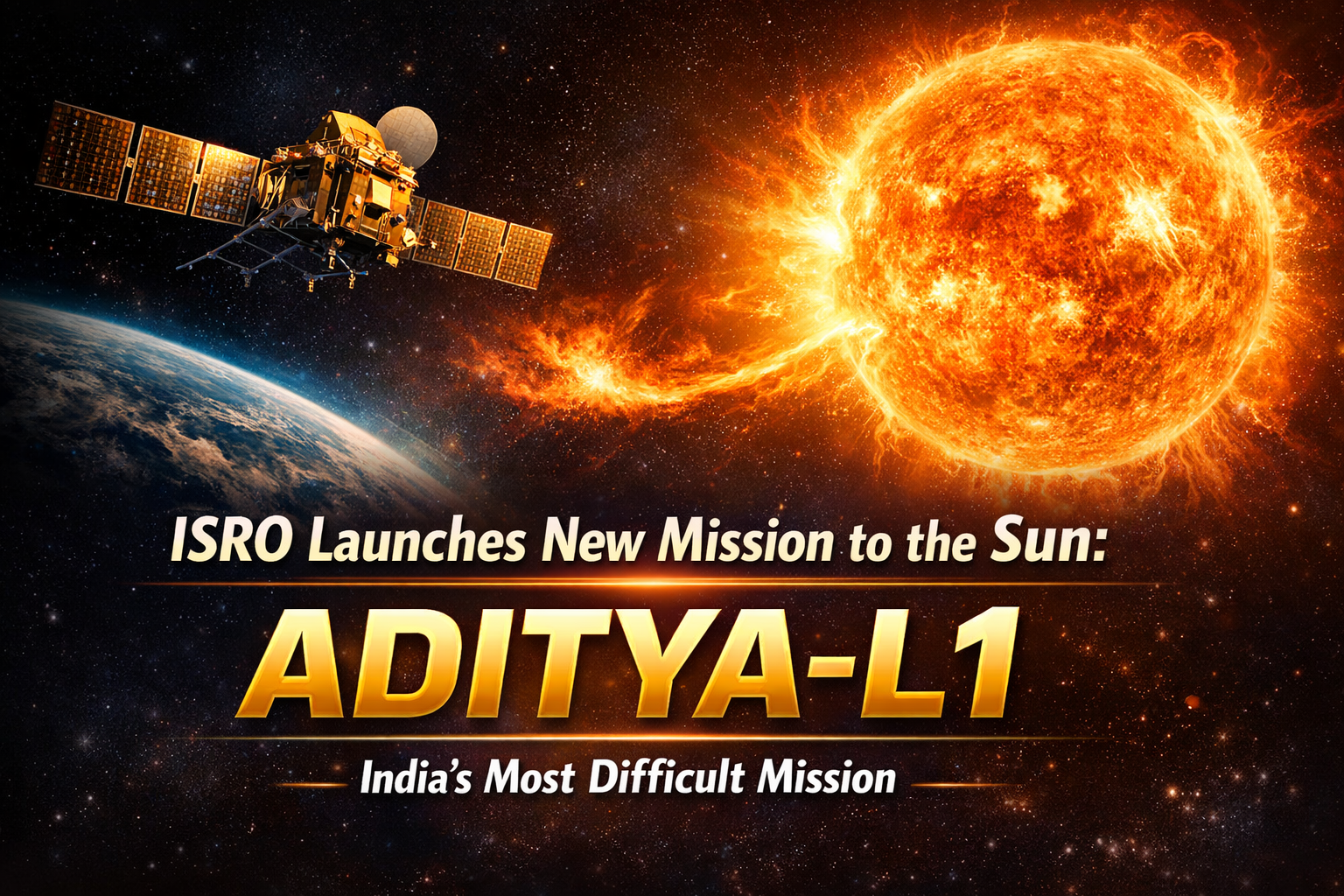
ISRO’s Aditya-L1 is India’s first independent mission to study the Sun from the L1 Lagrange point. Positioned 1.5 million km away, it uses seven payloads to investigate coronal heating, solar winds, and CMEs to protect satellites and predict space weather effectively.
Following the huge success of Chandrayaan-3, ISRO has not stopped; it has made the Sun its next target. Using the PSLV-XL rocket, ISRO has launched the Aditya-L1 mission, which will observe the Sun continuously for five years. However, making this massive mission successful comes with significant challenges. Unlike Chandrayaan-3, we will not be landing on solid ground, nor will we be orbiting the Sun in a traditional sense. instead, Aditya-L1 will remain static at a single position in space. Keeping a spacecraft suspended in mid-space in front of the Sun is a massive challenge
Why is this Mission Important?
This mission represents a historical achievement for ISRO and India. Generally, the success rate of solar missions globally is less than 50%. Out of 77 space agencies worldwide, only three—NASA, ESA, and JAXA—have launched solar missions, and mostly in collaboration. ISRO’s Aditya-L1 is a fully independent mission with negligible international involvement in its manufacturing or launch program.
A major reason for the high failure rate of previous solar missions has been unstable communication. To solve this, ISRO selected a station point 1.5 million kilometers away from Earth (only 1% of the distance to the Sun), ensuring a sufficient distance for observation while maintaining stable data transmission. Furthermore, this mission marks ISRO’s entry into the domain of space observatories, joining an elite group of only four other agencies that have launched such observatories to study stars and objects.
The Scientific Mysteries: The Coronal Heating Problem
One of the primary objectives is to solve the 150-year-old “Coronal Heating Mystery”. To understand this, we must look at the Sun’s structure. Like Earth, the Sun has an atmosphere divided into layers:
Photosphere: Extends 500 km above the surface with a temperature of around 6,000°C.
Chromosphere: Extends 1,500 to 5,000 km above the photosphere, reaching temperatures of 10,000°C.
Corona: The outermost layer, thick enough to fit 400 Earths, with a temperature of nearly 1 million degrees Celsius.
This contradicts the laws of thermodynamics, which state that temperature should decrease as you move away from the heat source. In the Sun’s case, the outer Corona is inexplicably hotter than the inner layers. NASA has conducted over 20 missions in the last 60 years to solve this, but we still lack an accurate explanation. According to Professor Divyendu Nandi, Aditya-L1 will observe the Corona more clearly than ESA’s SOHO mission, potentially making India the first nation to solve this mystery.
Protecting Earth from Solar Storms
Aditya-L1 will also study Coronal Mass Ejections (CMEs). When the Sun’s magnetic field changes drastically, it throws out plasma and magnetic loops—a phenomenon called CME. These travel at high speeds (cited as 6,000 km/h in the video) and can melt things around them. When directed at Earth, these magnetic loops interfere with satellite communication systems. For instance, Elon Musk previously lost 40 Starlink satellites due to such solar storms.
Since India is a major player in satellite deployment, Aditya-L1 is crucial for predicting these storms to protect our assets. By detecting changes in the magnetic field, instruments on board will help predict the intensity and direction of CMEs, allowing for timely preventative measures.
The Trajectory: How Will It Reach the Sun?
Aditya-L1 will follow a trajectory similar to the initial phases of Chandrayaan-3.
1. Launch & Orbit Raising: It enters Low Earth Orbit, where thrusters will fire in 4-5 steps to expand its orbit.
2. Cruise Phase: The spacecraft will be slingshotted out of Earth’s gravitational sphere of influence toward the Sun.
3. Journey to L1: It will travel 1.5 million km over 127 days.
4. Halo Orbit Injection: Upon reaching the vicinity of the L1 point, thrusters will fire to slow it down and turn it, injecting it into a specific orbit.
The Challenge of the L1 Point
The spacecraft will be stationed at Lagrange Point 1 (L1). In space, keeping an object static is difficult because massive bodies like the Earth and Sun constantly exert gravitational pull. The L1 point is a strategic spot where the gravity of the Sun and Earth balance each other out—like a game of tug-of-war ending in a draw—allowing the object to remain static without external force.
Why L1 and not others? There are five Lagrange points:
L2: Located behind the Earth, making solar observation impossible.
L3: Located behind the Sun, making communication with Earth difficult.
L4 & L5: These are naturally stable but contain asteroids (Earth Trojans) that could damage the spacecraft.
However, even L1 is not perfectly stable. To remain stationary, Aditya-L1 will not just sit at the point but will orbit the imaginary L1 point itself in what is called a Halo Orbit.
The Seven Payloads (Instruments)
Aditya-L1 carries seven instruments to study the Sun:
1. SUIT (Solar Ultraviolet Imaging Telescope): Acts like a camera with 11 science filters to capture images of the Photosphere and Chromosphere, monitoring temperature and solar flares 24/7.
2. VELC (Visible Emission Line Coronagraph): Since the Sun’s brightness usually hides the Corona, this instrument mimics a solar eclipse by blocking the main solar disc, making the Corona visible for study. It will analyze the spectrum to identify elements and ions in the Corona.
3. ASPEX & PAPA: These packages contain instruments (SWIS, STEP, SWEEP, SWICAR) to analyze low and high-energy particles (electrons, protons) in the solar wind to determine if they will reach Earth.
4. Magnetometer: Uses a tri-axial sensor based on the Hall Effect (similar to how wind pushes you, the magnetic field pushes electricity in a conductor) to measure the strength and direction of the interplanetary magnetic field.
5. SoLEXS & HEL1OS: X-ray spectrometers that detect X-rays emitted by the Sun to map energetic places and solar flares.
Limitations of the Mission
ISRO has transparently stated specific limitations of this mission:
1. Payload Constraints: Due to the carrying capacity of the PSLV rocket, some larger, more advanced instruments could not be included.
2. Viewing Angle: Being at L1 provides a “first-person” view. However, viewing CMEs from the side (like a third-person view from L5) would allow for better speed and depth judgment.
3. Polar Observation: The mission cannot study the Sun’s poles. Observing the poles requires a vertically inclined orbit, which is technologically very challenging and has not been attempted here.
Despite these limitations, Aditya-L1 is a highly advanced observatory. Identifying these flaws suggests that ISRO is already planning future missions to overcome them. Just as the Pragyan rover from Chandrayaan-3 has begun sending signals, this solar mission aims to take India’s space exploration to greater heights. This mission is a moment of pride and a significant step forward for Indian science.
Read More:
286 Days in Space: Sunita Williams on Starliner, Survival, and the Astronaut Mindset

I'm a education-driven content creator dedicated to breaking down complex ideas into simple, practical, and easy-to-understand explanations. The website is built with a clear mission: to promote learning, awareness, and education.