
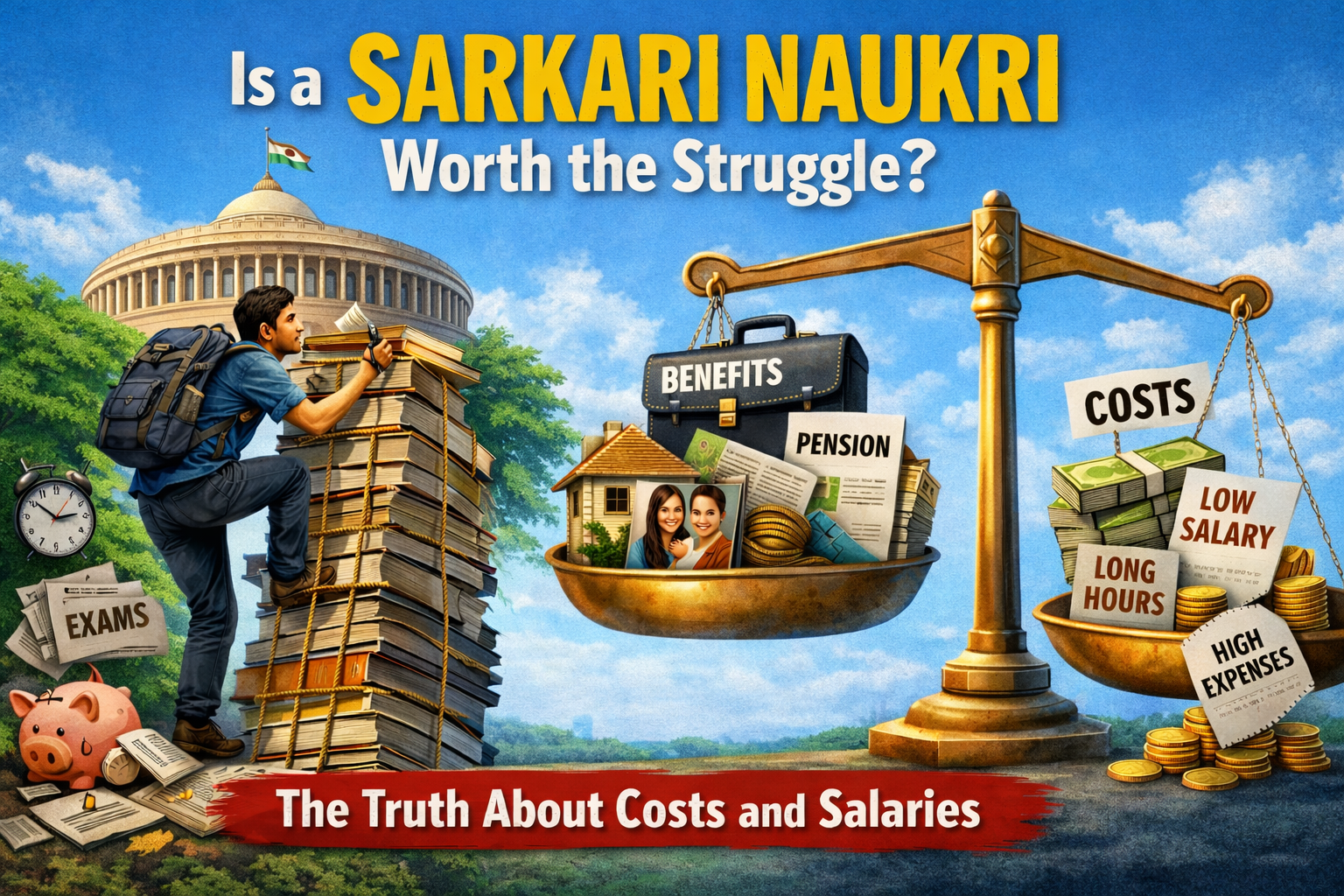
Securing government jobs in India involves immense competition, with success rates as low as 0.04%. While these roles offer stability, prestige, and extensive retirement benefits, the pursuit often leads to high coaching costs, years of unemployment, and mental strain.
The Truth About Government Jobs: Costs, Salaries, and Realities
When we think about government jobs in India, we often picture the final result: the stability, the respect, and the headlines celebrating the toppers. However, living through the preparation phase reveals a different reality. In hubs like Mukherjee Nagar, we see thousands of students sharing cramped rooms—some preparing for their third banking attempt, others on their fourth SSC attempt. Before we dive into the earnings, we must understand the cost of entering this world.
The Real Cost of Preparation The coaching industry is massive, but for an individual, the costs are steep. Coaching fees alone range from ₹1.5 lakh to ₹3 lakh. However, the hidden killer is the living expense. Rent, food, and study materials in a coaching hub can cost ₹12,000 to ₹20,000 a month. Over three to five years—the average time it takes to clear these exams—this amounts to ₹10-20 lakhs.
Beyond money, there is the“opportunity cost.” While we struggle with self-doubt and nervousness for years, our peers in the private sector are gaining experience, buying cars, and settling down. The success rates are daunting:IBPS PO has a 0.04% success rate, SSC CGL is roughly 0.05%, and Railway NTPC is an abysmal 0.02%. Statistically, buying a lottery ticket might offer better odds.
Banking Sector: IBPS and SBI For those targeting banks (excluding SBI and RBI), the IBPS Probationary Officer (PO) exam is the gateway. Eligible candidates (graduates aged 20-30) start as Assistant Managers with a basic pay of roughly ₹36,000. Including allowances, the in-hand salary in a metro city is about ₹50,000–₹55,000.
However, the SBI PO exam is in a league of its own. An SBI PO earns 15-20% more than other bank POs. Over a 30-year career, this difference accumulates to an extra ₹75-90 lakhs. Furthermore, specialized roles (like IT or Risk Management) often see faster promotions.
SSC: The “Mini IAS” The SSC CGL (Combined Graduate Level) is incredibly popular for Group B and C posts in central ministries. The eligibility age is wide (18-32 years), which can be a trap, keeping aspirants stuck in a loop of attempts for over a decade.
Salaries here vary wildly based on the role. An Inspector in Central Excise might earn ₹85,000 due to field allowances, while an Assistant in the Ministry of Agriculture might earn ₹45,000 for a desk job, despite clearing the same exam. Positions in the CBI or NIA offer significant power and allowances, pushing salaries near ₹1 lakh.
There is also the SSC CHSL (Higher Secondary Level) for those who have passed 12th grade. These are largely clerical or data entry roles with starting salaries between ₹25,000 and ₹40,000. Many use this as a stepping stone to state-level exams.
State Exams and Railways State Public Service Commissions (PSC) recruit for powerful administrative roles (like Deputy Collectors or DSPs). Salaries are generally ₹60,000–₹80,000, but the influence and perks are comparable to central services.
The Railways remains one of the largest employers. Technical roles (Junior Engineers) start around ₹60,000-₹65,000 with allowances. Non-technical roles (NTPC) range from junior clerks earning ₹25,000 to station masters earning significantly more.
The “Hidden” Paycheck: Perks and Benefits Why do we chase these jobs despite the low success rate? It is the economics of perks.
Housing: We get government accommodation in prime locations for nominal rent.
Loans: We can access loans at simple interest rates as low as 4%, while the market charges 8-9%.
Medical & Education: The CGHS covers healthcare for the entire family (parents included), saving lakhs over a lifetime. Children get preference in Kendriya Vidyalayas.
Retirement: Even with the New Pension Scheme, the retirement corpus—including gratuity and leave encashment—can range between ₹2 to ₹4 crores.
The Verdict Government jobs offer financial predictability, much like a Fixed Deposit. There are no massive highs, but no scary lows. However, this security demands a massive upfront investment of time and youth. If we have the courage, we should give it a shot for 2-3 years. But if it doesn’t work out, we must be brave enough to move on, because every extra year spent preparing is a year of income lost.
Read More:
The “Bhedchaal” Mentality: Why 90% of Indian Students Are Chasing the Wrong Dream

I'm a education-driven content creator dedicated to breaking down complex ideas into simple, practical, and easy-to-understand explanations. The website is built with a clear mission: to promote learning, awareness, and education.