


WILDLIFE KNOWLEDGE HUB
Herpetology · Venomous Reptiles · Australia
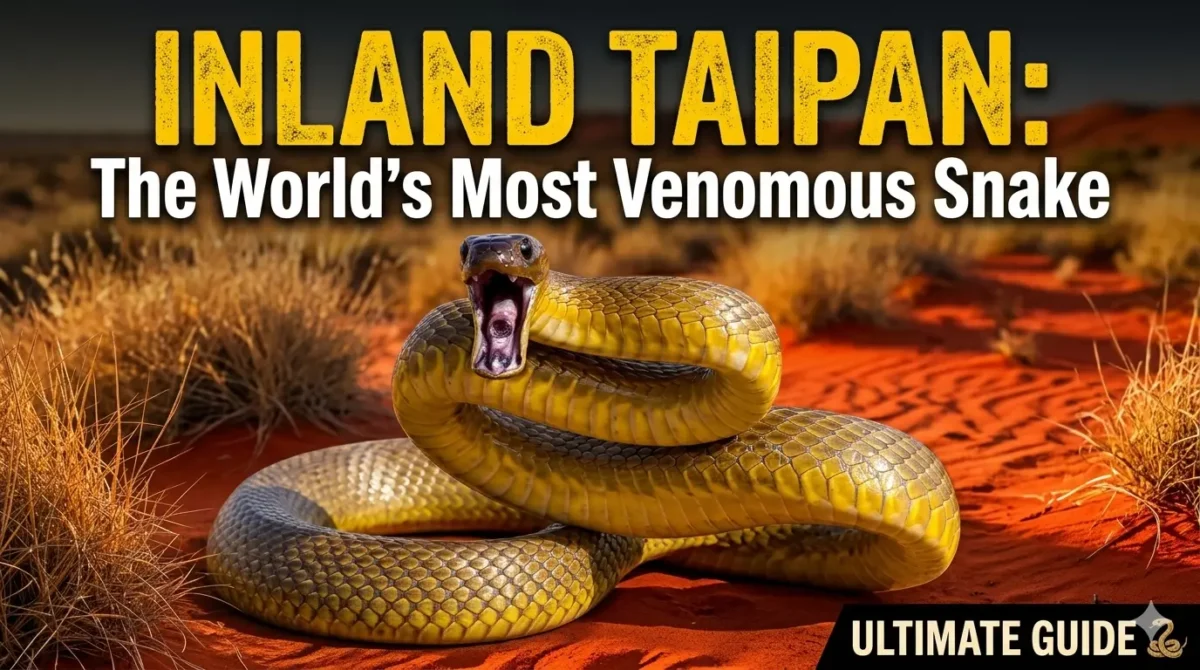
Inland Taipan: The Most Venomous Snake in the World
Inland Taipan
The Complete Guide to the Inland Taipan
Oxyuranus microlepidotus — Nature’s Most Potent Serpent
────────────────────────────────────────────────
|
⚠ DISCLAIMER: This article is for educational purposes only. Never attempt to handle or approach any wild snake. If bitten, seek emergency medical care immediately. |
Key Facts at a Glance
|
50× |
110 mg |
100+ |
~45 min |
|
More toxic than King Cobra |
Max venom per bite |
Humans one bite could kill |
Onset without treatment |
Introduction
When scientists and herpetologists discuss the most venomous snake in the world, one name rises above all others without debate: the Inland Taipan (Oxyuranus microlepidotus). Hidden deep within the scorching semi-arid plains of central Australia, this reclusive serpent holds the undisputed title of producing the most toxic venom of any snake species ever measured on Earth.
Unlike the aggressive cobras or the infamous black mamba — snakes more frequently responsible for human deaths — the Inland Taipan is paradoxically shy and rarely encountered by people. Yet, gram for gram, no snake alive today can match the terrifying biochemical potency it carries within its venom glands.
This comprehensive guide explores everything you need to know about the Inland Taipan’s venom potency, its biology, natural habitat, behavior, comparison with other deadly snakes, and what would actually happen if someone were bitten by the world’s most venomous serpent.
What is the Inland Taipan? Scientific Classification & Overview
The Inland Taipan, also known as the fierce snake or small-scaled snake, belongs to the family Elapidae — the same family that includes cobras, mambas, and sea snakes. It was first formally described by Frederick McCoy in 1879, though it was so rarely seen that it virtually vanished from scientific records for nearly a century before being rediscovered in 1972.
Scientific Classification
|
Kingdom |
Animalia |
|
Phylum |
Chordata |
|
Class |
Reptilia |
|
Order |
Squamata |
|
Family |
Elapidae |
|
Genus |
Oxyuranus |
|
Species |
O. microlepidotus |
|
Common Names |
Inland Taipan, Fierce Snake, Small-Scaled Snake, Western Taipan |
|
Conservation Status |
Least Concern (IUCN) |
|
Adult Length |
1.8 to 2.5 metres (up to 2.9 m) |
|
Range |
Channel Country, central Australia |
Despite its common nickname “fierce snake,” the Inland Taipan is actually quite docile and non-aggressive by nature. The name “fierce” originally referred to the ferocity of its venom, not its temperament. It will almost always attempt to flee from threats rather than strike.
Where Does the Inland Taipan Live? Habitat & Geographic Range
The Inland Taipan is an endemic Australian species, found exclusively in a remote region where the borders of Queensland, South Australia, and New South Wales converge — an area often called the Channel Country or the semi-arid floodplains of central Australia.
This region is characterised by vast, cracked black soil plains, gibber deserts, and dry river channels that flood only occasionally. Temperatures here can swing dramatically — exceeding 50°C (122°F) in summer and dropping near freezing in winter. The Inland Taipan has adapted masterfully to this extreme environment.
Microhabitat Preferences
The snake favours the following microhabitats:
- Cracks and fissures in dry clay and black soil plains
- Rocky outcrops and gibber desert pavements
- Abandoned burrows of long-haired rats and plains rats
- Deep soil crevices that provide insulation from extreme heat
This secretive, underground lifestyle is precisely why the Inland Taipan was “lost” to science for nearly a century.
Inland Taipan Venom: The World’s Most Potent Snake Venom Explained
The defining characteristic of the Inland Taipan — and the reason it tops every list of the most venomous snakes in the world — is its extraordinary venom. Measured by the median lethal dose (LD50) subcutaneous test in mice (the standard scientific benchmark), no other snake comes close.
One bite from an Inland Taipan contains enough venom to kill more than 100 adult humans — or 250,000 mice.
Venom Potency — The LD50 Benchmark
The Inland Taipan has an LD50 of just 0.025 mg/kg — meaning an almost unimaginably small dose of venom is needed to kill half of a test group of mice. To put this in context, a single bite can yield up to 110 milligrams of venom, and a lethal dose for an adult human is estimated at just 1–2 milligrams.
Composition of Inland Taipan Venom
The venom is a sophisticated biochemical cocktail that attacks the body through multiple pathways simultaneously:
- Paradoxin (Neurotoxins): Block signals at neuromuscular junctions, causing paralysis of breathing muscles
- Oxylepitoxin-1: A presynaptic neurotoxin that destroys nerve terminals, causing irreversible neuromuscular blockade
- Procoagulants: Trigger disseminated intravascular coagulation (DIC), causing blood to clot throughout vessels
- Myotoxins: Directly destroy muscle tissue (rhabdomyolysis), releasing proteins that clog and damage the kidneys
- Hyaluronidase: Acts as a spreading factor, helping venom penetrate tissues rapidly
Seasonal Venom Variation — A Remarkable Adaptation
One of the most fascinating aspects of the Inland Taipan’s biology is that its venom potency changes with the seasons. Research has shown that venom collected in winter is significantly more toxic than venom collected in summer. Scientists believe this adaptation is linked to prey availability — in winter, the snake needs to kill prey as efficiently as possible with fewer hunting opportunities.
Inland Taipan vs. Other Most Dangerous Snakes in the World
A common source of confusion is the difference between the most venomous snake and the most dangerous snake. Venom potency (toxicity per milligram) is not the same as overall lethality to humans, which also depends on aggression, range overlap with human populations, and access to medical care.
|
Snake |
LD50 (mg/kg) |
Max Venom Yield |
Temperament |
Avg. Human Deaths/Yr |
|
🏆 Inland Taipan |
0.025 |
110 mg |
Shy / Reclusive |
Near zero (recorded) |
|
Eastern Brown Snake |
0.053 |
6 mg |
Aggressive |
2–4 (Australia) |
|
Coastal Taipan |
0.099 |
400 mg |
Aggressive |
Several/year |
|
Black Mamba |
0.32 |
400 mg |
Very Aggressive |
~20,000+ (Africa) |
|
King Cobra |
1.28 |
7,000 mg |
Moderately Aggressive |
Several hundred |
|
Russell’s Viper |
0.40 |
150 mg |
Aggressive |
~25,000 (Asia) |
The Black Mamba, Russell’s Viper, and Saw-scaled Viper kill far more humans annually than the Inland Taipan — but this is due to geography, aggressive temperament, and proximity to dense human populations, not venom potency. By the pure biochemical measure of toxicity, the Inland Taipan reigns supreme.
Physical Appearance & Identification
The Inland Taipan is a medium-to-large snake, typically measuring 1.8 to 2.5 metres (6–8 feet) in length, with some exceptional individuals reaching nearly 2.9 metres. It has a slender, muscular body, a distinctive rounded snout, and comparatively small eyes for an elapid.
Seasonal Colour Change
In a remarkable physiological adaptation, the Inland Taipan changes colour with the seasons. During winter, it darkens to a deep, rich brown or jet-black to absorb solar heat. In summer, it lightens to a tan or straw-yellow colour to reflect heat. This seasonal pigment shift is unusual even among reptiles. The scales have a glossy sheen, and each dark-edged scale creates a subtle chevron pattern across the body.
Diet & Hunting Behaviour of the Inland Taipan
The Inland Taipan is a specialist predator, feeding almost exclusively on small to medium-sized mammals, particularly the long-haired rat (Dasymys incomtus) and the plains rat (Pseudomys australis), which undergo boom-and-bust population cycles in the Channel Country.
Strike Mechanics
Unlike pit vipers that make a single strike and withdraw, the Inland Taipan often delivers multiple rapid strikes in quick succession — sometimes up to 8 bites in a single attack. Each strike injects a full load of venom. This behaviour is adapted for killing rodents that could bite back and injure the snake if given time.
Has Anyone Ever Been Bitten by an Inland Taipan? Bite Cases & Survival
Given its remote habitat and reclusive nature, verified bites by Inland Taipans are extraordinarily rare. The vast majority of documented bite cases involve professional herpetologists, snake handlers, or researchers who work directly with the species.
Notably, no documented human fatality from an Inland Taipan bite has ever been confirmed in medical literature — an astonishing fact for the world’s most venomous snake. The combination of its remote habitat and non-aggressive temperament keeps the human encounter rate incredibly low.
What Happens During an Inland Taipan Bite — Symptom Timeline
|
Time |
Symptoms / Effects |
|
0–30 min |
Localised pain, swelling, nausea, headache, vomiting begin |
|
30–60 min |
Coagulopathy begins; neurotoxic symptoms emerge (ptosis, diplopia); blood clotting dysfunction |
|
1–3 hours |
Muscle paralysis, difficulty swallowing, laboured breathing; dark urine from muscle breakdown |
|
3–6 hours |
Without treatment: respiratory failure, renal failure, cardiovascular collapse |
|
With antivenom |
Gradual stabilisation; full recovery typically possible with early intervention |
The Antivenom
Australian antivenom manufacturer Seqirus produces the Taipan Antivenom, which is effective against both the Inland Taipan and the Coastal Taipan. All cases where antivenom was administered quickly resulted in full recovery. The critical factor is time — without treatment, death from respiratory failure can occur within hours.
Conservation Status: Is the Inland Taipan Endangered?
The Inland Taipan is currently listed as Least Concern on the IUCN Red List — largely because it inhabits one of Australia’s most remote and least-disturbed regions. However, ongoing threats include:
- Habitat degradation from feral grazing animals (camels, cattle, goats) compacting the black soil plains
- Invasive predators such as feral cats and foxes
- Climate change potentially altering flood-dependent ecosystems and prey populations
Frequently Asked Questions About the Inland Taipan
Q: Is the Inland Taipan the most venomous snake in the world?
Yes. By the standard scientific measure of LD50, the Inland Taipan produces venom that is more toxic per milligram than any other snake species on Earth. Its LD50 of 0.025 mg/kg makes it roughly 10 times more toxic than the Coastal Taipan and 50 times more toxic than the King Cobra.
Q: Has anyone ever died from an Inland Taipan bite?
No confirmed human fatality from an Inland Taipan bite has been documented in medical literature. The snake’s remote habitat and shy temperament mean bites are extraordinarily rare. All documented bite cases involving rapid medical treatment have resulted in survival.
Q: What is the difference between the Inland Taipan and the Coastal Taipan?
Both belong to the genus Oxyuranus, but they differ significantly. The Inland Taipan is more venomous per milligram, lives in remote inland areas, and is far more reclusive. The Coastal Taipan produces much larger venom yields per bite, is found along Australia’s east coast, and is considered more aggressive.
Q: Can you survive an Inland Taipan bite?
Yes — with prompt administration of Taipan antivenom and intensive medical care, survival is very possible. All documented cases treated rapidly with antivenom resulted in recovery.
Q: Why is the Inland Taipan called the ‘fierce snake’?
The name ‘fierce snake’ refers to the ferocity of its venom — not its behaviour. In its natural habitat, the Inland Taipan is actually quite timid and will flee from threats. The name originated from early scientific descriptions of its extraordinarily potent venom chemistry.
Q: Where exactly can you find the Inland Taipan?
The Inland Taipan is found in the Channel Country of central Australia — specifically in remote areas where Queensland, South Australia, and New South Wales meet. Key locations include the Diamantina River and Georgina River floodplains. It is not found anywhere outside Australia.
────────────────────────────────────────────────
Conclusion
The Inland Taipan is one of nature’s most extraordinary examples of biochemical specialisation. Armed with the most potent venom ever measured in a snake species, it represents the pinnacle of millions of years of evolutionary refinement. Yet despite its fearsome reputation, this remarkable serpent lives a quiet, secretive life deep in the Australian outback — far from human eyes and almost never causing harm.
Understanding the Inland Taipan means appreciating the crucial distinction between venom potency and danger to humans. The world’s most venomous snake is, in reality, one of the least likely to kill you — not because its venom is anything less than lethal, but because evolution crafted it as a specialist desert predator, not a threat to people.
Like all venomous snakes, the Inland Taipan deserves our respect, our curiosity, and our commitment to preserving the wild places it calls home.
────────────────────────────────────────────────
Target Keywords: most venomous snake in the world inland taipan · inland taipan venom potency facts · fierce snake Australia complete guide · inland taipan vs king cobra comparison · most dangerous snake in Australia · can you survive inland taipan bite · inland taipan habitat Channel Country · inland taipan LD50 venom explained · Oxyuranus microlepidotus facts


Hardik is a professional writer and researcher with over 5 years of experience and a Master’s in Writing. He specializes in simplifying complex topics and government schemes into easy-to-understand guides. Passionate about accuracy and empowerment, Hardik helps the Namaste Vishwa community stay informed and navigate opportunities with confidence.