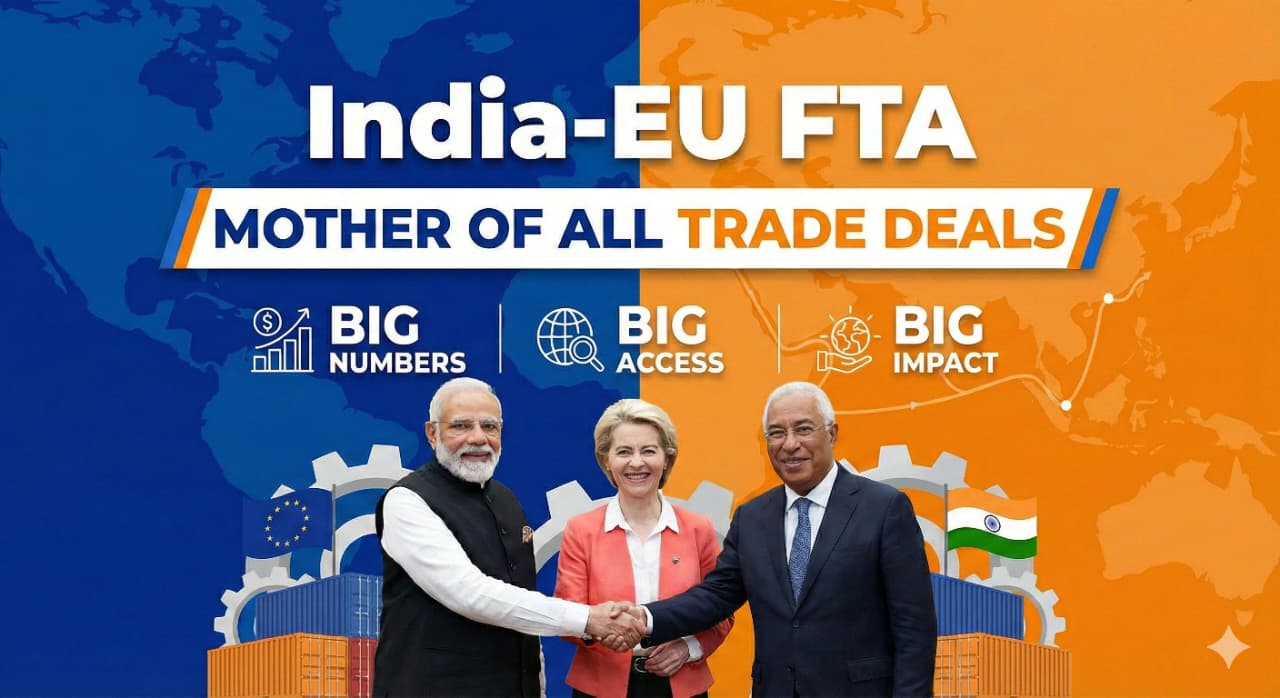
India and the EU have signed a landmark Free Trade Agreement, eliminating or reducing tariffs on 90% of goods. Key sectors include aerospace, luxury cars, and textiles. The deal facilitates services, investment, and unlimited mobility for Indian students and workers.
A Historic Moment
Finally, it can be said that the trade deal between India and the European Union (EU) has been signed, as both sides have officially announced it. During the press conference held at Hyderabad House, a very friendly atmosphere was observed. The President of the European Commission and the President of the European Council visited India to participate in the Republic Day parade. Prime Minister Modi shared personal interactions with the leaders, and notably, Antonio Costa, the President of the European Council, displayed his Overseas Citizen of India (OCI) card, highlighting his Indian origins.
Why This is the “Mother of All Trade Deals”
This Free Trade Agreement (FTA) is distinct from normal tariff deals. It is being termed the “Mother of All Trade Deals” due to its sheer scale and depth. The EU represents a massive market of 27 countries. Unlike standard agreements, this deal includes almost everything: goods, services, investments, standards and regulations, Intellectual Property Rights (IPR), sustainability and climate clauses, and supply chain cooperation. The negotiations for this deal have been ongoing for nearly 18 to 20 years. Discussions began in 2007 but stalled in 2013 due to disagreements over alcohol, automobiles, agriculture, and data protection. Momentum returned after the COVID-19 pandemic and the Ukraine war (2021-2022), leading to this final signature.
Economic Scale and Tariff Reductions
The economic scale of this agreement is massive, covering 2 billion people, 25% of the global GDP, and 30% of global trade. In the history of India, no other FTA has been witnessed at this scale. The core feature of the deal is the massive reduction in tariffs. Approximately 90% of tariff lines will either be reduced or completely eliminated. This will be implemented in a phased manner over 5 to 10 years. While the deal is signed, it requires ratification by both the European Parliament and the Indian Parliament, meaning it may take six months to a year to come into effect.
Sector-Wise Breakdown of the Deal
Aircraft and Aerospace: A Game Changer This sector is considered a game changer. Currently, airlines pay heavy custom duties on imports. Under this deal, 0% tariff will apply to aircraft, engines, spare parts, and maintenance equipment coming from Europe. This helps Airbus (a European company) compete against the American company Boeing. It aligns with “Make in India” by reducing dependency on limited suppliers and boosting the Indian Maintenance, Repair, and Overhaul (MRO) sector.
Alcohol: A Politically Sensitive Sector India previously imposed tariffs up to 150% on wines and spirits and 100% on beer. Now under the deal , wine tariffs will drop to 20-30%, spirits to 40%, and beer to 50%. India has agreed to a “Quota Based” system. Only a specific quantity of alcohol can enter India at these rates, ensuring the domestic mass liquor market is not threatened. This move is expected to boost hospitality and tourism.
Automobiles: The automobile sector was a controversial point of negotiation. Currently, India levies a 110% tariff on European cars. Under the deal, this will drop to 10% over the next 5 to 10 years. This primarily benefits luxury brands like BMW and Audi. High-end cars costing crores could see price drops of ₹20-25 lakhs. Mass-market Indian cars remain protected, and the longer timeline for EVs protects domestic startups.
Food, Beverages, and Processed Products Tariffs have been eliminated on premium products such as chocolates, biscuits, pasta, olive oil, fruit juices, and specific cheeses. This will lower prices for Indian consumers and offer higher quality choices. Since these are premium products, the impact on India’s food security is minimal.
Chemicals and Pharmaceuticals: Duty reduced to zero on specialty chemicals, medical devices, and industrial machinery from Europe. India can export generic drugs, APIs (Active Pharmaceutical Ingredients), and bulk chemicals to Europe at zero duty. Crucially, Europe will not object to India’s production of generic drugs or Compulsory Licensing, protecting India’s pharmaceutical interests.
Textiles, Leather, and Footwear: India’s Biggest Win This is arguably the most significant negotiating success for India. Previously, Indian textiles and garments faced 8-12% duties. Bute now Almost 0% duty. This provides a massive boost to MSMEs, labor-intensive industries, and women’s employment. It allows India to compete effectively against Bangladesh and Vietnam in the European market.
Services, Investment, and Digital Trade
India has a strong advantage in services.
- Market Access: Greater access for IT services, engineering, and consultancy.
- Student & Professional Mobility: The EU has committed to uncapped mobility for Indian students, workers, and professionals. Unlike the US H-1B visa issues, there is no cap on the number of Indians going to Europe for work or study.
- Investment: The deal ensures a stable dispute resolution system, encouraging European capital to flow into India.
- Digital Trade: India is aligning data protection rules with EU norms while maintaining data sovereignty.
Strategic Importance and Future Outlook
- Trade Volume: Bilateral trade is expected to double by 2032. Currently, goods trade is around €120 billion (approx. $140 billion).
- Diversification: This is India’s fourth major trade deal (after Mauritius, UAE, and Australia, and negotiations with UK/Oman), helping diversify markets away from over-reliance on the US, especially given tariff issues with the US.
- Key Partners: Six countries—Netherlands, Germany, Italy, Spain, France, and Belgium—account for a significant portion of India’s exports to the EU.
- Trade Surplus: In 2024, India enjoyed a trade surplus of $25 billion with the EU (compared to $45 billion with the US).
Despite the benefits, there are concerns:
- Domestic Industry Fears: Sectors like automobiles and dairy fear an influx of products, though the government maintains that safeguards are in place.
- Regulatory Pressure: The EU has strict environmental and labor standards. Indian manufacturers might face non-tariff barriers if they fail to meet these norms.
- Implementation: Success depends on customs reforms, infrastructure, and “Ease of Doing Business” improvements within India.
This deal represents a strategic shift for India, positioning it as a central global trade hub. While challenges exist regarding implementation and standards, the potential for technology transfer, lower costs for consumers, and massive export boosts for textiles and services makes it a landmark agreement.
ALSO READ

I'm a education-driven content creator dedicated to breaking down complex ideas into simple, practical, and easy-to-understand explanations. The website is built with a clear mission: to promote learning, awareness, and education.