

Rising myopia rates among children are creating a global epidemic. Theories suggest genetics, near-work strain, and lack of sunlight cause eyeball elongation. To prevent vision loss, experts recommend outdoor activity to boost dopamine and taking breaks from screens.
Namaste Friends ! Do you remember when we were younger, our parents often warned us not to watch too much TV because it would affect our eyes and force us to wear glasses? Unfortunately, do you know the truth today? We have to wear glasses anyway. Millions of kids have become nearsighted, and children are having trouble seeing things that are far away.
If you cannot properly see things that are at a distance, it means you have Nearsightedness, or in scientific terms, Myopia. The data regarding this is shocking. In India, among kids aged 5-15, the prevalence rate of Myopia was around 4.5% just 20 years ago. Today, that number has crossed 21%, meaning one in five children in the country has to wear prescription glasses. Myopia is now considered an epidemic, and it is predicted that by 2050, every other human being in the world will wear glasses.
Why is this happening? Can we naturally cure our eyes, or how can we protect them in this world of smartphones? Today, I will answer these questions by exploring the latest scientific studies.
How Our Eyes Actually Work
To understand this topic in detail, we first have to understand the mechanism of human eyes. Basically, a human eye works like a Convex Lens, which converges light rays falling on it to a single focus point. In a normal human eye, this focal point is the back part of the eye called the Retina.
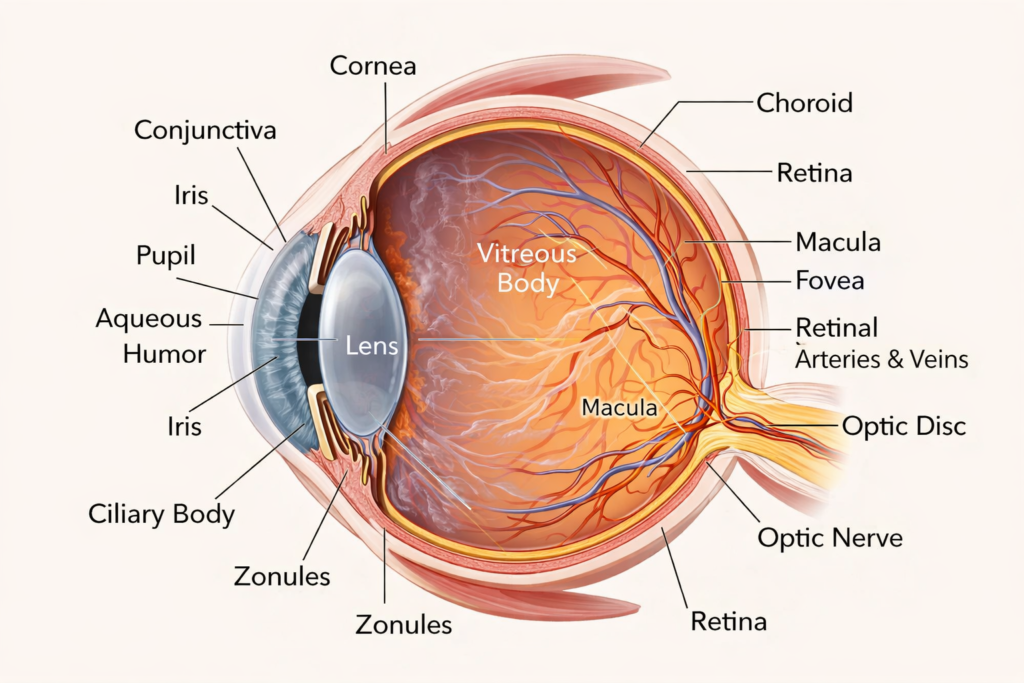
When light enters our eyes, it first hits the cornea (the outermost layer), passes through the pupil, and then through a lens inside the eye. The Retina is connected to an Optic Nerve which carries signals to our brain, enabling us to see. Interestingly, while we assume the lens does the work, about 70% of the bending of light is actually done by the cornea; the lens just does the fine-tuning.
If your eyes aren’t working properly, the shape of the cornea or the eyeball has changed.
• Myopia (Nearsightedness): The eyeball becomes elongated. Because of this, the focal point forms before the Retina rather than on it.
• Hyperopia (Farsightedness): The eyeball gets squished. The light rays converge after the Retina, making things close to you look blurry.
An interesting fact is that all newborn babies have squished eyes (Hyperopia) and cannot see things close to them properly until they are about 1-2 years old. As the baby grows, the eyeballs shift to the right size, a process that takes about 2 years.
The Mechanism of Focus: Accommodation
How do we see both far and near objects if lenses have fixed focal lengths? This is done by the Ciliary muscles (eye muscles). When you bring a finger closer to your eyes, you feel stress because these muscles contract to make the lens rounder, allowing you to focus on nearby objects. When you look far away, these muscles relax, flattening the lens. This ability is called Accommodation.
However, Ciliary muscles have a limit. When the eyeball elongates due to Myopia, these muscles cannot compensate enough.
Why Do We Get Myopia? Three Scientific Theories
Why do some eyeballs elongate? There are three main theories.
1. The Near-Work Theory This theory suggests that the more time we spend looking at things near us (books, phones, laptops), the more strain we put on our eyes, keeping the eyeballs in a squeezed state. This theory is actually over 400 years old; the German astronomer Johannes Kepler suggested it in 1604. Historically, British doctors noticed that Oxford University students had more Myopia than military recruits.
A 2015 meta-analysis found that for every hour per week you spend on near-work activities, your chance of getting Myopia increases by 2%. However, an Australian study in 2008 noted that the intensity of the session matters more than the total time.
2. The DNA Theory Until the 1970s, scientists believed Myopia was purely genetic and hereditary. If your family wore glasses, you would too. However, this theory failed to explain rapid changes. In 1969, a study on Alaskan tribes found that while elderly people had almost no Myopia, more than 50% of their children and teenagers (who adopted a westernized lifestyle) did. Genetics alone could not explain such a shift in a single generation.
3. The Outside Theory (The Leading Theory) Today, most scientists believe this is the main reason. It suggests that near-work isn’t the sole cause; rather, the lack of time spent outdoors is key. Exposure to daylight increases dopamine production in our retina. Dopamine regulates eye growth and stops the eye from elongating too much.
A large-scale study in California (2007) and another in Sydney (2008) confirmed that spending time outdoors—regardless of the activity—greatly reduced Myopia risk. This explains why Myopia is often called a “disease of affluence,” prevalent in richer countries where people stay indoors more.
The Power of Sunlight: Empirical Evidence
To prove the Outside Theory, we can look at Taiwan. In 2010, the government launched the “Tian-Tian Outdoor 120” program, mandating 2 hours of outdoor time for students daily. By 2015, Myopia rates dropped from 49.4% to 46.1%.
We need brightness levels of roughly 10,000 lux to trigger this dopamine benefit. Even in the shade on a sunny day, you get this amount easily, whereas indoors (even with windows open), you rarely reach 1,000 lux. Installing artificial lights to reach 10,000 lux indoors would produce too much heat to be practical.
Myopia is Not Just About Glasses
We must understand that Myopia is not a joke; there is a significant correlation between Myopia and blindness. By 2050, it is predicted that 10% of the world will have High-Grade Myopia (prescription of -6 or lower).
Because the retina has a finite amount of tissue, as the eye elongates, the retina stretches thin—like spreading the same amount of butter on a larger slice of bread. If it becomes too thin, it can rip (Retinal Tear) or detach (Retinal Detachment), leading to blindness. High Myopia also increases the risk of Glaucoma and Myopic Maculopathy (an untreatable condition).
The COVID-19 Impact
The pandemic made things significantly worse. A study in China showed that after just 5 months of lockdown in 2020, the Myopia rate in 6-year-olds spiked to 21.5%, compared to 5.7% in previous years. This has become a national security issue for China because they are struggling to find pilots with perfect vision for their Air Force.
In India, the situation is also dire. Among urban kids aged 5-15, Myopia jumped from 4.44% in 1999 to 21.15% in 2019, with predictions hitting 48.14% by 2050.
What Are the Solutions?
When looking for solutions, we must consider all three theories. Genetics play a role (if parents have it, risks increase), but we cannot control that. Therefore, we must focus on the Outside and Near-Work theories.
Preventative Measures:
1. Go Outside: Spend time in daylight to boost dopamine. (Don’t forget sunscreen to protect your skin).
2. Reduce Near-Work Intensity: Take breaks.
3. Sports: Participate in sports like badminton or table tennis. These activities force your eyes to constantly shift focus from far to near, giving them a chance to relax.
Government Actions: Countries are already intervening. China has banned written exams for kids up to 6-7 years old, restricted video games, and some schools even installed metal bars on desks to prevent kids from reading too closely. Singapore removed mid-year exams for some grades and doubled preschool outdoor time to ensure children play outside for at least an hour daily.
Can We Cure Myopia?
Unfortunately, Myopia is irreversible naturally. Once the eye elongates, it cannot shrink back. However, you can stop it from getting worse by following the preventative measures I mentioned.
Medical Treatments:
LASIK Surgery: This is an artificial way to restore vision. A laser removes microscopic corneal tissue to change its shape. It takes 15-30 minutes and is generally safe, eliminating the need for glasses.
Orthokeratology (Ortho-K) Lenses: These are special contact lenses worn at night that temporarily thicken peripheral areas of the cornea. They can improve daytime vision and slow Myopia progression in children by about 50%, but the effects are reversible—if you stop wearing them, the effect fades.
In my opinion, the best option is prevention. Spend less time on screens, take breaks, and go outside. If you follow these steps long-term, you may avoid the need for glasses entirely.
Read More :
The Invisible Crisis: Why India is the Diabetes Capital and How to Fix Our Metabolic Health

I'm a education-driven content creator dedicated to breaking down complex ideas into simple, practical, and easy-to-understand explanations. The website is built with a clear mission: to promote learning, awareness, and education.