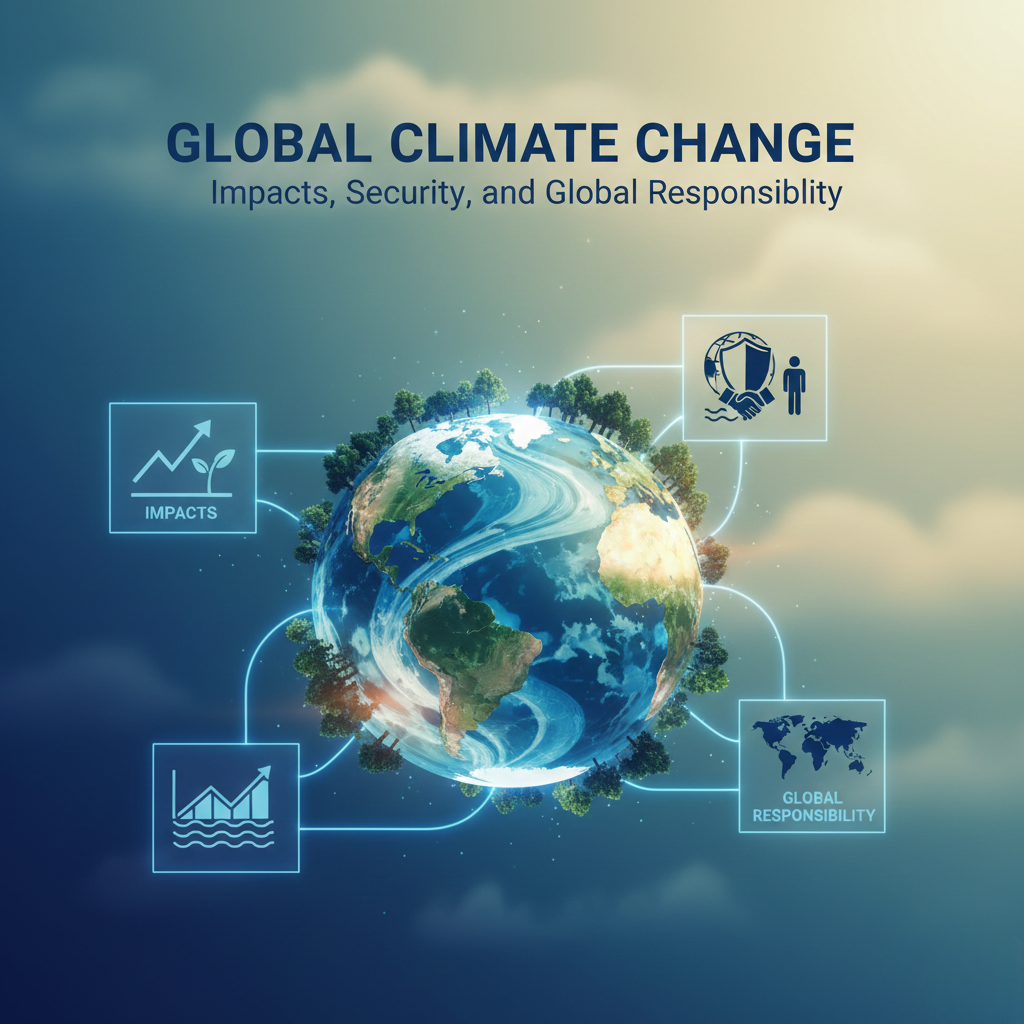
Climate change, driven by anthropogenic greenhouse gas emissions, causes global warming and extreme weather. It creates national security risks, threatening food security and displacing populations as refugees. International environmental standards and aid are vital for stability.
Weather, Climate, and the Atmosphere
To truly understand the crisis we face, we must first distinguish between key terms that are often used interchangeably but mean different things.
Weather vs. Climate “Weather” refers to the state of the atmosphere at a specific time and place, described by elements like temperature, humidity, and rainfall,. “Climate,” on the other hand, is the long-term average of these weather conditions—typically over a period of 30 years or more,. Therefore, Climate Change is a long-term shift in temperature and weather patterns. While this can occur naturally, the rapid changes we are seeing now are driven by human activity.
Global Warming vs. Climate Change Global warming is just one aspect of climate change. It specifically refers to the rise in the average temperature of the Earth’s atmosphere,. However, climate change is a broader “umbrella” term that includes global warming as well as other shifts like erratic rainfall patterns, droughts, floods, and extreme weather events.
The Atmosphere’s Composition: Our atmosphere acts as a blanket surrounding the Earth. It is composed of fixed gases (which don’t change much in concentration) and variable gases:
Fixed Gases: Nitrogen (~78%), Oxygen (~20.8%), and Argon (~0.93%). These gases dilute the atmosphere; without them, the highly combustible oxygen would make the Earth a fire hazard under the sun’s heat.
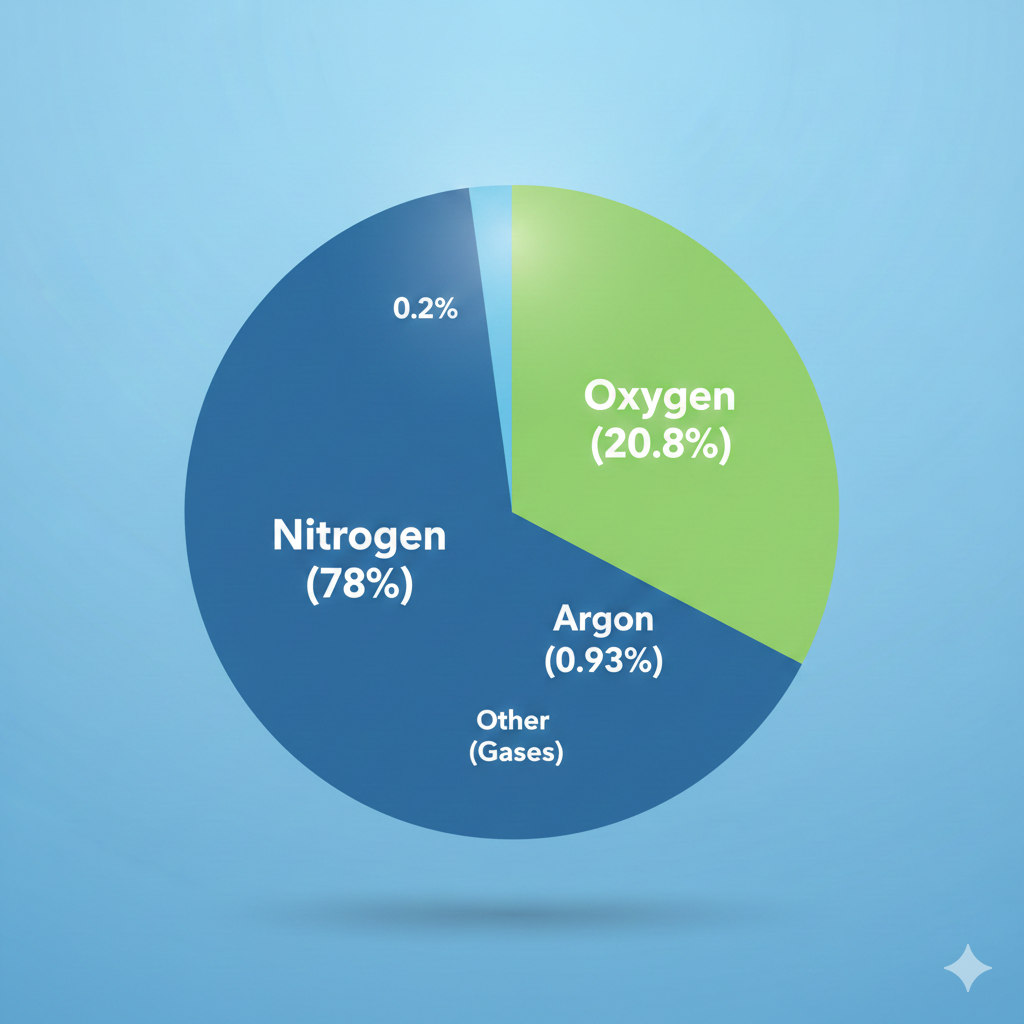
Variable Gases: These include Carbon Dioxide (CO2), Water Vapor, Ozone, and Methane. Though they make up a tiny fraction of the atmosphere, they are crucial because they are Greenhouse Gases (GHGs).
The Science of Warming—How It Happens
The Greenhouse Effect The Earth’s temperature depends on a delicate balance. The sun sends energy to Earth in the form of short-wave, high-energy radiation (visible light). Our atmosphere is transparent to this incoming energy, allowing it to reach the surface. The Earth absorbs this heat and radiates it back out as long-wave, low-energy infrared radiation.
Greenhouse gases (like CO2 and Methane) are transparent to incoming sunlight but opaque to outgoing infrared heat. They trap this outgoing energy, keeping the planet warm. Without this natural greenhouse effect, Earth would be frozen. However, human activities have increased the concentration of these gases, turning a comfortable blanket into a suffocating trap.
A Tale of Two Planets: Earth vs. Venus To understand the danger, look at Venus. Earth and Venus are roughly the same size and distance from the sun, with the same amount of carbon. On Earth, carbon is trapped underground (coal, oil). On Venus, it is in the atmosphere. Consequently, Earth averages around 15°C (50°F), while Venus burns at around 450°C (850°F)—not just because it is closer to the sun, but because its atmosphere is 95% CO2.
The Culprits—Greenhouse Gases and Pollutants
Human activity, particularly since the Industrial Revolution (starting around 1750), has spiked the levels of these heat-trapping gases.
Carbon Dioxide (CO2): The primary driver. Pre-industrial levels were around 300 ppm; today, they have jumped to over 419 ppm, a rise documented by the Keeling Curve from the Mauna Loa Observatory,. Major sources include burning fossil fuels (coal, oil, gas) for electricity and mobility, industrial processes (cement, steel), and deforestation.
Methane (CH4): A potent gas with a shorter life but higher heat-trapping ability. Sources include rice cultivation (anaerobic decomposition), cattle rearing (enteric fermentation), landfills, and melting permafrost.
Nitrous Oxide (N2O): Released from synthetic fertilizers and biomass burning.
Fluorinated Gases (HFCs, PFCs, SF6): Man-made gases used in refrigeration, air conditioning, and electronics (semiconductors). Though present in small amounts, they are thousands of times more potent than CO2.
Short-Lived Climate Pollutants (SLCPs) These are pollutants that stay in the atmosphere for a shorter time than CO2 but cause significant warming. They include Methane, Hydrofluorocarbons (HFCs), Tropospheric Ozone (a “bad” ozone formed by reactions between pollutants like VOCs and Nitrogen Oxides in sunlight), and Black Carbon (soot from burning wood/diesel which absorbs sunlight and darkens ice).
The Impact—How the World is Changing
We are already seeing the effects. The average global temperature has risen by at least 1.1°C compared to pre-industrial levels.
Melting Cryosphere and Rising Seas
Arctic Amplification: The Arctic is warming faster than the rest of the planet due to the loss of the “albedo effect” (white ice reflects heat; dark water absorbs it).
Sea Level Rise: Sea levels have risen over 8 inches since 1880, with 3 inches in the last 25 years alone. This threatens low-lying nations like Bangladesh (which risks 17% land loss) and the Maldives.
Zombie Fires: As permafrost (frozen ground) melts in places like Siberia, it releases trapped ancient carbon and methane. This can ignite, creating “zombie fires” that burn underground even in winter.
Ocean Deoxygenation and Marine Heatwaves Oceans absorb 90% of excess heat. This causes Marine Heatwaves, which destroy coral reefs and kill marine life. Warmer water holds less oxygen, leading to Ocean Deoxygenation—expanding “dead zones” where fish cannot survive.
Extreme Weather and Agriculture
Hydrological Changes: We are seeing more intense droughts in some areas (like the Horn of Africa) and massive floods in others. In India, heatwaves destroy wheat crops, linking Arctic melting directly to food prices.
The “Carbon Bomb”: Certain massive fossil fuel projects (in the US, China, Russia, Saudi Arabia) are termed “Carbon Bombs” because they have the potential to release gigatons of CO2, locking us into catastrophic warming.
Health and Disease Warmer temperatures allow tropical diseases to spread to previously cooler regions like Europe and North America. Pollution and smog (like ground-level ozone) are increasing respiratory and cardiovascular diseases.
The Security Dimension—Climate Change as a Threat Multiplier
Climate change is not just an environmental issue; it is a profound national security threat, particularly for countries like India.
Internal Security and Stability
Resource Scarcity: Changes in monsoons and glacial melt lead to water scarcity and reduced crop yields, fueling poverty and civil unrest. This creates fertile ground for insurgencies like Left-Wing Extremism.
Disaster Response: The military is increasingly diverted from its primary defense duties to conduct Humanitarian Assistance and Disaster Relief (HADR) operations for floods and cyclones (e.g., Kashmir floods, Cyclone Remal ).
Border and Strategic Challenges
Hostile Terrain: Soldiers in high-altitude zones like Siachen and Ladakh face higher risks of avalanches and glacial lake outburst floods (GLOFs) due to melting ice.
Water Wars: China has built massive dams on rivers like the Brahmaputra (Yarlung Tsangpo) near the Indian border. In conflict scenarios, these could be used as strategic weapons—either by withholding water during droughts or releasing it to cause flash floods.
Climate Refugees: Rising seas in Bangladesh and the Maldives could trigger mass migration into India, altering demographics and straining resources in border states like Assam and West Bengal.
The Global Debate—Responsibility and Justice
A fierce debate exists regarding who should pay to fix this mess.
The Development Dilemma: Developing nations like India argue that the West industrialized by burning cheap fossil fuels, causing the current crisis. It is seen as hypocritical for Western nations to now demand that developing countries halt their own growth to solve a problem they didn’t create.
The Counter-Argument: However, the consequences are global. If developing nations mimic the West’s carbon-heavy path, the planet is doomed. Arguments suggest the West has a duty to provide technology and aid to help these nations “leapfrog” to sustainable methods, rather than imposing unfair standards that hinder their economic progress.
The situation is dire—trapping the heat equivalent of 400,000 Hiroshima bombs daily. We are in the “Era of Anthropocene,” where humans are the dominant force changing the planet. However, hope remains. The Paris Agreement aims to limit warming to 1.5°C. Solutions involve shifting to renewable energy, protecting carbon sinks (forests, oceans, wetlands), and regulating short-lived pollutants like methane and HFCs (via the Kigali Amendment).
As we move forward, the focus must be on adaptation (building resilience against inevitable changes) and mitigation (cutting emissions now). The cost of inaction—economic collapse, submerged nations, and global conflict—is far higher than the cost of change.
READ MORE:
The Ultimate Guide to Earthquakes: Causes, Waves, and Safety

I'm a education-driven content creator dedicated to breaking down complex ideas into simple, practical, and easy-to-understand explanations. The website is built with a clear mission: to promote learning, awareness, and education.