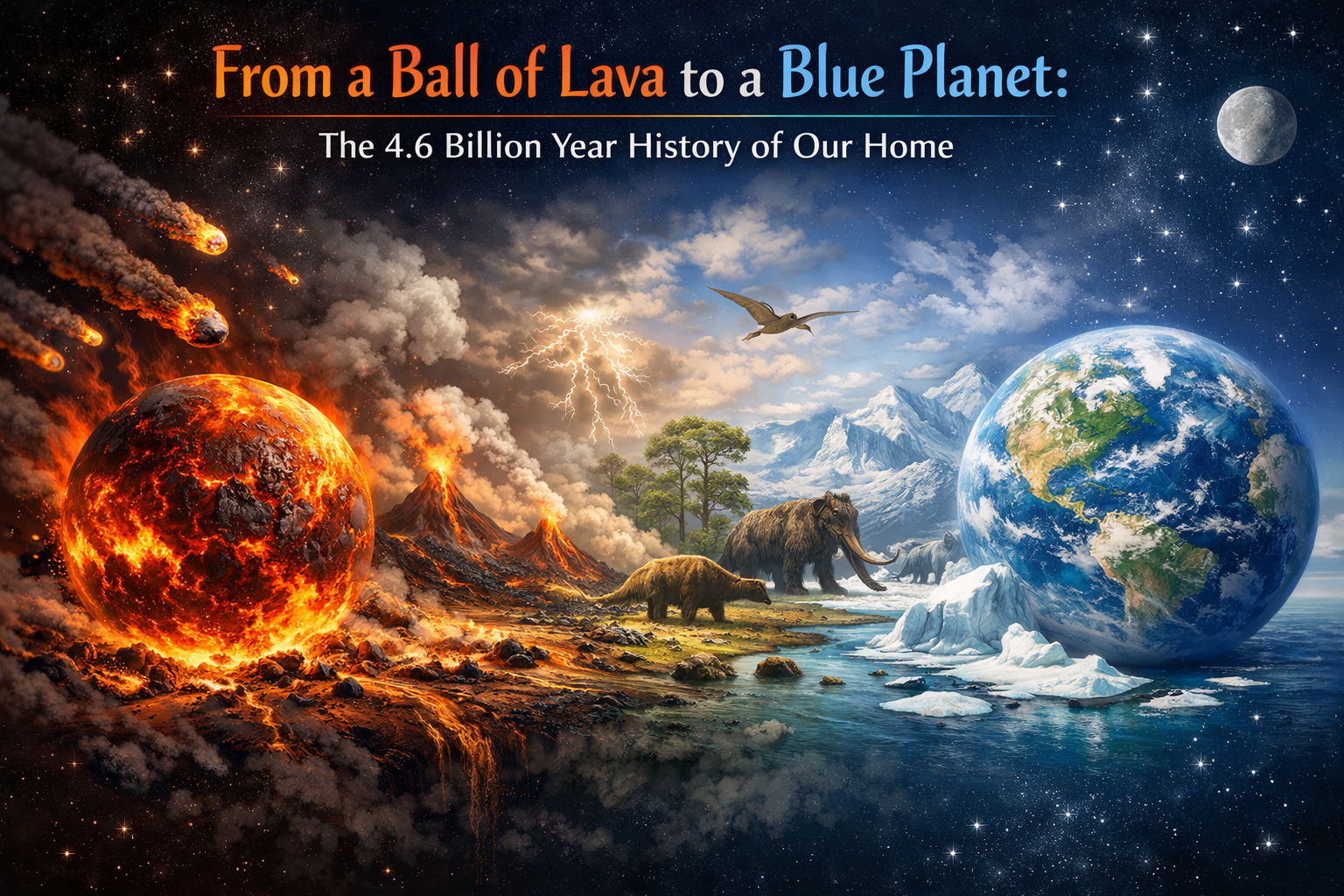
Earth formed 4.6 billion years ago from a solar nebula triggered by a supernova. Through accretion, dust became planetesimals and then planets. A massive collision with Theia created the Moon, while volcanic outgassing and icy comets brought water to the surface.
Can you imagine that this Earth, on which we humans have been born and which is home to innumerable species of living beings, was once a ball of boiling lava? About 4 billion years ago, it was a sphere with no sign of life. This begs the obvious question: How did a ball of lava transform into the Earth we live in today? To find the answers to where water came from and how the Moon was formed, we must look at the birth of our Sun and Solar System
The Solar Nebula and the Supernova
Let’s travel back in time to about 4.6 billion years ago. At that time, our Solar System did not exist; there was only darkness and deep, quiet, empty space. In this space floated a cloud full of dust and gas, now known as the Solar Nebula . This cloud contained various gases, with Hydrogen and Helium being the most abundant.
For millions of years, this cloud travelled peacefully through the darkness, until suddenly, a massive explosion occurred nearby. I am not talking about the Big Bang, but a Supernova—the explosion of a dying star that reached the end of its life. The shock waves from this explosion reached our solar nebula, causing gravitational instability. The gas and dust began compressing, and gradually, the entire nebula started collapsing inward and revolving.
The Birth of the Sun
At this stage, the nebula looked like a flat, rotating disk called a Proto-Planetary Disk. This flat shape explains why the planets in our solar system orbit on almost the same plane today. As the pressure and temperature at the center of this disk kept increasing, it gave birth to a Protostar. Eventually, the center became so concentrated that a nuclear fusion reaction began, turning Hydrogen into Helium at around 15 million degrees Celsius. This is how our Sun was born.
Back then, most of the gas and dust converged into the Sun, which is why the Sun still makes up about 99.8% of the total mass of our solar system.
The Formation of Planets: Accretion
So, what happened to the remaining 0.2%? That small fraction accounts for all 8 planets, hundreds of moons, and millions of asteroids. The process of forming planets is fascinating. Small dust particles in the rotating disk started colliding and sticking together due to static or chemical bonding forces. Over millions of years, these clusters grew into Planetesimals (tiny versions of planets) ranging from 1,000 meters to a few kilometers in diameter.
As gravity pulled these bodies together, they formed Protoplanets. This process of matter accumulating to form larger bodies is known as Accretion. Soviet astronomer Victor Safronov presented this theory in 1969, and while it wasn’t taken seriously initially, it was widely adopted by 1984. We have even found evidence of this in meteorites containing “Chondrules”—small pieces of dust and rock that date back to before the planets formed. Interestingly, the uranium found on Earth is about 6 billion years old, implying it was formed in a Supernova before our solar system even existed.
The Hadean Eon: Hell on Earth
Through constant collisions generating immense heat, our Earth was born. Gravity pulled the rocks together, making the planet spherical, but it was initially a sea of lava. This period, lasting from 4.6 to 4 billion years ago, is known as the Hadean Eon, named after Hades, the Greek god of the underworld.
During this time, objects as large as 200 km in diameter collided with Earth, melting any rocks into lava. However, this hellish period is actually the reason we have water. Comets and asteroids that collided with Earth contained high concentrations of water, originally from ice crystals in the solar nebula. During these collisions, water would turn to steam, enter the atmosphere, and eventually come down as rain.
Differentiation: Creating the Core, Mantle, and Crust
By the end of the Hadean Eon, Earth was a homogeneous ball of lava held together by gravity. This led to a process called Differentiation, which occurred mainly during the Archean Eon (4 billion to 2.5 billion years ago).
During this period, heavier elements like iron and nickel, being denser, sank through the magma toward the center due to gravity. Meanwhile, lighter elements like silicon, oxygen, aluminum, and calcium flowed upward to form the surface. This created Earth’s structure:
• The Core: Iron and nickel accumulated at the center. Although the temperature reaches 6,000°C, the pressure is so high that the inner core remains solid.
• The Mantle: A layer over 3,000 km thick. Radioactive decay of elements like Uranium and Thorium in this layer keeps the Earth hot.
• The Crust: The solidified outer layer dominated by Oxygen (46% of its mass).
If we look deeper, Earth is actually differentiated into five layers based on physical properties: the Lithosphere (divided into oceanic and continental crust), the Asthenosphere (a weak, moving layer that acts as a lubricant for tectonic plates), the Mesospheric Mantle, the Outer Core (liquid), and the Inner Core (solid).
The liquid iron churning in the Outer Core generates electrical currents, creating Earth’s magnetic field. This field is crucial for life as it protects us from harmful solar winds and helps hold our atmosphere together.
The Formation of the Moon
A major mystery is how Earth got its Moon. Scientists proposed theories like the Capture Theory or Fission Theory, but the one most accepted today is the Giant Impact Hypothesis.
About 4.5 billion years ago, a Mars-sized protoplanet named Theia collided with Earth. At that time, both planets were balls of lava. The cores of the two planets fused into one, explaining why Earth has a massive iron core while the Moon does not. The debris from this collision formed the Moon.
We are sure of this because samples of basaltic rocks brought back by NASA’s Apollo missions showed that the Moon’s composition is strikingly similar to Earth’s mantle. This collision was a blessing in disguise. It tilted Earth’s axis by 23.5 degrees, giving us seasons, and the Moon’s presence created oceanic tides which eventually helped life move from the oceans to land.
The Atmosphere and Oceans
In the Archaean Eon, as the layers stabilized, massive volcanic activity released gases like water vapor, carbon dioxide, methane, and ammonia. This mixture was toxic and lacked Oxygen. However, as Earth cooled, the water vapor condensed and rained down for millions of years, creating huge oceans.
These oceans played a vital role by absorbing carbon dioxide and heat, making temperatures pleasant enough for life to eventually thrive. Even today, oceans absorb most of the carbon emissions generated by human activities.
The conditions that allowed life to exist on Earth were exceptionally rare preconditions. We needed the Sun at just the right distance, Earth to be the right size, a magnetic field to protect us from gamma rays, and the exact right amount of greenhouse effect—neither as extreme as Venus nor as weak as Mars. Everything happened in an exceptionally fantastic way, and that is why I believe it is our duty to protect this wonderful planet.
Read More :
ISRO Launches New Mission to the Sun: ADITYA-L1 – India’s Most Difficult Mission

I'm a education-driven content creator dedicated to breaking down complex ideas into simple, practical, and easy-to-understand explanations. The website is built with a clear mission: to promote learning, awareness, and education.