
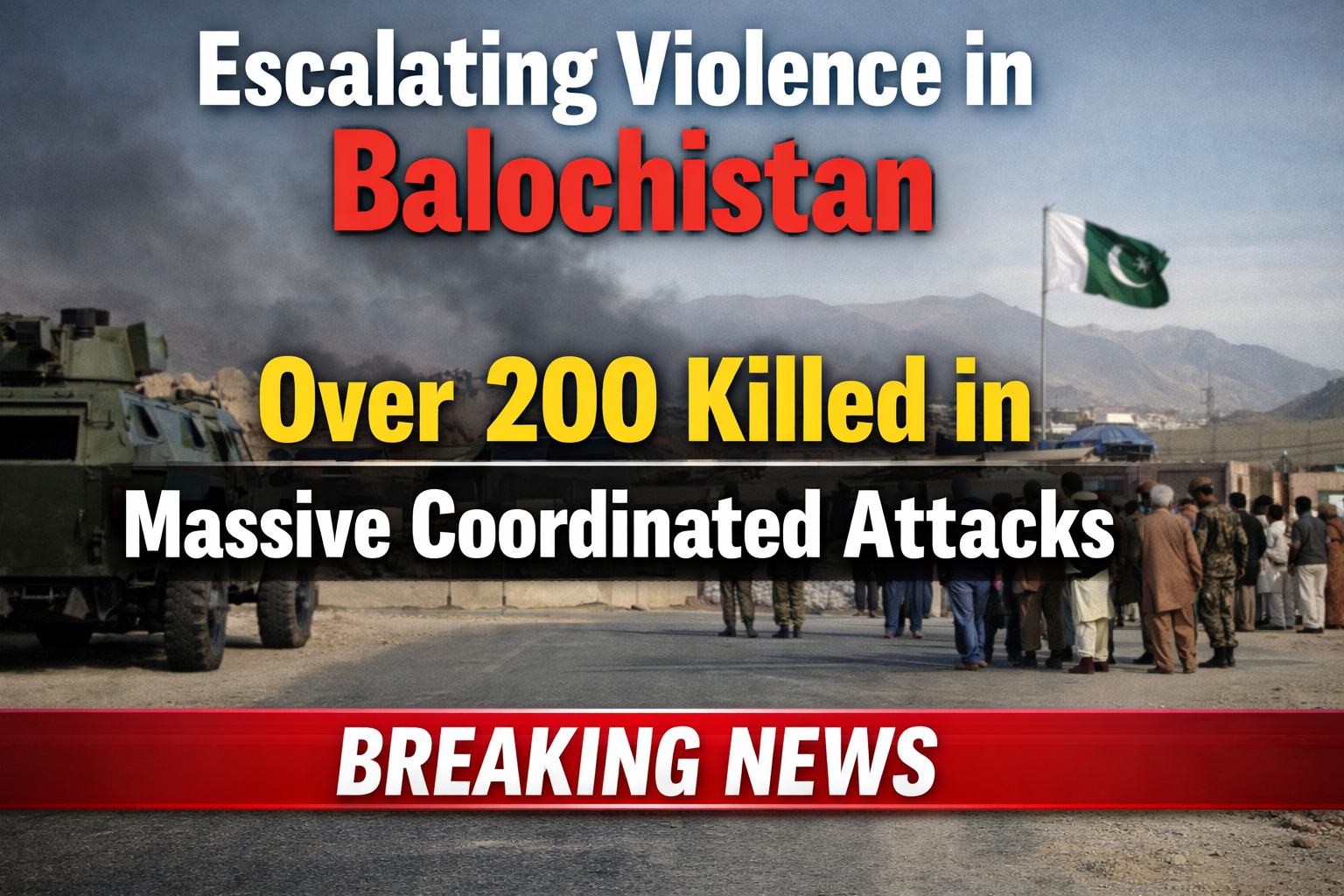
The Balochistan Liberation Army (BLA) launched massive, coordinated attacks across Pakistan, killing over 200 people. Using suicide bombers and IEDs, the insurgents targeted military assets. Pakistan blames India for the unrest, while India dismisses these claims as baseless.The Balochistan Liberation Army (BLA) launched massive, coordinated attacks across Pakistan, killing over 200 people. Using suicide bombers and IEDs, the insurgents targeted military assets.
Check Live : Map
A Massive Strike in Pakistan
A massive attack has been executed within Pakistan by the Balochistan Liberation Army (BLA), resulting in claims that at least 200 people have been killed. This wave of violence was characterized not only by the use of Improvised Explosive Devices (IEDs) but also by the significant involvement of women fidayeen (suicide attackers). Reports indicate that multiple attacks occurred simultaneously over a very short period, overwhelming the Pakistan Army and leaving them unable to respond effectively. This offensive, which the insurgents have termed “Operation Herof,” marks a significant escalation in the region’s instability.
The Root Causes: Why Balochistan is Burning
To understand the sudden escalation, it is essential to look at the history of the region. Balochistan is Pakistan’s largest province by area, rich in natural resources such as natural gas, copper, gold, and a vast coastline. It houses famous sites like the Reko Diq mine, known for its gold deposits. Despite this wealth, the region is politically marginalized and economically underdeveloped.
For decades, the ethnic Baloch population has felt that their resources are being exploited by the central government, with benefits flowing primarily to other areas, specifically Punjab, rather than the local Baloch people. Grievances include military repression and the phenomenon of enforced disappearances, where locals are allegedly abducted by security forces. These deep-seated issues have fueled armed separatist movements for decades, most notably the BLA, which Pakistan has declared a terrorist organization.
The Anatomy of the Attack: 40 Hours of Coordinated Strikes
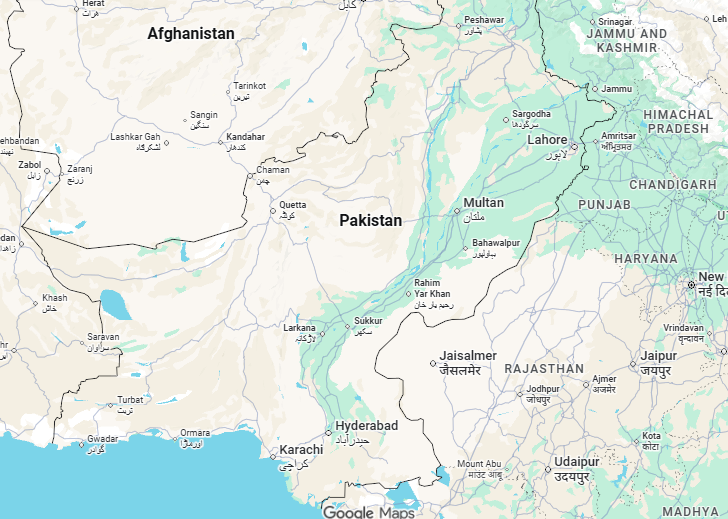
The BLA claimed responsibility for a series of coordinated attacks across Balochistan that lasted for approximately 40 hours. These strikes targeted various locations, including Noshki, Turbat, and the strategic port city of Gwadar. The BLA asserts that they killed over 200 Pakistani security personnel by targeting military convoys, intelligence facilities, and check posts.
The insurgents utilized a variety of tactics:
• Roadside IEDs: These low-cost, high-impact weapons were planted along highways to detonate when military trucks passed, a tactic highly effective in Balochistan’s rugged terrain.
• Vehicle-Borne IEDs: Similar to recent high-profile attacks elsewhere, insurgents packed vehicles with explosives and drove them into security convoys or crowded areas to cause massive damage and panic.
• Coordinated Multi-Site Strikes: Attacks were launched simultaneously within a short timeframe to stretch security forces thin.
A Tactical Shift: The Use of Women Fidayeen
A disturbing and significant development in this conflict is the BLA’s use of women fidayeen. While the BLA historically relied on guerrilla ambushes, they have shifted tactics to include suicide bombings. For the first time, reports suggest the use of a female suicide bomber named Asifa Mangal, whose photo was released by the group.
The use of female attackers offers insurgents several tactical advantages: they can often bypass security checkpoints more easily, their attacks create immense psychological shock, and such incidents generate significant global media attention, which helps the BLA highlight their grievances to the international community.
The War of Narratives: Disputing the Casualty Count
There is a massive discrepancy regarding the casualty figures, driven by an ongoing information war.
• The BLA Claim: They assert they have killed over 200 Pakistani personnel.
• The Pakistan Authority Claim: Officials state that only 17 security personnel and some civilians were killed. Conversely, the Pakistan military claims to have killed between 90 to 145 militants in retaliation.
Because there is no neutral verification mechanism in the region, both sides engage in exaggeration—the BLA to show strength, and the Pakistan Army to downplay losses—making it difficult to ascertain the exact death toll.
Pakistan’s Response and the Blame Game
Following the attacks, Pakistan launched a large-scale counter-insurgency operation involving the Army, Frontier Corps, and intelligence agencies. However, consistent with its historical pattern during large-scale internal violence, the Pakistani establishment attempted to divert attention by alleging foreign sponsorship.
Pakistan’s military media wing (ISPR), senior ministers, and local media propagated a narrative accusing India of being behind the violence, claiming the attacks were externally sponsored and funded. This is a standard tactic used by Pakistan to deflect attention from its internal security failures.
India’s Rebuttal: “Baseless and Frivolous”
India’s Ministry of External Affairs (MEA) issued a sharp rebuttal, terming Pakistan’s allegations as “baseless and frivolous”. India stated that the claims were an attempt by Pakistan to deflect attention from its own domestic problems.
India emphasized that unlike Pakistan, which often makes accusations without proof, India provides evidence when it makes claims (citing the Pahalgam attack as an example where evidence was provided). By using the term “frivolous,” India suggested that Pakistan’s claims were not even worthy of serious consideration. India’s strategic messaging highlighted that the violence in Balochistan is a “home-grown problem” resulting from decades of political alienation, economic neglect, and repression, and that Pakistan is a state unwilling to confront its own structural failures.
Strategic Implications: The Threat to CPEC
The instability in Balochistan poses a severe threat to the China-Pakistan Economic Corridor (CPEC). Attacks have increasingly targeted Chinese interests, including engineers and assets around the Gwadar port. The rising violence increases security costs and creates anxiety in Beijing, potentially slowing down investment. This situation places immense pressure on Pakistan, which is already grappling with an economic crisis, political instability, and terrorism in other regions like Khyber Pakhtunkhwa.
The situation in Balochistan remains volatile, with the BLA demonstrating increased capability and changing tactics. As Pakistan faces internal dissent and economic pressure, the region’s instability continues to grow.
Read More:
Budget 2026 Explained in English | India

I'm a education-driven content creator dedicated to breaking down complex ideas into simple, practical, and easy-to-understand explanations. The website is built with a clear mission: to promote learning, awareness, and education.