
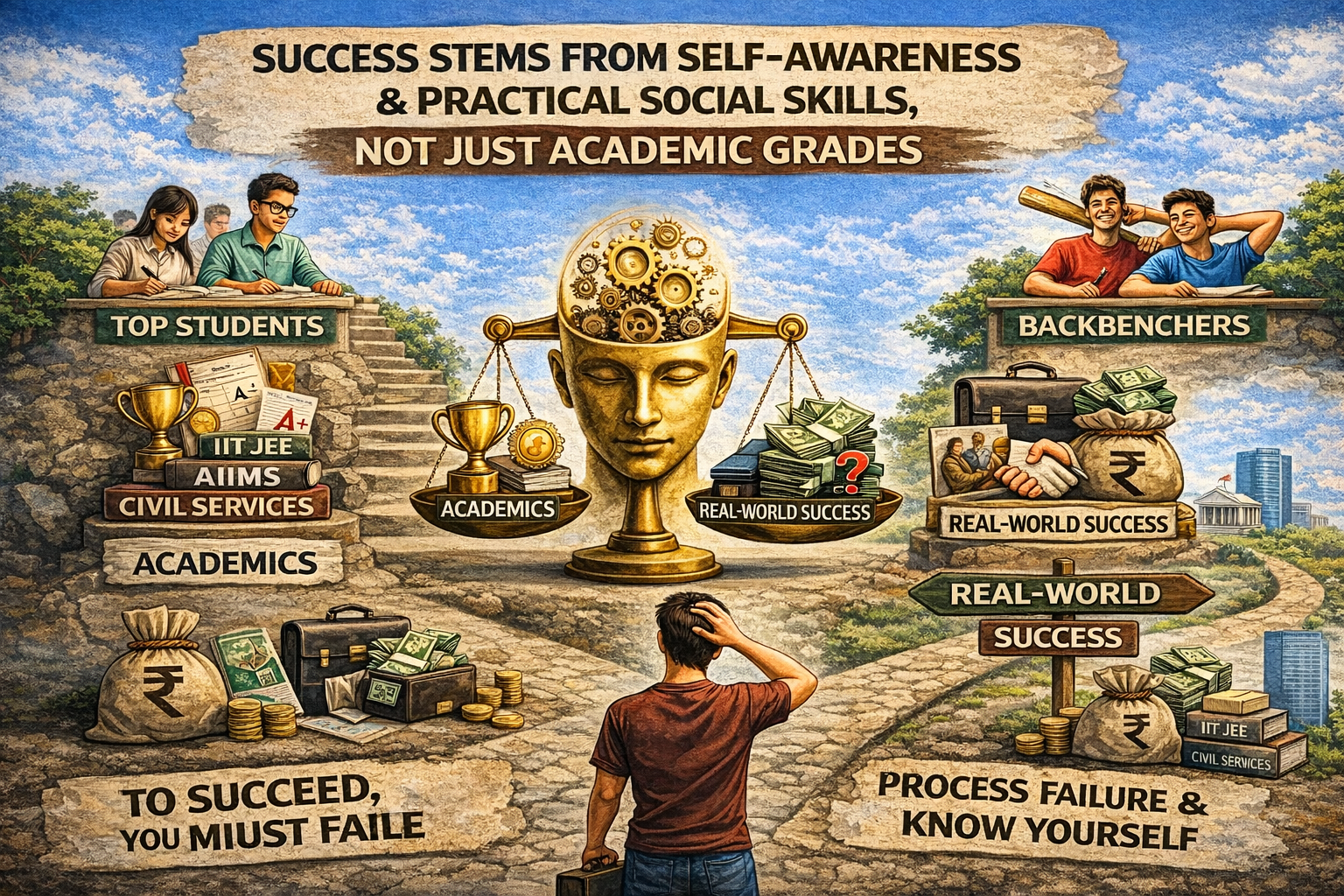
Success stems from self-awareness and practical social skills, not just academic grades. While top students follow traditional paths, “backbenchers” often thrive by mastering human connection and real-world problem-solving. To succeed, you must process failure and know yourself.
The Untold Truth About Success: Why Grades Aren’t Everything
When we look at the statistics for the country’s most competitive exams, the numbers are daunting. The selection rate for medical exams like NEET is around 6 to 7%, while engineering exams like IIT JEE sit at roughly 1.2%, and the civil services acceptance rate is less than 1%. Millions of students dedicate years of their lives to these pursuits. However, I recently asked people to look back at their school days and observe the current status of two distinct groups: the toppers and the backbenchers.
The results were eye-opening. As expected, the toppers are doing well, working in top technology firms, investment banks, or successful law and medical practices. But surprisingly, the students who barely passed, who had little interest in studies and scraped by with grace marks, are often doing just as well, if not better financially. How did this happen? We were always told that studying was the only way to escape financial struggle, yet those who seemingly didn’t pay attention have found their way.
The Fear of Failure
A major reason we struggle to understand this is our relationship with failure. In our society, losing is seen as a sin. We are conditioned to believe that we must not return home defeated because it will bring shame to our parents and families who have pinned their hopes on us. This pressure creates a fear that eats us alive.
Furthermore, we are never taught how to process failure. When someone fails, society simply says, “Move on.” But true success doesn’t come to those who never fail; it comes to those who fail and then deeply analyze why it happened. If we don’t examine our mistakes—whether they were due to a lack of aptitude, intent, or mindset—we are doomed to repeat them. As Einstein famously said, insanity is doing the same thing over and over again and expecting a different result. To change your outcome, you must change how you do things.
Karma and Self-Respect
We also need to rethink our understanding of “Karma.” We often view it through a faith-based lens: if we treat others well, good things will happen to us. However, I believe a crucial component of Karma is devotion to one’s work.
If you are supposed to be studying but are scrolling through social media, that is a form of theft—you are stealing your own time. If you look at a friend’s success with jealousy, you are hurting yourself. Most importantly, negative self-talk—telling yourself you are worthless or incapable—is a crime against your own existence. We must learn to respect ourselves, accept our weaknesses, and play to our strengths. I focus only on the areas where I know I can win and where my specific strengths are needed.
Why the “Average” Succeed
This brings us back to why the backbenchers often succeed. While they may not have had book smarts, they understood how the real world works. Academic education often keeps us in a bubble of theory. When I was strictly academic, I knew physics, but I didn’t know what sales, HR, or strategy were.
Real-world success relies on people skills: how to communicate, how to negotiate, how to handle stress, and how to work within a team. You can memorize every concept, but if you cannot deal with people, you will struggle. Backbenchers often develop these social instincts early. They know that every job, every business, and every relationship boils down to understanding human beings.
Finding Your Own Path
The goal of sharing this is not to say you shouldn’t study or that you should aim to be a backbencher. The goal is self-awareness. I often see young people confused because they don’t know what they want. When asked, they list what they can do, rather than what they want to do.
You must find the answer to what you truly want to achieve in life. Once you have a destination, you will realize that a competitive exam is just one path. Business, politics, arts, or understanding people are all valid paths. There are many ways to win, but you can only choose the right one if you first know where you want to go.
Read More
Is a Sarkari Naukri Worth the Struggle? The Truth About Costs and Salaries

I'm a education-driven content creator dedicated to breaking down complex ideas into simple, practical, and easy-to-understand explanations. The website is built with a clear mission: to promote learning, awareness, and education.