
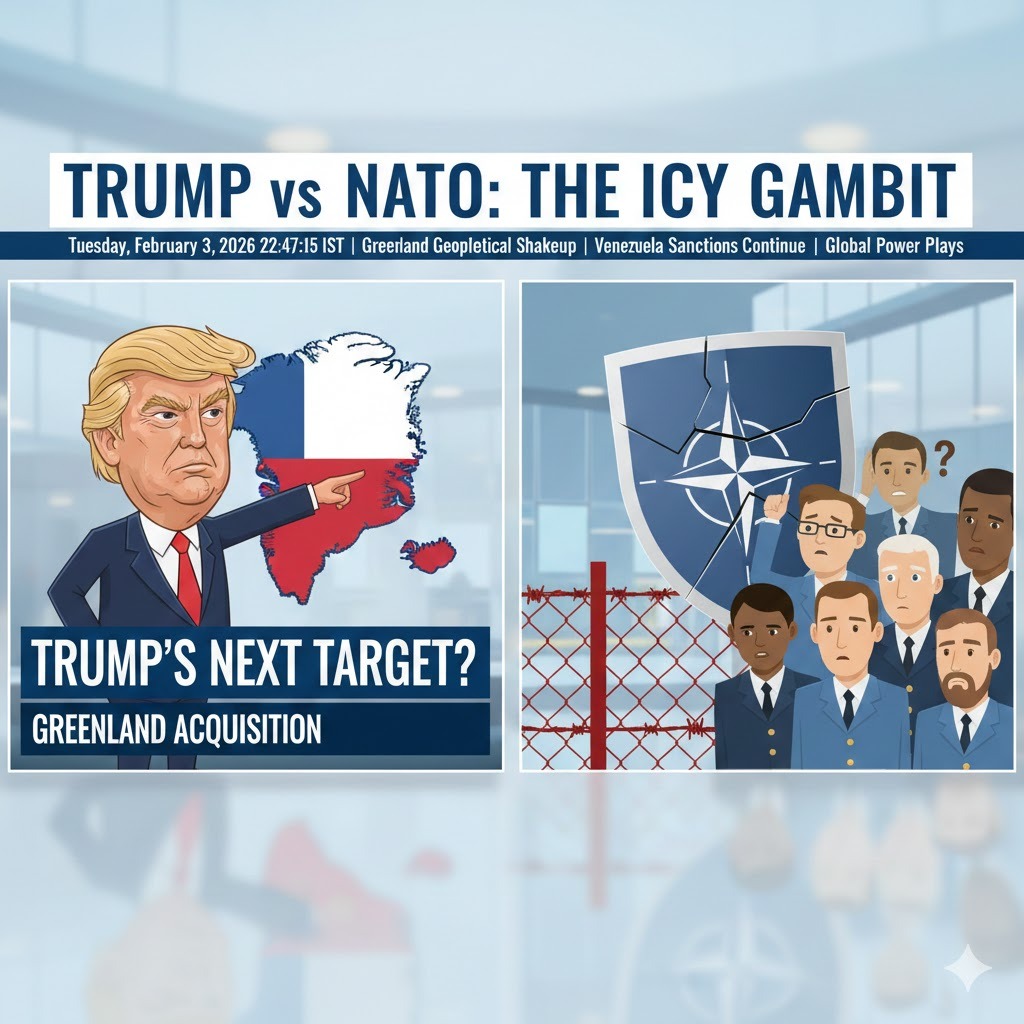
Trump threatens to annex Greenland, citing national security and mineral resources. While Denmark and NATO allies vow to defend the island, experts doubt their ability to stop the US military. This conflict tests NATO unity and the future of Arctic sovereignty.
After Venezuela, Donald Trump’s New Target: The Battle for Greenland
Following recent aggressive moves and strikes in Venezuela, a new geopolitical flashpoint has emerged. US President Donald Trump has made a bold declaration regarding Greenland, stating, “We will do it the hard way”. While discussions previously revolved around diplomatic agreements, the rhetoric has shifted toward a forceful acquisition, with Trump insisting that to ensure American security against threats like Russia and China, the US needs to “own” Greenland rather than just operate there.
Greenland’s Reaction: “We Are Not for Sale”
The response from Greenland and Denmark has been swift and defiant. Danish Member of Parliament Rasmus Jarlov warned that they will defend Greenland, signaling that any attempt to take the territory would involve consequences involving NATO. The local sentiment in Greenland is equally firm, with citizens asserting that “No means no” and that they do not wish to become Americans. Locals like Morgan Angu have expressed that it is terrifying to see world leaders treating their home as a mere object to be acquired, laughing about it while the local population lives in fear.
Geography and Demographics: The Prize in the North
Greenland is the world’s largest island, yet it is sparsely populated with approximately 56,000 to 57,000 residents. About 80% of this population lives in coastal areas because the inland regions are too cold for habitation. The capital city is Nuuk, and the majority of the population follows Catholic or Protestant faiths. Geographically, Greenland is part of the North American continent, a point Trump uses to support his claim, but political boundaries do not always follow geography. To visualize its size, Greenland is roughly two-thirds the size of India, or conversely, India is about 1.5 times the size of Greenland. The United States is approximately 4.5 times larger than Greenland.
Strategic Value: Security and Resources
Trump’s primary justification for this pursuit is national security. He argues that Russian and Chinese ships are increasing their activity in the region, though concrete proof of this specific threat is debated. Strategically, Greenland sits between the US, Europe, and Russia, acting as a defensive “wall” against potential ballistic missile attacks. Beyond defense, the island is a treasure trove of resources. Greenland holds one of the world’s largest deposits of rare earth elements and critical minerals like lithium, which are essential for defense equipment and batteries. While the media focus is on security, the control of these vast mineral resources is a significant underlying factor.
Historical Context and Political Status
The island is currently controlled by Denmark. Its history dates back about 5,000 years when Inuit people arrived from the Siberian region of Russia. In 1814, Denmark declared Greenland a colony. During World War II, when Denmark was occupied, the US defended Greenland, establishing a precedent for American military presence. In 1953, Denmark formally integrated Greenland as a part of the country, ending its colonial status. By 1979, Greenland was granted “home rule,” allowing control over internal matters like education and healthcare. Since 2009, Greenland has enjoyed self-autonomy, making its own decisions on all matters except defense and foreign affairs, which remain with Denmark.
The US Military Footprint: Pituffik Space Base
The US already maintains a significant presence on the island under a 1951 defense agreement. The Pituffik Space Base (formerly Thule Air Base), located in northwest Greenland, is a critical asset. This base houses roughly 650 personnel and operates strictly as a surveillance hub to monitor Russian activities in the Arctic and provide missile warnings. Despite this existing access, the US has tried to buy the island multiple times: first in 1946, then in 1955, and again during Trump’s previous term in 2019. Each time, Denmark refused. Now, however, the approach has shifted from purchase offers to threats of unilateral action.
The Military Imbalance and NATO Crisis
Experts suggest that if a conflict were to occur, it would be incredibly one-sided. The US possesses the world’s strongest military, while Denmark ranks 45th, with the smallest military force in NATO (around 17,000 personnel total, with only 8,000 in the army). Analysts predict a US takeover could theoretically conclude in less than a day, likely targeting the capital, Nuuk, first. However, the political fallout would be massive. Major European powers, including Germany, Italy, Poland, Spain, and the UK, have reportedly issued joint statements (dated to January 6, 2026, in the video’s analysis) asserting that Greenland belongs to its people and cannot be taken.
Fractures in the Alliance
This potential conflict threatens to shatter NATO. The alliance has faced internal rifts before, such as the 1956 Suez Crisis, the 1974 Turkey-Greece conflict over Cyprus, and the 2003 Iraq War. However, an attack on Greenland would test Article 5 of the NATO treaty, which calls for collective defense.Article 5 requires unanimity to be activated. Since Denmark would likely vote “no” to supporting a US action against its own territory, and other European nations would stand with Denmark, the article would be rendered ineffective. Jamie Shea, a former NATO official, suggests that while European nations might not militarily engage the US, they would not support the takeover, leading to a severe diplomatic breakdown.
The situation presents a severe test for Western unity. While Trump insists on “owning” the territory to counter rivals like Russia and China, his methods risk dismantling the NATO alliance from within. As the year 2026 approaches in this timeline, the world watches to see if the “hard way” will prevail over diplomatic norms.
ALSO READ
Global Climate Change: Impacts, Security, and Global Responsibility

I'm a education-driven content creator dedicated to breaking down complex ideas into simple, practical, and easy-to-understand explanations. The website is built with a clear mission: to promote learning, awareness, and education.