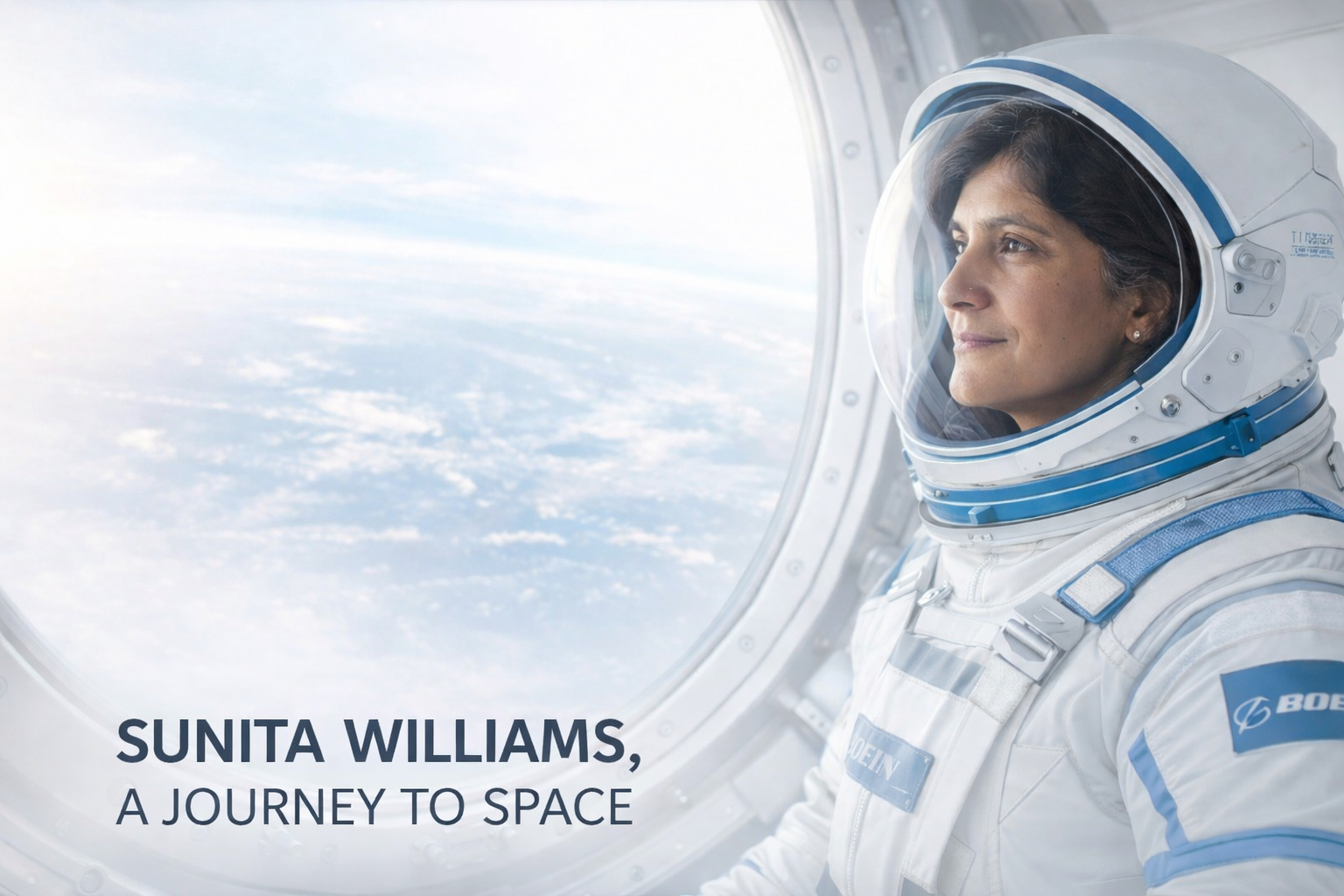
Astronaut Sunita Williams – 286-day mission, including an extended stay due to Starliner thruster failure. She emphasizes resilience, multiculturalism, and problem-solving. Despite the risks and isolation, she finds unity in humanity and inspiration in the stars.
Sunita Williams is a legend in space exploration. Having spent a total of 608 days in space (the second most of any NASA astronaut) and completed nine spacewalks, she is a veteran of the cosmos. However, her most recent mission made headlines for unexpected reasons: an 8-day test flight turned into an 8-month stay on the International Space Station (ISS) due to technical failures on the Boeing Starliner.
In this deep dive, Williams opens up about the reality of being “stuck” in space, the mechanics of living in zero gravity, the view of India from above, and the deep philosophical shifts that come from leaving Earth.
The Starliner Crisis: When 10 Days
Turned into 8 Months
The mission began with high stakes. Williams and her colleague Butch Wilmore launched on the Boeing Starliner for what was supposed to be a short 10-day test flight. However, things went wrong quickly.
The Thruster Failure
As they approached the ISS, the Starliner faced significant issues. Williams describes the situation as “pretty messed up”. Five thrusters failed, and the spacecraft lost redundancy in its control systems. While the situation was chaotic, Williams and Wilmore fell back on their training. “Compartmentalization is something that we’ve trained to do,” she explains. Just like in the movie The Martian, you cannot let the magnitude of the problem overwhelm you; you have to solve it “one little bite at a time”.
They managed to dock successfully, but once they arrived, it became clear they wouldn’t be coming home soon. NASA and Boeing needed to understand why the thrusters failed before risking a return trip. This meant a waiting game that stretched through the summer and into the next year.
The “Safe Haven” Emergency
One of the most terrifying moments of the mission wasn’t the thruster failure, but a debris threat. A satellite in orbit below them disintegrated, creating a debris field that threatened the ISS. The crew was woken in the middle of the night and ordered to retreat to their respective spacecraft, which serve as “Safe Havens”.
Williams recalls the surreal nature of the moment. The crew had about 45 minutes to secure the station. In a moment of human connection amidst the danger, the astronauts all met near the bathroom to hug each other goodbye, unsure if they would see one another on Earth again. They even fashioned makeshift seats in the SpaceX Dragon capsule as a backup escape plan, proving that even in high-tech spaceflight, Apollo 13-style improvisation is sometimes necessary.
Dealing with the “Stuck” Narrative
While the media on Earth painted a picture of two astronauts hopelessly stranded with NASA and Boeing fighting, Williams says the reality onboard was different. She never felt hopeless. She knew thousands of people on the ground were working on the solution. To stay sane, she integrated herself into the ISS crew, taking on chores like transferring food, fixing the toilet, and conducting experiments
Life on the ISS: The Sensory Experience
Williams provided a rare, unfiltered look at the sensory details of living in orbit—the things you don’t usually see in sci-fi movies.
The Smell and Sound of Space
What does space smell like? According to Williams, it smells like “us” and food. With the ventilation system, smells dissipate, but strong scents like garlic, fish, or Indian food can linger.
The station is also noisy. It creaks and moans as the metal expands and contracts due to the extreme temperature changes between sunlight and shadow. Pumps, fans, and valves are constantly clicking and whirring. Over time, these sounds become familiar, like the furnace kicking on in an old house
The Bathroom and “Space Gas”
Using the bathroom is one of the biggest challenges. Without gravity, you have to rely on airflow and muscle control. “You have to commit,” Williams jokes. She also confirmed a funny rumor: people fart a lot in space. Whether it’s the food preservatives or physiological changes, it happens frequently. Because of the airflow, you might occasionally “fly right through” a cloud of it.
Crying in Zero-G
Williams admits she has cried in space, mostly from missing her family and her dogs. Crying is physically different in orbit; tears don’t fall. They ball up around your eyes like you are a fish in an aquarium, and you have to use a tissue to wick the water away so you can see.
The View of India
Williams, who has Indian heritage, shared her observations of looking down at India
.• Daytime: The Himalayas are spectacular, and you can see the runoff from the rivers swirling into the ocean
.• Nighttime: India is incredibly bright. She describes the city lights connecting like a nervous system. A new observation from this trip was seeing massive clusters of fishing boats off the west coast of India in the Arabian Sea, visible only by their immense light arrays.
The Making of an Astronaut: Mindset and Training
Williams wasn’t born a fearless pilot. Her journey was defined by overcoming insecurity and embracing her multicultural identity.”
The Pandas” and Multiculturalism
Growing up in Needham, Massachusetts, her family was the only Indian family in town. She and her sister, known as “The Pandas” because of their long dark hair and swimming background, stood out. While it was uncomfortable as a teenager, she later realized her multicultural upbringing (Indian father, Slovenian mother) gave her the ability to relate to different people—a crucial skill for an astronaut.
Overcoming Insecurity
Williams confessed to suffering from “Imposter Syndrome” throughout her career. She struggled with academics in college and gets nervous about written tests. However, she excels at doing—flying helicopters, spacewalks, and robotics. Her advice to young people is that you don’t need to know who you want to be at 17. She pivoted from swimming to the Navy to test piloting to NASA. “Be ready for those extra doors to open that you didn’t even anticipate,” she advises
Psychological Resilience
NASA selects for team players. During training, astronauts are sent on NOLS (National Outdoor Leadership School) expeditions—camping in the wilderness to see how they handle stress and uncomfortable living conditions. This helps them understand their own “hot spots” and how to tolerate teammates’ annoying habits, which is vital when locked in a metal box for months
The Return: Re-adapting to Earth
Returning to gravity is brutal. Williams describes the neuro-vestibular system (balance) essentially shutting down in space. Upon landing, she felt nauseous for 24 to 48 hours.
•The Landing: The capsule bobbed in the ocean “like a cork,” making the nausea worse.
•The Rehab: It takes about a month to feel fully human again. Even holding a pen feels risky, as her brain expects it to float away if she lets go.
•Sensory Overload: The most beautiful thing upon opening the hatch is the smell of Earth—dirt, sagebrush, and rain.
•First Meal: Her first desired meal back on Earth was a grilled cheese sandwich made with her husband’s homemade bread. It was a comfort food that reminded her of her late father
Philosophy, Legacy, and The Beyond
Her Father’s Influence
Williams speaks deeply about her father, a neuroscientist who immigrated to the US. He arrived on a boat, eating cheese because he didn’t know what it was (he thought it was plastic). He taught her to be observant and spiritual. He gifted her the Bhagavad Gita and Lord Ganesha idol she carried to space. She feels his “spark” is still with her, watching over her achievements
Kalpana Chawla
The tragedy of the Space Shuttle Columbia and the death of her friend Kalpana Chawla didn’t scare Williams away; it fueled her. “We’ve got to do this in their memory,” she says. The loss made the astronaut corps want to explore more and ensure those lives were not lost in vain.
Life Beyond Earth
When asked if she believes in aliens, Williams is definitive: “Absolutely.” She notes that with billions of stars, we are just a small planet. She mentions the discovery of microbes living on the exterior of the ISS and the potential for life in the thermal vents of Jupiter’s moons. “There is life out there,” she affirms
The Biggest Lesson
After 286 days of uncertainty, media storms, and technical failures, Williams’ biggest takeaway wasn’t technical—it was human.
People are good,” she concludes. Upon returning, she was overwhelmed by messages from people of all religions, politics, and ethnicities who had been praying for her safe return. Her final message to the world is simple: drop the noise, stop fighting over small things, and realize that, at our core, human beings care about one another.
READ MORE :
The Mystery of the Vanishing Ozone: How We Saved the World

I'm a education-driven content creator dedicated to breaking down complex ideas into simple, practical, and easy-to-understand explanations. The website is built with a clear mission: to promote learning, awareness, and education.